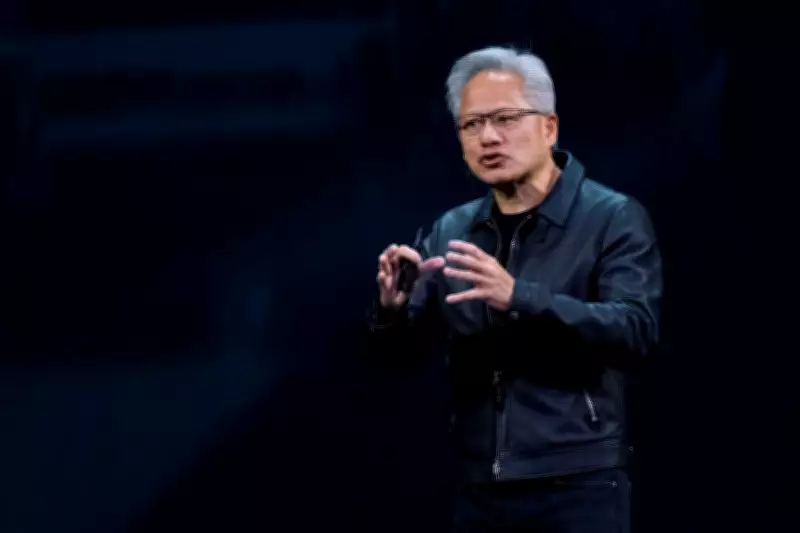
Nvidia CEO Jensen Huang Challenges AI Unemployment Predictions
Nvidia CEO Jensen Huang has publicly dismissed alarming predictions about massive artificial intelligence-driven unemployment, directly countering warnings from prominent tech leaders. In a notable stance, Huang rejects the doomsday scenarios put forward by figures like Anthropic CEO Dario Amodei and AI pioneer Geoffrey Hinton, who have expressed concerns about widespread job displacement.
Huang's Vision: Gradual Transformation, Not Catastrophe
According to a detailed report by Fortune, Huang shared his perspective during a December interview with podcast host Joe Rogan. The Nvidia leader stated he does not foresee a sudden spike in AI-related layoffs, though he fully acknowledges that the technology will fundamentally reshape the global job market. Huang provided a vivid analogy to illustrate his point, remarking, "If your job is just to chop vegetables, Cuisinart's gonna replace you." This comment suggests that routine, repetitive tasks are indeed most vulnerable to automation.
However, Huang strongly argued that roles requiring human interpretation, nuanced judgment, or genuine creativity—such as radiologists analyzing medical images—will remain resilient and essential. He emphasized that the evolution of work will be gradual and transformative rather than catastrophic, offering a more optimistic outlook compared to some of his peers in the technology industry.

AI as a Catalyst for New Industries and Job Creation
While rejecting pessimistic forecasts, Huang also revealed his forward-looking vision of a future where artificial intelligence actively creates completely new industries and employment opportunities. He speculated imaginatively about emerging job categories, such as robot tailors who design specialized apparel for AI-powered robots. Huang explained, "You're gonna have robot apparel, so a whole industry of—isn't that right? Because I want my robot to look different than your robot."
Huang added that numerous new roles will inevitably emerge to build, program, and maintain sophisticated AI assistants, alongside industries that are difficult to imagine with today's technological landscape. He highlighted that even his own example of a robot clothesmaker might eventually be automated, but then something else will take its place, demonstrating a continuous cycle of innovation and job transformation.
The Trillion-Dollar Market of Physical AI and Robotics
At Nvidia's recent GPU Technology Conference (GTC), Huang emphasized that "physical AI," particularly advanced robotics, represents the company's next trillion-dollar-plus market opportunity. His ambitious comments align with broader industry visions, notably from Tesla CEO Elon Musk, who has made the Optimus humanoid robot central to Tesla's future strategy. Musk has predicted that work could become optional within 10 to 20 years as robotic labor drives the cost of work toward zero, a concept that complements Huang's focus on new economic sectors.
The measurable impact of AI disruption is already evident. A recent comprehensive study from the Massachusetts Institute of Technology (MIT) estimated that artificial intelligence could adequately perform tasks equivalent to approximately 12% of all U.S. jobs. This represents more than 151 million workers and over $1 trillion in annual wages potentially at risk, underscoring the significant scale of the transformation underway.
Despite these substantial figures, Jensen Huang maintains his belief in a balanced transition. He advocates for viewing AI not merely as a displacer of labor but as a powerful engine for economic growth, innovation, and the creation of unforeseen professions. His perspective offers a counter-narrative to the fear-driven discourse, focusing on adaptation and the long-term benefits of technological advancement.