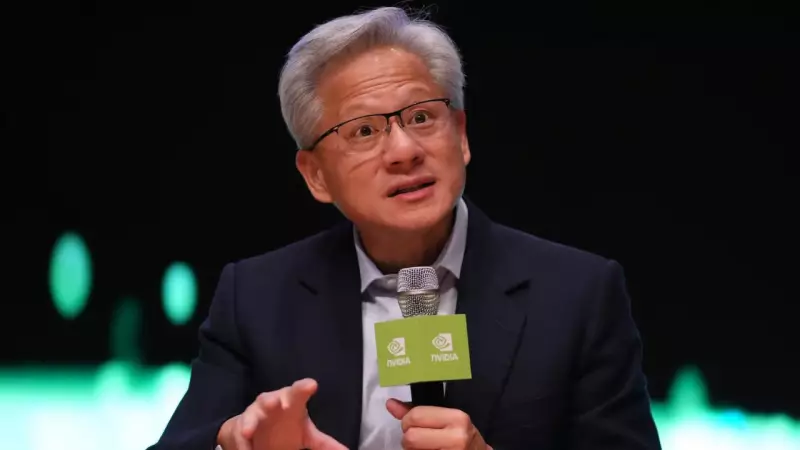
In a stark warning that has sent ripples through the tech and policy communities, Nvidia CEO Jensen Huang has expressed concerns that the United States risks falling behind China in the critical global artificial intelligence (AI) race. Speaking at an event hosted by the Center for Strategic and International Studies (CSIS) earlier this month, Huang outlined a series of vulnerabilities that could hinder American dominance in this pivotal technological frontier.
The "Five-Layer Cake" of AI Competition
Huang framed the US-China competition in AI as a complex "five-layer cake," identifying five critical areas where America faces potential challenges. These layers, as detailed in his interview, encompass public sentiment, energy capacity, semiconductor leadership, infrastructure speed, and AI model development. His analysis suggests that while the US leads in some aspects, lagging in others could prove decisive in the long run.
The first and perhaps most surprising layer highlighted by Huang is public sentiment. He pointed out a dramatic divergence in how American and Chinese societies perceive AI. "If you were to do a poll of their society and ours, and you ask them is AI likely to do more good than harm," Huang stated, "in their (China’s) case 80% would say AI will do more good than harm. In our (US) case, it'd be the other way around." This foundational difference in societal acceptance, he argued, could slow the application and diffusion of AI technology in the US.

Energy, Chips, and the Speed of Building
The second critical vulnerability is energy. Huang expressed bafflement at China's reported energy advantage, noting they have "twice as much energy as we have as a nation." He emphasized that abundant energy is non-negotiable for building the physical backbone of the AI revolution: "Without energy how do we build chip plants, computer system plants, and these AI datacenters? We call them AI factories."
On the third layer, semiconductors or chips, Huang offered a contrasting note of confidence. He asserted that the US is "generations ahead" of China in chip technology, a significant advantage given Nvidia's central role in this industry.
However, the fourth layer—infrastructure—presents another stark challenge. Huang contrasted the lengthy timelines in the US with China's rapid execution. "If you want to build a datacenter here in the United States, from breaking ground to standing up an AI supercomputer is probably about three years," he said. "They can build a hospital in a weekend. That’s a real challenge."
The Open Source Advantage and Final Thoughts
The fifth and final layer in Huang's analysis is AI models. He acknowledged that US models are "unquestionably world class" and that America is likely about six months ahead in proprietary model development. However, he flagged a crucial area where China has seized leadership: open-source models. "China is well ahead – way ahead on open source," Huang stated.
He explained the strategic importance of open-source ecosystems, noting they are essential for startup innovation, university research, education, and scientific advancement. This lead in open-source could enable a broader and faster base of experimentation and application in China.
Huang concluded with a powerful reminder of the stakes, tying success to the broader historical context of industrial revolutions. "Whoever applies the technology first and most wins that industrial revolution," he cautioned, urging careful attention to ensure the US does not fall behind in the practical deployment of AI. His comments serve as a multifaceted warning, highlighting that technological superiority in one area must be supported by societal will, physical infrastructure, and a vibrant developer ecosystem to secure long-term leadership.