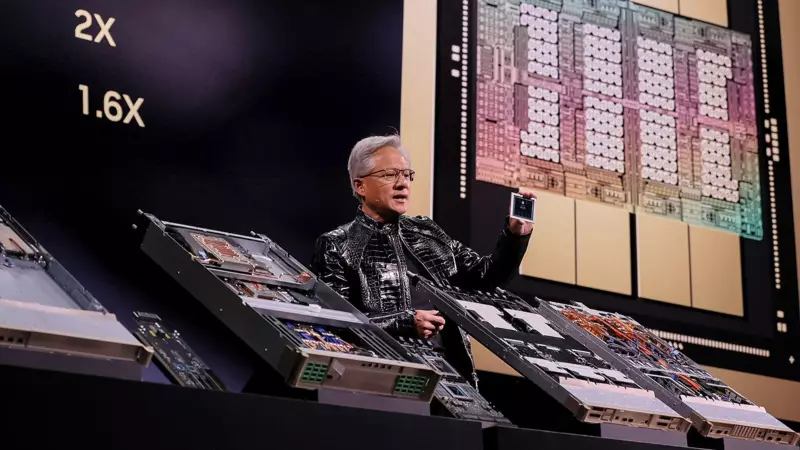
In a major announcement that sets the course for the future of artificial intelligence, Nvidia has revealed its next-generation AI computing platform, named 'Rubin'. The unveiling took place at the CES 2026 event in Las Vegas, United States, on Monday, January 5, by the company's founder and CEO, Jensen Huang.
What is the Rubin AI Platform?
Rubin represents Nvidia's first extreme-codesigned platform, engineered as a tightly integrated unit comprising six specialized AI chips. This holistic system combines advanced networking technologies and sophisticated software to function as a single, powerful computing entity. The platform is named in honour of Vera Rubin, the pioneering American astronomer whose work on galaxy rotation rates provided crucial evidence for the existence of dark matter.
Huang, during his extensive two-hour keynote, positioned Rubin as the successor to the current flagship Blackwell architecture. He emphasized that AI is now scaling into every domain and device, and with Rubin, Nvidia aims to "push AI to the next frontier". A standout claim is the platform's potential to slash the cost of generating AI tokens to roughly one-tenth of the previous generation, making large-scale AI deployment far more economical.

Performance and Technical Specifications
The Rubin computing unit is a technological marvel built from several co-designed components. According to Nvidia, the key elements include:
- Rubin GPUs boasting 50 petaflops of NVFP4 inference capability.
- Vera CPUs, specifically engineered for optimized data movement and agentic processing.
- Advanced networking with NVLink 6 and Spectrum‑X Ethernet Photonics.
- ConnectX‑9 SuperNICs and BlueField‑4 Data Processing Units (DPUs).
This extreme codesign is critical for scaling AI to gigascale, as it eliminates bottlenecks by ensuring tight integration across chips, trays, racks, networking, storage, and software. Nvidia claims Rubin GPUs deliver five times the AI training compute power of Blackwell GPUs. Furthermore, the entire Rubin architecture can train a large 'mixture-of-experts' AI model in the same timeframe as Blackwell while using only a quarter of the GPUs and at one-seventh the token cost.
The company also highlighted that Rubin will support third-generation confidential computing, positioning it as the industry's first rack-scale trusted computing platform.
Market Context and Future Roadmap
The launch of Rubin follows a period of record-breaking success for Nvidia, which recently reported a 66 per cent year-on-year surge in data centre revenue, driven by soaring demand for Blackwell and Blackwell Ultra GPUs. This growth has been a key indicator of the sustainability of the ongoing AI boom.
Rubin computing units are already in full production, with the first products and services powered by the platform expected to hit the market in the second half of 2026. Alongside Rubin, Nvidia announced Alpamayo, its latest series of open-weight AI reasoning models designed for autonomous vehicles like self-driving cars.
Huang underscored the fundamental reshaping of computing due to accelerated computing and AI, noting that roughly $10 trillion worth of computing infrastructure from the last decade is now being modernized. "The faster you train AI models, the faster you can get the next frontier out to the world. This is your time to market. This is technology leadership," he stated.
Emphasizing Nvidia's commitment to an open ecosystem, Huang pointed to the global intelligence framework they are building, which developers and enterprises can leverage. He noted the rapid pace of innovation, with new, smarter models emerging every six months, leading to an explosion in downloads.
Nvidia also introduced an Inference Context Memory Storage platform featuring an AI‑native KV‑cache layer. This technology boosts long‑context inference with a 5x increase in token throughput, better performance per dollar, and five times better power efficiency.

The unveiling of Rubin sets a new high bar for performance and market expectations, following the runaway success of the Blackwell architecture. It marks Nvidia's next strategic step in consolidating its leadership in the global AI hardware race.