A mirror can seem deceptively simple. To us, it is an everyday object, useful for checking appearances or watching what is happening behind us. Yet understanding a reflection requires more than seeing it. The reflected image must be linked to a real object occupying a different position in space. For many animals, that connection is far from straightforward.
Scientists have spent decades exploring how different species respond to mirrors. A small number of vertebrates, including some primates, birds, and mammals, have demonstrated an ability to use reflections to locate objects hidden from direct view. Now, evidence from studies involving California two-spot octopuses suggests that this skill may not be restricted to animals with backbones. Octopuses can learn to use reflected visual information to find prey-related cues that would otherwise remain out of sight.
How octopuses use mirrors to find hidden prey
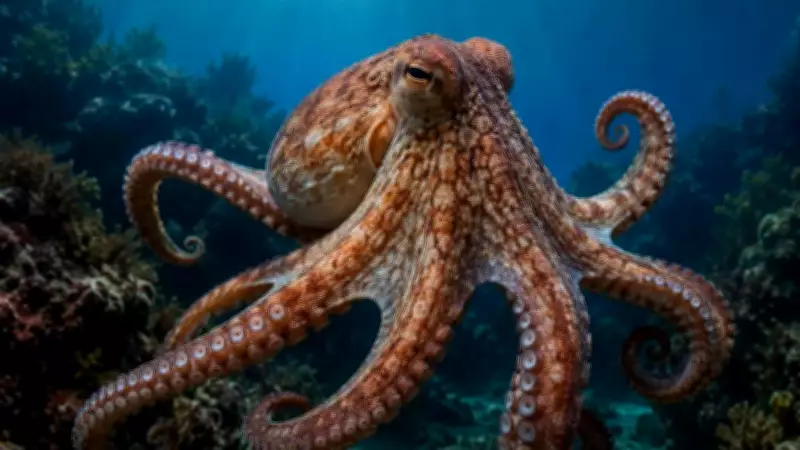
According to the research published in Current Biology, titled “Octopus bimaculoides can learn to utilise a mirror to localise a reward outside the line of sight”, the researchers explored this question using three Octopus bimaculoides. During each trial, an octopus was placed inside an opaque box facing a mirror. A virtual crab was projected onto a screen hidden from the animal's direct view, although the image could still be seen reflected in the mirror. The idea behind the experiment was simple enough. Researchers wanted to know whether an octopus could use a mirror as a source of information rather than treating the reflection as the thing itself.

To succeed, the octopus had to leave the box, turn around, and travel to the side where the virtual crab was actually being displayed. Reaching the correct location depended on interpreting the reflection and connecting it to a point elsewhere in the environment. It sounds straightforward when described on paper. In practice, the task required the animal to respond to information that was visually available but spatially displaced.
Training octopuses to use mirrors to locate hidden prey
According to a recent publication in Physics.org titled “Octopuses learn mirror-guided navigation to locate prey”, it expanded on those earlier findings through a series of training exercises designed to familiarise octopuses with mirrors. Before formal testing began, the animals were given time to become accustomed to the reflective surface. Researchers then introduced reward-based tasks that encouraged them to use information seen in the mirror to locate food.
For the main experiment, a virtual crab stimulus was projected behind the octopus, either to the left or right side of the testing arena. The animal could not see the projection directly from its starting position. Instead, the only indication of its location came from the reflected image in front of it.
The octopus was then faced with a choice. Rather than moving towards the apparent crab in the mirror, it needed to turn away from the reflection and travel to the place where the stimulus actually existed. Across the trials, the animals selected the correct side far more often than would be expected by chance. According to the current biology, reported statistically significant results, while the Dartmouth research found successful choices in roughly three-quarters of attempts.
What mirror-guided navigation reveals about octopus intelligence
Mirror-guided navigation has previously been documented in several vertebrate species, including monkeys, chimpanzees, elephants, pigs, parrots, and crows. Until recently, evidence for comparable behaviour in invertebrates was lacking. The octopus findings raise the possibility that similar cognitive solutions can emerge in animals with very different evolutionary histories. According to Physics.org, the ability may represent an example of convergent evolution, where unrelated groups arrive at similar ways of solving the same problem.
That idea remains an active area of investigation. The researchers themselves note that further work will be needed to understand precisely how octopuses accomplish the task and what mental processes are involved. Questions also remain about whether the animals build internal representations of space or rely on other learned strategies.

For now, the studies offer another reminder that intelligence does not always follow familiar patterns. An octopus viewing a reflection through the glass of an experimental tank may seem far removed from a driver checking a rear-view mirror, yet both are relying on the same basic challenge: using indirect visual information to understand where something is in the world.