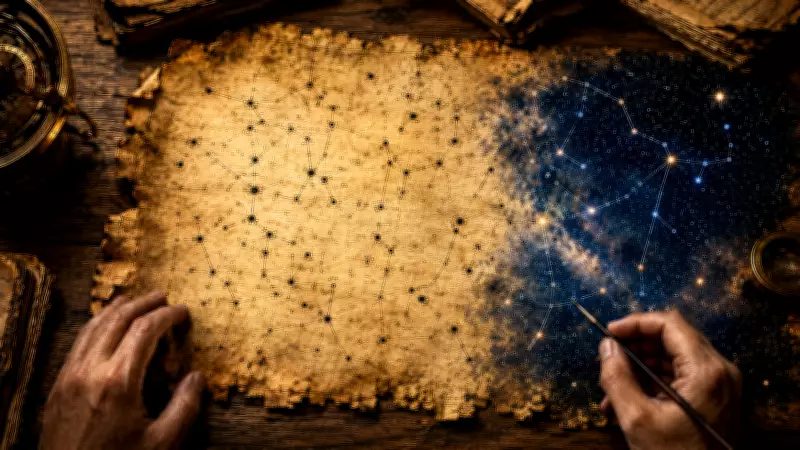
Scientists have discovered what may be the oldest surviving map of the universe ever created, hidden for centuries within the pages of an ancient medieval book. This remarkable find is linked to Hipparchus, the renowned ancient astronomer who lived over two thousand years ago and laid the foundations for scientific astronomy. The original text was not lost; it was simply buried beneath later writings. Now, researchers are using advanced X-ray technology to reveal what the naked eye cannot see. Ancient star catalogs are gradually being uncovered, and scientists believe that hidden constellations, celestial coordinates, and forgotten astronomical observations may still lie concealed beneath medieval manuscript pages. Although still in its early stages, this discovery is generating significant excitement.
The Lost Star Map Hidden Beneath Medieval Script
As reported by Scientific American, this breakthrough involves a manuscript known as Codex Climaci Rescriptus. On the surface, it appears to be an ancient religious document. However, experts suggest that it may contain a portion of an astronomical catalogue dating back to Hellenistic times. Such documents are called palimpsests. During the Middle Ages, parchment was expensive, so old texts were often scraped off and rewritten. Consequently, many ancient books were lost over time. In this case, researchers suspect that an entire map of the night sky may have been overwritten. What makes this find particularly remarkable is its scientific nature, and modern techniques may now help reveal it once again.
The Ancient Greek Traces Beneath Codex Climaci Rescriptus
The Codex was long thought to be purely theological. However, closer examination revealed faint traces of earlier Greek writing beneath the later Syriac text. These subtle marks indicated that the manuscript had a much older origin. Historians suggest that the underlying text may not be random notes but a structured star catalogue. Early analysis has already identified references to known constellations and astronomical measurements. The presence of such data suggests a highly developed understanding of the night sky, far earlier than previously assumed for this manuscript. It also raises the possibility that important scientific knowledge survived through layers of reuse and rewriting, hidden in plain sight for centuries.

How Scientists Are Using X-rays to Read Hidden Ancient Text
To uncover what remains beneath, researchers are employing advanced scanning techniques at the SLAC National Accelerator Laboratory. This facility is equipped with a synchrotron particle accelerator, which generates powerful X-rays that can penetrate the material without causing damage. This technology helps differentiate the chemical components of various inks. It has been determined that the medieval ink contained iron, while the older Greek text is suspected to be composed of other chemical elements, such as calcium compounds. This method enables the separation of text layers. So far, the findings have been positive. Several fragments containing Greek texts have been successfully discovered, some even containing partial information about stars and their coordinates.
Hipparchus and the Origins of Star Mapping
If the fragments prove authentic, they can be associated with Hipparchus, one of the most significant figures in ancient astronomy. Hipparchus is credited with creating one of the earliest recorded star catalogs in the Western world. He was known for his contributions to the study of the Earth's axial rotation, known as precession. His calculations were remarkably accurate even without telescopes or modern tools. Specialists propose that if the star catalog he produced matches the discovered fragments, our understanding of ancient astronomical knowledge will be completely transformed.

The Manuscript Still Holds Many Secrets Waiting to Be Scanned
This research is still in its early stages. Only a portion of the manuscript has been examined, and the entire Codex contains nearly 200 pages, many of which are scattered around the globe. As researchers continue scanning accessible pages, they aim to restore fragments that may shed light on missing parts of the sky. It remains unclear how much of the map is preserved, but even the progress made so far has caused a stir. The thought that a star map written hundreds of years ago might finally see the light of day is astonishing, yet it is becoming increasingly scientific. The skies may remain concealed for a while longer, but with each new scan, they come closer to being visible once again.