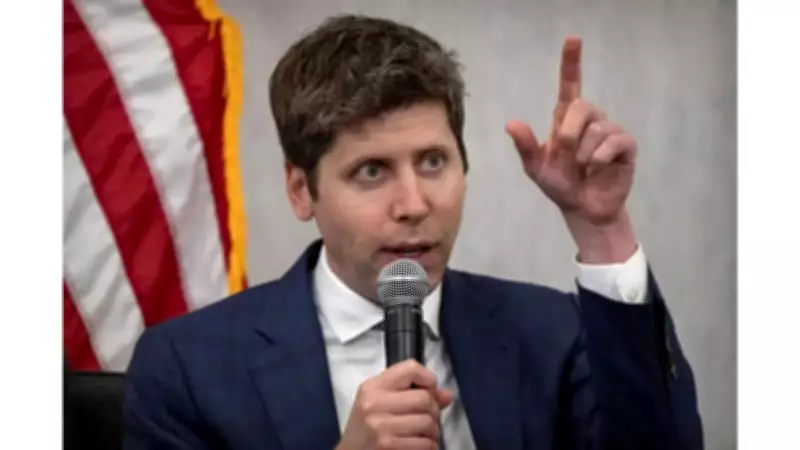
OpenAI CEO Sam Altman is pushing back against the growing belief that artificial intelligence is directly causing widespread job losses. In an interview with CNBC on June 1, Altman argued that companies embracing AI the most are often the same companies that continue to hire workers, while firms blaming layoffs on AI may not be using the technology extensively at all.
Altman's Perspective on AI and Employment
“The companies that I know that have adopted AI the most are also the ones hiring the most,” Altman said. “And the companies, as a general rule, that are talking about doing layoffs because of AI are the ones adopting AI the least,” he added. The OpenAI CEO further noted that AI can sometimes become “a convenient way” for companies to explain job cuts.
A Shift in Stance
Altman’s latest remarks mark a departure from his previous statements when he suggested that entire job categories could be wiped out by AI. In 2025, he told Federal Reserve Vice Chair for Supervision Michelle Bowman that “some areas” in the job market will be “just like totally, totally gone” as they are replaced by AI agents. Earlier, he also suggested that jobs being eliminated or transformed by AI might not be considered “real work” in the long run.

These comments come at a time when concerns about AI-driven job displacement are growing across industries. Executives including Anthropic CEO Dario Amodei and Microsoft AI CEO Mustafa Suleyman have warned that AI could significantly reshape the labor market and replace many existing jobs. Several major technology companies, including Salesforce, Cisco, Coinbase, Snap, and Block, have also referenced AI while discussing layoffs or restructuring efforts. However, Altman said his observations from companies using OpenAI’s tools suggest a more complicated picture.
Underestimating AI's Impact
Despite the debate around AI and layoffs, Altman said he has become more optimistic about AI’s impact on employment after seeing how businesses are actually using OpenAI’s coding tools, including Codex. “I think I underestimated how jagged these models are going to be,” he said. “They do some things incredibly well, but they don't do kind of the long-term, complex task supervision well at all.”
According to Altman, the most successful users are combining AI with human expertise rather than replacing workers entirely. “And so watching people who are really good at using these models, they can do an amazing amount of work, create way more economic value than people without models could or certainly the models could on their own,” he said.
People Remain Central
The OpenAI CEO also argued that human interaction remains an important part of how businesses and society function. “People really like other people and want to interact with other people. They want to collaborate. They work with other people,” Altman said during the interview. “When they buy a product, they want to talk to a person at the company.”
He added that many people still value human creators over AI-generated content. “Most people, I think, don't want to watch an AI-generated creator. They want to know about the person behind it.” “I think our industry underestimated how much we're going to be able to keep people at the center of everything in an economy that is and a world that is based on people,” he added.
About the Author: The TOI Tech Desk is a dedicated team of journalists committed to delivering the latest and most relevant news from the world of technology to readers of The Times of India. Their coverage spans gadget launches, reviews, trends, in-depth analysis, exclusive reports, and breaking stories that impact technology and the digital universe.