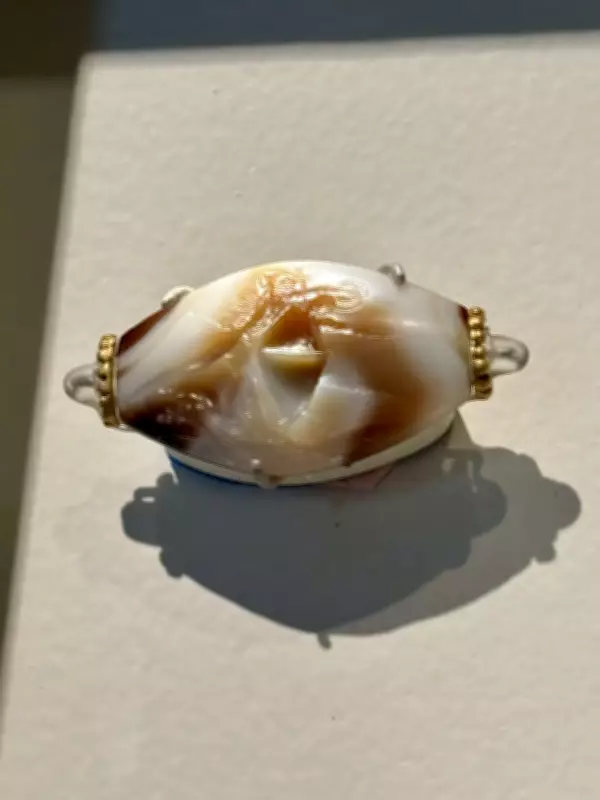
A recent archaeological excavation near the ancient site of Pylos has unearthed a remarkable artifact that provides unprecedented evidence of the sophisticated technical skills of early European artisans. While exploring the undisturbed tomb of an elite warrior, now famously known as the Griffin Warrior, researchers uncovered a wealth of Bronze Age treasures, including weapons and luxury items. Among these finds was a heavily encrusted gemstone that has fundamentally altered scholarly understanding of early Mediterranean art.
Discovery of the Pylos Combat Agate
As archaeologists meticulously removed compacted sediment from the tomb floor, they recovered a miniature hardstone seal measuring just 3.6 centimeters in length. This object, now called the Pylos Combat Agate, depicts an extraordinarily detailed battle scene featuring three figures. The level of precision displayed in the carving astonished the archaeological team, as such intricate miniature work was previously thought to have emerged much later in history.
Redefining Prehistoric Engraving Capabilities
The recovery of the Pylos Combat Agate represents a major breakthrough in understanding early Aegean art. According to the University of Cincinnati publication Archaeologists unearth 'masterpiece' sealstone in Greek tomb, the burial complex dates to approximately 1450 BCE, placing the agate within the early Mycenaean period. This finding demonstrates that miniature engraving techniques were developed centuries earlier than previously assumed.

Previously, mainstream archaeology held that early Bronze Age artisans on the Greek mainland focused primarily on abstract and geometric designs. However, the Pylos Combat Agate reveals that some engravings are so fine that they require magnification to be fully appreciated. The University of Cincinnati research highlights that the object's details are minute, necessitating special lenses for comprehensive study.
Cultural Connections and Artistic Exchange
This miniature seal also sheds light on the interconnectedness of ancient societies. Rather than depicting a culture solely preoccupied with warfare, the find suggests that early Greek elites valued elaborate imagery. The stylistic execution of the battle scene indicates a strong link with the neighboring Minoan civilization, renowned for its fluid representations of the human form.
As explored in the Griffin Warrior Tomb research database, the artifacts recovered from the tomb demonstrate complex cultural interactions. Mainland rulers actively acquired elite materials from other regions, systematically collecting and displaying items that represented the pinnacle of contemporary engraving techniques to assert their authority.
Impact on Art History
Today, the Pylos Combat Agate serves as a crucial benchmark in art history, proving that an object's physical size does not limit its historical significance. The data from the study confirms that prehistoric artisans were capable of extreme precision when working on hard surfaces. This discovery demonstrates that the development of detailed representational art in Europe followed a more complex and technically advanced trajectory than early twentieth-century models suggested.
While modern archaeology often relies on monumental stone structures to understand the past, the parameters of Bronze Age artistic capabilities are now vividly captured on a tiny gem buried near Pylos.