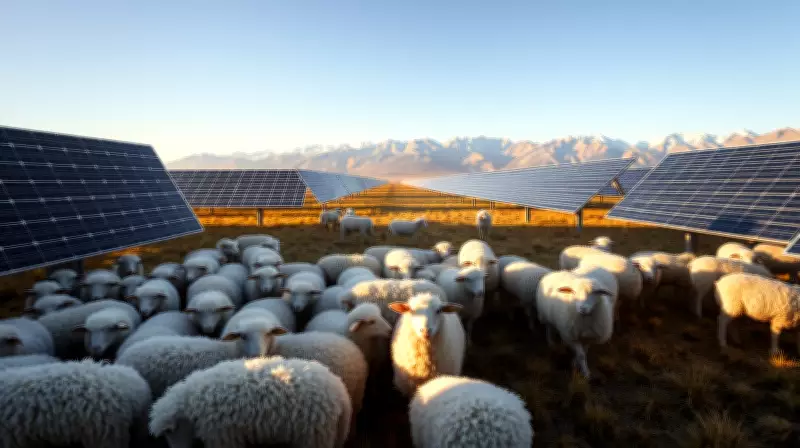
When you imagine a massive solar farm, you probably picture endless rows of panels stretching across an empty desert. That is essentially what happened on the Tibetan Plateau, where China built one of the world's largest solar installations. However, something unexpected began to occur. The sheep refused to leave. Local herders discovered that their animals could graze peacefully under the panels, consuming grass that would otherwise grow thick and become a fire hazard. The utility companies appreciated the free landscaping. The farmers were delighted with the extra income they desperately needed. The sheep enjoyed having shade and food in one location. Suddenly, a clean energy project evolved into something more. It became a means to assist people living in one of Earth's most remote and challenging landscapes. This is the story of how solar panels in Tibet accidentally created a new economic opportunity for communities that rarely receive them.
When Solar Farms Meet Shepherding: The Unexpected Partnership
The Talatan Solar Park is situated on the Tibetan Plateau, surrounded by vast grasslands and sparse vegetation. In 2012, the first solar panels were installed. They were mounted at a standard height, low enough to conserve space and materials, but not high enough for animals to graze beneath. The operators quickly realized that something was happening underneath those panels. Grass was growing, and a lot of it. Without proper management, thick vegetation becomes a fire hazard and blocks sunlight from reaching lower levels. That is when someone proposed an idea: what if local shepherds brought their sheep to graze?
The agreement started simply. Talatan made a deal with local farmers. They could bring their animals to graze in the solar farm. The sheep would eat the grass, solving the vegetation problem without requiring mowers or chemical management. For farmers struggling in one of the world's poorest regions, this meant new income. A few sheep could generate meaningful money over the course of a year. For people living on the Tibetan Plateau, where incomes are limited and opportunities are scarce, that matters significantly.

However, there was a problem. The panels from 2012 were too short. Sheep could not fit underneath. So Talatan made an adjustment; they mounted the later panels higher, specifically designed with grazing in mind. This seems minor, but it demonstrates real commitment to making the partnership work. The company did not merely tolerate the sheep. They adapted their design around them.
How Sheep Became Solar Panel Maintenance Crews
This practice, called solar grazing, is smarter than it sounds. Sheep are natural landscapers. Unlike tractors or lawnmowers, they can fit into tiny spaces between poles and panels. They do not require fuel or electricity. They simply eat. According to research from Frontiers in Sustainable Food Systems, solar grazing is a rapidly growing agrivoltaic solution for vegetation management at solar sites, with approximately 7 to 11 percent of existing installed solar capacity utilizing solar grazing in 2024, providing economic benefits for graziers while managing vegetation without mechanical removal. The animals also gain something valuable: shade and a reliable food source. On the exposed Tibetan Plateau, where sun exposure is intense and grazing land is limited, solar panels create microclimates where grass grows better and animals stay cooler. It is a genuine win for the herds. They are healthier because they have shelter. The panels help support the vegetation that feeds them.
From the utility company's perspective, solar grazing saves money. Maintenance costs drop. No fuel is needed. No equipment wears out. Just sheep doing what sheep do naturally. The arrangement is so practical that it has spread beyond Tibet. Since 2018, the American Solar Grazing Association has been matching solar companies with farmers across the United States, creating the same kind of partnerships. What started as a local adaptation in Tibet is becoming a standard practice worldwide.

The Science Behind Why Soil Improves Under Solar Panels
Here is something counterintuitive: the ground beneath solar panels often becomes healthier. Research from the National Renewable Energy Laboratory's Innovative Solar Practices Integrated with Rural Economies and Ecosystems team found that soil health improves under photovoltaic panels compared to open sun, and that pollinator visitation increased over time with prairie restoration activities under panels. The reasons are environmental. Solar panels shade the ground beneath them. That shade changes temperature and moisture patterns. Without intense sun beating down, the soil does not dry out as quickly. Vegetation adapted to that microclimate establishes and grows. Microbes that live in soil respond to the changed conditions. Studies have shown that grassland management matters significantly, with higher soil organic matter content where grazing animals are present, suggesting that the system management approach affects biodiversity and soil quality. It is not automatically better everywhere. Some studies show lower plant biomass directly under panels. But with proper management, like bringing in sheep or planting native grasses, the soil actually benefits. The combination of shade, grazing animals, and managed vegetation creates conditions where soil improves instead of degrading.
That is huge. In most modern agriculture and construction, disturbing the land damages it. Building something usually means accepting some environmental cost. But with solar grazing, the land gets better. Soil organic matter increases. Microbial diversity improves. Wildlife finds habitat. You are generating clean energy and healing the land at the same time.
More Than Just Energy: How Solar Creates Opportunity
For the farmers on the Tibetan Plateau, solar grazing is personal. These are people living in one of the world's harshest environments, where economic opportunities are limited. Climate change is making traditional pastoralism harder. Grasslands are shrinking. Competition for grazing land increases every year. An agreement to bring sheep to a solar farm is not just extra money; it is economic stability in a place where that is hard to find.
The story in Tibet shows something important about the energy transition. Clean energy gets framed as a global problem with a global solution. Massive installations in the desert. Thousands of panels in neat rows. But the real impact happens locally. When a solar farm becomes a place where farmers can earn income, where the land improves instead of degrading, where traditional livelihoods connect with modern technology, that is when the transition matters to actual people.
China is building solar capacity aggressively. The Gonghe Photovoltaic Park covers 162 square kilometers, seven times the size of Manhattan. That scale is necessary to meet energy demand. But scaling up does not mean scaling down the human element. The practice in Tibet proves that massive clean energy projects can be designed with local communities in mind.
The Bigger Picture: Energy and Community
Solar grazing is one example of what researchers call ecovoltaics, combining renewable energy with ecological benefits. It is different from agrivoltaics, which focuses on agricultural production under panels. Ecovoltaics emphasizes soil improvement, ecosystem services, and community benefits alongside energy generation.
That distinction matters. It means energy transition does not have to be a choice between power and people. It can be both. Tibet's solar farms will generate clean electricity for decades. But they are also generating income, healthier soil, and better grazing conditions for communities that need them. That is not a minor benefit. That is the difference between energy that just gets built and energy that actually improves lives where it is installed.