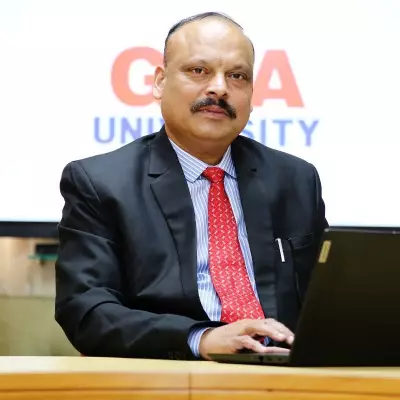
SP Jain School of Global Management, the first Indian-founded business school in Britain to receive powers to award its own UK degrees, is betting that the university of the future will be built not around lectures but around artificial intelligence, global classrooms and employability — and it has reorganised much of its curriculum accordingly.
Artificial intelligence (AI) is forcing universities to rethink not only what they teach but also how they teach it, Nitish Jain, president of SP Jain School of Global Management, told The Tribune.
Traditional Lectures No Longer Sufficient
Jain believes business education is undergoing its most profound transformation since the birth of the modern university. The catalyst is not simply technology but artificial intelligence (AI), which he says is forcing universities to rethink not only what they teach but how they teach it.

"The traditional lecture is no longer enough," he says during an exclusive interview at the school's London campus. "Students don't come to university simply to collect information. Information is everywhere. They come to learn how to think."
That philosophy has shaped the school's rapid international expansion. Founded in India and now operating campuses across several continents, SP Jain has deliberately positioned itself as a global institution rather than a conventional national university. London represents both a strategic location and a statement of intent.
Its Canary Wharf campus sits at the heart of one of Europe's leading financial centres, giving students close proximity to international employers while reflecting the school's ambition to prepare graduates for careers that increasingly cross borders.
Redesigned Learning Experience
Unlike traditional universities, where lectures remain the dominant form of teaching, SP Jain has redesigned much of the learning experience around participation. Students are expected to study material before class. Classroom time is then devoted to discussion, case studies, simulations and presentations.
"The classroom becomes a place where ideas are tested," Jain explains. "Students learn from faculty, but they also learn from one another."
Artificial intelligence now plays an integral role in that process. Rather than discouraging students from using AI, the school actively encourages them to understand its capabilities and limitations. AI tutors help reinforce classroom teaching, answer routine questions and personalise revision, allowing lecturers to spend more time challenging students intellectually rather than repeating basic concepts.
Jain rejects suggestions that AI will replace universities. "It won't replace teachers," he says. "But it will change what teachers do. Faculty will spend less time delivering information and more time developing judgement, creativity and critical thinking."
He believes employers are already changing their expectations. "In the past, companies recruited people because they possessed knowledge. Today knowledge is available instantly. What employers increasingly value is the ability to analyse information, solve problems and make sound decisions."
Global Classroom Integration
The transformation extends beyond technology. SP Jain links classrooms across its international campuses, allowing students to collaborate across time zones and cultures. "It prepares them for the world they will actually work in," says Jain. "Business today is global."
SP Jain recently became the first Indian-founded business school in Britain to receive powers to award its own UK degrees. Students can now graduate with Bachelor of Business Administration (BBA) and Master of Business Administration (MBA) qualifications awarded directly by the institution in the United Kingdom.
For Jain, degree-awarding powers represent more than regulatory approval. "They demonstrate confidence in our academic standards," he says.

Student Demographics and Employability Focus
The London campus currently teaches around 410 students in person, with a further 430 studying online. Around nine out of every ten BBA students are British, reflecting the school's growing acceptance within the UK's higher education market. That statistic may surprise those who still assume international business schools primarily recruit overseas students. Instead, SP Jain has found increasing interest among British applicants attracted by smaller classes, close engagement with faculty and an emphasis on employability.
Career preparation is woven into the curriculum from the outset. Among the school's flagship initiatives is the Professional Readiness Programme (PRP), which develops communication, leadership and workplace skills alongside academic study. The Job Preparation Tool (JPT) provides structured support for interviews, assessment centres and recruitment exercises. Meanwhile, Engaged Learning Online (ELO) extends teaching beyond the classroom, encouraging continuous interaction between students and academics through digital learning platforms.
"We don't see employability as something you think about during the final semester," Jain says. "It begins on the first day."
The institution says these programmes contribute to exceptionally high graduate employment outcomes, claiming a 100 per cent placement rate among eligible graduates seeking work. Its academic staff combine full-time faculty with experienced industry practitioners, while Dean Andres Perez oversees the London campus.
Tuition Fees and International Positioning
Fees reflect the school's international positioning. Annual tuition is approximately £18,800 (about Rs 24 lakh) for the Bachelor of Business Administration, £36,000 (around Rs 46 lakh) for master's programmes and £39,000 (just under Rs 50 lakh) for the MBA.
Jain's own career reflects the increasingly international character of higher education. Born and educated in Mumbai before studying at Cornell University in the United States, he has spent decades building educational programmes that operate across continents.
He believes tomorrow's graduates will probably change careers several times during their working lives, making adaptability as important as technical expertise. "Universities cannot simply prepare students for their first job," he says. "They must prepare them for jobs that haven't even been invented yet."
That demands a different educational philosophy. Assessment increasingly rewards analysis rather than memorisation. Students are encouraged to question assumptions, defend arguments and work collaboratively on complex business problems. "The world doesn't reward people who can memorise facts," Jain says. "It rewards people who can interpret them."
Despite rapid technological change, he insists universities remain indispensable. "The human element becomes even more important," he says. "Artificial intelligence can provide answers. It cannot replace judgement, ethics or leadership."
As London's financial district continues to reinvent itself in the age of digital finance, Jain believes universities face a similar challenge. Institutions that fail to embrace change risk becoming irrelevant. Those willing to rethink teaching, assessment and international collaboration, he argues, will define the next generation of higher education.
Looking out across the towers of Canary Wharf towards the O2 Arena, he sees more than a changing skyline. He sees a glimpse of the future — one in which classrooms are global, technology is woven into every lesson, and universities succeed not by teaching students what to think, but by teaching them how to think.