

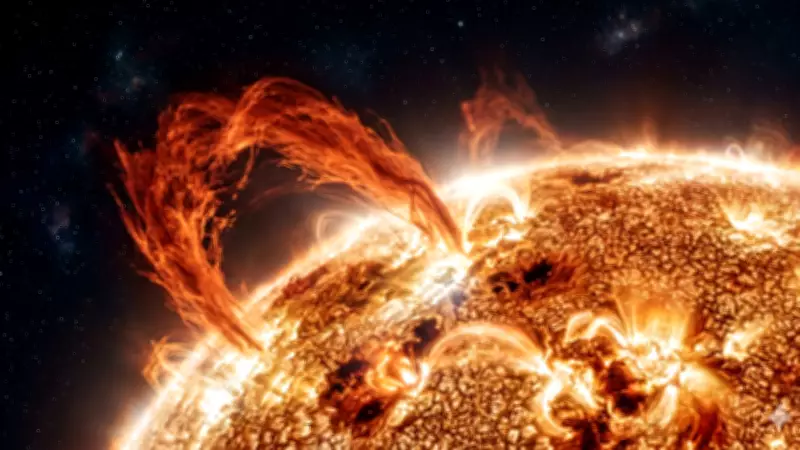
The Sun's Unheard Roar: A 100 Trillion Jet Engine Symphony in Space
Have you ever wondered about the volume of the Sun? On the surface, it might seem like a peculiar question, as space is famously silent, lacking the air or water needed to transmit sound waves that we can hear. However, scientific evidence reveals that the Sun is far from quiet; in fact, it is incredibly noisy, producing a roar that would dwarf the sound of trillions of jet engines if we could perceive it. This paradox highlights the fascinating interplay between energy and the vacuum of space.
How the Sun Generates Sound
The creation of sound on the Sun occurs due to turbulence and the boiling of gases both within and outside its structure. This turbulence generates pressure waves that behave similarly to sound waves experienced on Earth. The key difference lies in the medium: while Earth's atmosphere allows sound to travel, space is a near-perfect vacuum, preventing these waves from reaching us. NASA utilizes a technique called helioseismology, where sound waves act as probes to study the Sun's interior through its vibrations, offering insights into its composition and behavior.
Measuring the Sun's Immense Loudness
Researchers estimate that the sound on the Sun's surface would measure around 100 decibels, but this figure belies the immense energy involved. Given the density of solar matter, the acoustic energy is so colossal that, when hypothetically compared to Earth's atmosphere, it equates to the roar produced by 100 trillion jet engines operating simultaneously. This analogy, as noted in scientific journals, helps conceptualize the Sun's power, though the actual intensity is beyond human comprehension.

Why Space Remains Silent Despite the Noise
Despite the Sun's prodigious noise output, space is eerily silent because sound requires a medium like air or water to propagate. The vacuum of space lacks such a medium, confining the Sun's acoustic energy to its own plasma layer. This means that while energetic phenomena, such as solar flares and vibrations, occur, they cannot travel to Earth, leaving our cosmic neighborhood in silence. This fundamental principle of physics explains why astronauts experience quiet during spacewalks, even as the Sun roars unseen.
Recording and Studying Solar Vibrations
What makes this topic particularly captivating is that scientists have recorded the Sun's vibrations, which can be heard through specialized headphones. These recordings reveal deep, resonating tones, unlike any sharp sounds on Earth. Solar scientists use these vibrations to study the Sun's nature, behavior, and life stages, akin to how medical ultrasounds examine the human body. This observational method not only demystifies solar processes but also underscores the Sun's role as a dynamic celestial body.
Appreciating the Sun's Energy Through Analogy
Ultimately, the analogy of 100 trillion jet engines allows us to appreciate the Sun's immense energy in a tangible way. It serves as a reminder that our closest star is not just a source of light and heat but also a hub of acoustic activity, confined by the laws of physics. As we continue to explore through techniques like helioseismology, we gain a deeper understanding of the universe's wonders, even when they remain unheard.






