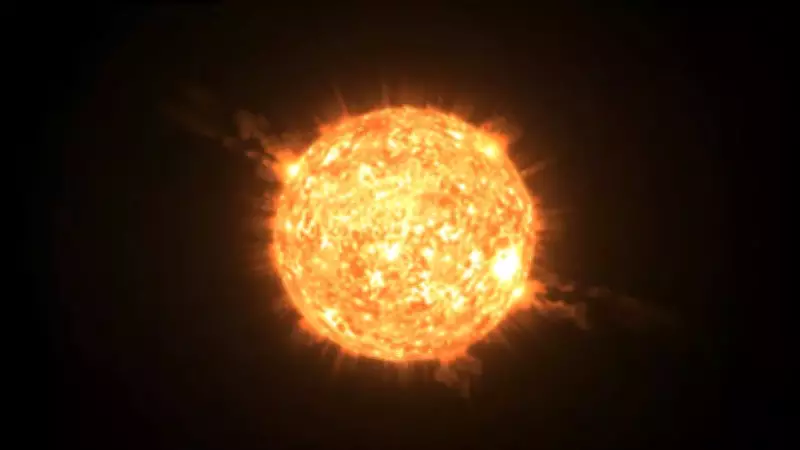
The Sun rotates, but not like a solid celestial body. Unlike planets with defined surfaces, our star lacks a hard boundary, making its motion a complex phenomenon of plasma dynamics rather than rigid mechanics.
Budget 2026 Live Updates: Capital Expenditure Target Set at Rs 12.2 Lakh Crore
In the Union Budget 2026-27, the government has announced a capital expenditure target of Rs 12.2 lakh crore for FY27, signaling continued infrastructure push and economic growth priorities.
What Gets Cheaper, What Gets Costlier in Budget 2026-27
The latest budget brings changes to taxation and pricing structures. While certain essential commodities and services see reduced costs, luxury items and specific imports face increased tariffs, affecting household budgets across income groups.

Latest Income Tax Slabs FY 2026-27: New vs Old Regime Details
Budget 2026 introduces revised income tax slabs under both new and old regimes. Taxpayers must carefully examine the updated rates, exemptions, and deductions to optimize their financial planning, with significant changes affecting middle and high-income brackets.
The scientific understanding of solar rotation emerges from observing patterns across the Sun's turbulent, luminous surface. This motion fundamentally influences solar behavior, from quiet periods to explosive activity bursts.
Differential Rotation: The Sun's Uneven Spin
Decades of observations reveal that solar rotation operates on broad timescales rather than precise measurements. The rotation period varies dramatically depending on solar latitude, creating what astronomers term differential rotation.
Equatorial Speed vs Polar Slowness
At the solar equator, the Sun completes one rotation in approximately 25 Earth days. This measurement comes primarily from tracking sunspot movement across the visible disk. However, as one moves toward the poles, rotation slows significantly, requiring about 36 days for a complete turn.
This latitude-dependent variation occurs because the Sun consists of superheated plasma rather than solid material. The gaseous nature allows different regions to move independently, creating the observed rotational gradient.
Sunspots: Nature's Solar Rotation Markers
Sunspots serve as crucial indicators for measuring solar rotation. These darker, cooler regions on the solar surface act as temporary markers that researchers track to determine rotational periods.
Since sunspots constantly form, dissipate, and regenerate, measurements represent averages rather than precise clocks. Over extended observation periods, consistent patterns emerge despite minor variations in individual spot behavior.
The Gradual Transition Between Latitudes
The change from faster equatorial rotation to slower polar rotation happens gradually rather than abruptly. Each solar latitude exhibits slightly different rotational speeds, creating a smooth transition zone that has been documented for over a century.
Rotation's Impact on Solar Activity
The Sun's differential rotation silently shapes its magnetic field architecture. As different latitude zones move at varying speeds, magnetic field lines stretch, twist, and sometimes reconnect.
This process, while gradual, contributes significantly to solar phenomena like flares, coronal mass ejections, and sunspot cycles. The effects unfold over years rather than days, influencing space weather that reaches Earth.
Solar Motion in Galactic Context
While rotating on its axis, the Sun simultaneously orbits the Milky Way's center. One complete galactic revolution takes approximately 230 million Earth years, making the Sun's 25-36 day rotation seem brief by comparison.
Despite this temporal disparity, the Sun's rotational characteristics remain central to understanding stellar behavior and evolution over cosmic timescales.
The TOI Science Desk continues to explore such celestial mysteries, bringing readers insights from astronomy, space science, and fundamental physics research that shapes our understanding of the universe.