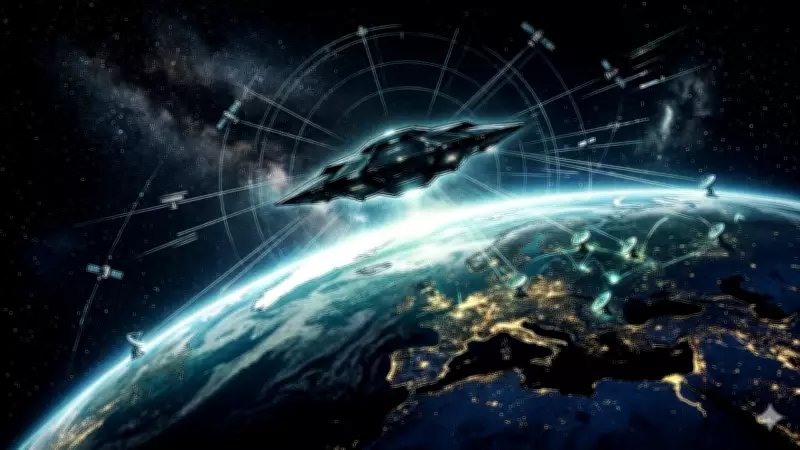
From Sci-Fi to Science: The Enduring Quest for Extraterrestrial Life
For decades, the concept of alien life has occupied a unique space between scientific possibility and science fiction fantasy. From blockbuster films in Hollywood and Bollywood to grainy UFO footage circulating online, the idea that humanity might not be alone in the cosmos has captivated imaginations worldwide. However, in recent years, this fascination has shifted significantly from mere speculation to serious scientific investigation.
Government Disclosures Fuel Public Interest
Renewed global attention has been sparked by reports that the United States government may release additional classified records concerning Unidentified Aerial Phenomena (UAPs), the contemporary term for UFOs. This initiative gained momentum after former US President Donald Trump announced that his administration would direct the Pentagon and other federal agencies to identify and declassify such documents. In a social media statement, Trump referenced the "tremendous interest" in extraterrestrial matters following remarks by former President Barack Obama, emphasizing that the public deserves greater transparency.
These anticipated files, expected to originate from agencies like the Pentagon and US intelligence departments, are believed to contain observations of aerial objects that remain unexplained by conventional science. While experts caution that these documents are unlikely to confirm the existence of alien spacecraft, they have reignited a profound question: Are we any closer to discovering life beyond Earth?

The Scientific Paradox: Advances Amidst Silence
The answer is complex and paradoxical. Humanity has acquired more knowledge about the universe in the past three decades than in the preceding three centuries. Thousands of exoplanets have been discovered beyond our solar system, telescopes can now analyze the atmospheres of distant worlds, and space missions persistently search for microbial life on Mars and icy moons. Yet, despite these monumental advances, a perplexing enigma endures: If the universe is so vast and ancient, why have we found no clear evidence of alien civilizations?
Political Fascination with the Extraterrestrial
The allure of extraterrestrial life extends beyond scientific circles, reaching the highest echelons of political power in the United States. Curiosity about aliens and UFOs has long permeated American politics, with several presidents addressing the topic publicly, reflecting its deep entrenchment in the public psyche.
Former President Barack Obama recently stated in a podcast interview that aliens are "real," though he clarified he had seen no evidence of extraterrestrial contact during his tenure. He elaborated that statistically, the universe's immensity makes the odds of life elsewhere high, even if visits to Earth are improbable.
Historical precedents abound. Jimmy Carter reported witnessing what he believed was a UFO in Georgia in 1969 and later documented the experience. As president, he included a message from Earth on the Voyager Golden Record, launched in 1977, intended for any extraterrestrial civilization that might encounter it. Ronald Reagan famously invoked the idea of an alien threat to underscore humanity's shared destiny during the Cold War, while Bill Clinton expressed interest in investigating Area 51 to ensure no hidden alien activity existed there.
More recently, Donald Trump acknowledged receiving briefings about UFOs during his presidency but remained skeptical about extraterrestrial visitors. His daughter-in-law, Lara Trump, suggested in a podcast that Trump might have "a speech ready" on the topic for an opportune moment. These instances illustrate how the possibility of alien life, once confined to fiction, has surfaced in presidential discourse, blending scientific curiosity with enduring cosmic mystery.

The Fermi Paradox: A Cosmic Conundrum
This puzzle lies at the heart of the Fermi Paradox, named after physicist Enrico Fermi, who posed a simple yet profound question in 1950: "Where is everybody?" The logic is straightforward: the Milky Way contains hundreds of billions of stars, many likely hosting planets. Over billions of years, some could develop intelligent life, which might spread across the galaxy. Yet, humanity has found no traces of such civilizations, creating a contradiction between high probability and zero evidence.
Over decades, scientists, philosophers, and futurists have proposed numerous explanations for this paradox:
- The Rare Earth Hypothesis: Suggests that while microbial life might be common, the conditions for complex, intelligent life are extraordinarily rare, with Earth being a unique convergence of factors like a stabilizing moon and protective magnetic field.
- The Great Filter Hypothesis: Proposes a difficult barrier—a "filter"—that most life forms fail to pass, possibly occurring at stages like the evolution of complexity or technological self-destruction.
- The Distance Problem: Posits that even if intelligent life exists, the vast distances of space make contact extremely challenging, with current human signals having traveled only a tiny fraction of the galaxy.
- The Zoo Hypothesis: Theorizes that advanced civilizations might observe Earth without interference, akin to humans watching animals in a reserve, until humanity reaches a certain technological maturity.
- The Dark Forest Theory: A darker idea that civilizations remain silent out of fear, hiding to avoid potential attacks in a resource-limited universe.
- The Simulation Hypothesis: Speculates that reality might be an advanced computer simulation, with alien life absent by design of the creators.
- The Self-Destruction Theory: Suggests intelligent civilizations often eliminate themselves through technological risks like nuclear war or environmental collapse.
- The Ocean Worlds Hypothesis: Proposes that alien life might exist in hidden environments, such as subsurface oceans on icy moons, making detection difficult.
- The Technological Mismatch: Argues that alien civilizations might use communication technologies beyond human detection capabilities.
- The "They Are Already Here" Idea: A controversial notion that extraterrestrials have visited Earth, often citing UFO sightings, though scientists stress that unexplained does not equate to extraterrestrial.
Global UFO Sightings and Speculation
High-profile incidents have fueled public speculation about alien visitors. The Roswell Incident of 1947, initially described as a "flying disc" but later attributed to a surveillance balloon, remains iconic. In 2004, US Navy pilots encountered an unidentified object near the Pacific Ocean, with radar and infrared footage showing it defying conventional aircraft behavior. In 2017, the US Department of Defense released several such videos, renewing interest in unexplained aerial phenomena.
Beyond the West, reports of strange objects have emerged globally. In India, sightings in Ladakh in 2012 were likely Chinese lanterns or astronomical phenomena, but attracted media attention. A notable case occurred in November 2023 at Imphal Airport, where a bright, ball-like object hovered over the airfield, prompting the Indian Air Force to scramble Rafale jets. The object vanished upon approach, and the airport was shut down for over three hours, with no official explanation provided. In the Kongka La Pass of the Himalayas, locals have reported "silent, triangular craft" for years, with glowing orbs logged by Indian Army units as "unidentified technical observations" in 2024 and 2025.
The Scientific Search for Life
While UFO sightings capture imagination, the scientific search for alien life focuses on astronomy and planetary science. The discovery of thousands of exoplanets since the 1990s, using telescopes like Kepler and James Webb, has been groundbreaking. Some lie in habitable zones where liquid water might exist, and scientists are analyzing their atmospheres for biosignatures like oxygen or methane.
Robotic missions continue exploring our solar system, with rovers on Mars seeking signs of past microbial life and future plans to probe icy moons like Europa. Even finding microbial life beyond Earth would be a monumental discovery, reshaping our understanding of biology and the universe.
Scientific Caution and Cosmic Perspective
Despite growing public interest, most scientists remain cautious. There is no verified evidence that extraterrestrial spacecraft have visited Earth, yet many astronomers believe the universe's vastness makes it improbable that life exists solely here. The challenge lies in detecting life across cosmic distances, with astronomers comparing the search to scooping a glass from the ocean and concluding whales don't exist because none appear in the sample.
A Defining Question for Humanity
The search for alien life transcends curiosity, touching on profound questions about human uniqueness and the commonality of intelligent life in the cosmos. New telescopes, space missions, and scientific techniques may provide answers in coming decades. For now, the universe remains silent, but the possibility persists that one day, a faint, distant, and unmistakably artificial signal could transform humanity's cosmic perspective.
Until then, the mystery endures, and Enrico Fermi's question from over seventy years ago continues to resonate: "Where is everybody?"