

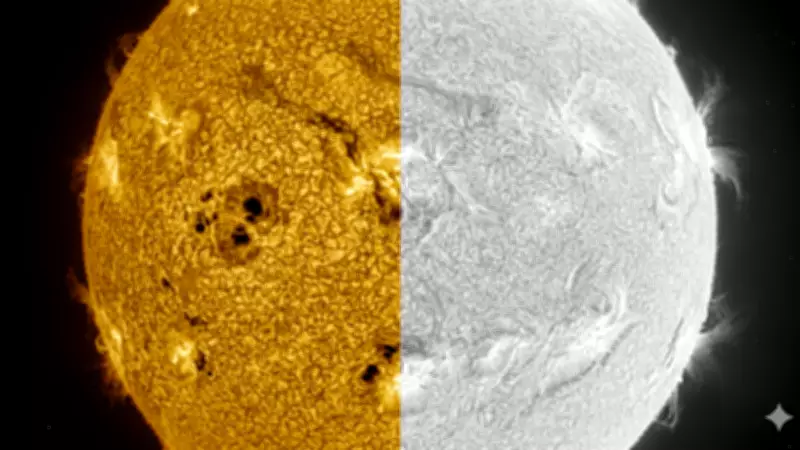
Most of us have been raised learning that the Sun is yellow. Children draw it that way, weather forecasts show it yellow, and even textbooks often depict it as such. However, the Sun's true color is white. This is evident in space photographs, where no atmosphere alters its appearance. The yellow hue we see from Earth is due to our atmosphere and a process called Rayleigh scattering. Blue wavelengths scatter more effectively, giving us a blue sky and reducing blue light reaching our eyes directly from the Sun.
The Sun Is Actually White: Science Explains Why
Though often called a yellow star, the Sun emits light across all visible wavelengths. When combined, these wavelengths produce white light. According to Matt Bobrowsky of Delaware State University, sunlight contains all colors of the rainbow. When kept together, they appear white. A prism can split white light into its constituent colors, proving this. NASA explains that the Sun's surface temperature of about 5,800°C (10,000°F) causes it to radiate a broad spectrum of energy. The photosphere, the visible surface, is relatively cool, while the corona reaches millions of degrees. These combined wavelengths make the Sun appear white in space.
Why Earth's Atmosphere Makes the Sun Look Yellow
The yellow color we perceive is due to Earth's atmosphere. When sunlight enters, it encounters oxygen and nitrogen molecules that scatter shorter wavelengths like blue and violet. NASA notes that blue light scatters more because its wavelength is smaller. Thus, most blue light disperses through the atmosphere, leaving direct sunlight with more yellow, orange, and red hues. This creates the golden Sun we see.

The Same Physics Makes the Sky Blue
The reason the Sun appears yellow and the sky blue is the same. Blue light scatters in all directions within the atmosphere. Looking up, we see scattered blue light from all parts of the sky. According to NASA, blue light is scattered more due to its shorter, smaller waves. The Met Office confirms that scattering by atmospheric particles affects blue light more. Without an atmosphere, the sky would be dark and the Sun white.
Why the Sun Turns Orange and Red at Sunrise and Sunset
At sunrise and sunset, sunlight travels a longer path through the atmosphere. NASA's Earth Observatory states that early morning or late evening sunlight passes through more atmosphere than midday light. With blue light scattered out, only orange and red remain, creating beautiful sunrises and sunsets. Dust and pollution can intensify these colors. The Sun's color is a reminder that things aren't always as they appear. Our atmosphere acts as an optical filter, diffusing blue light and altering our perception.
Next time you see a blue sky, remember that both the sky's color and the Sun's yellow appearance result from the same phenomenon.






