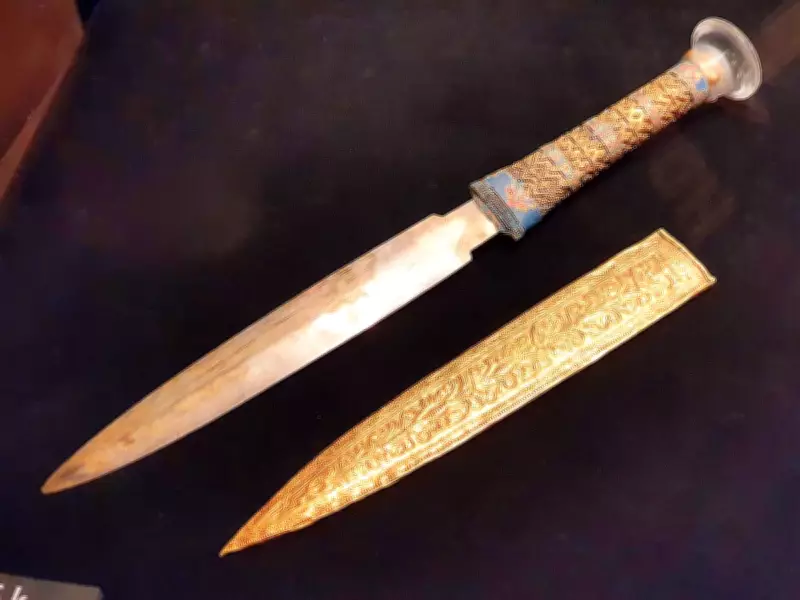
Two daggers were discovered among the objects wrapped with Tutankhamun's mummy in his tomb. One blade gleamed with the familiar luster of gold, but the second, a simple iron blade, quietly ignited a historical debate that lasted a century.
The Mystery of the Iron Blade
In 14th-century BCE Egypt, during Tutankhamun's reign, large-scale iron smelting was not yet established. It would be several centuries before it took root in large-scale production. The temporal paradox had historians scratching their heads – how could a pristine, unrusted iron weapon turn up in a Bronze Age royal tomb?
A Message from the Sky
Finally, in 2016, a study published in the journal Meteoritics and Planetary Science provided strong chemical evidence for a meteoritic origin. An international team of Italian and Egyptian researchers used a portable X-ray fluorescence spectrometer to study the blade inside the Egyptian Museum in Cairo. This non-intrusive technique allowed the team to bombard the metal with X-rays and measure the unique wavelengths emitted by its components, cracking the chemical signature of the material without damaging a priceless treasure.

The results strongly supported a meteoritic origin. Analysis showed the blade was roughly 11% nickel and 0.6% cobalt. Historical iron objects made from terrestrial ores typically contain far less nickel. This chemical composition strongly supports a meteoritic origin. The composition was consistent with meteoritic iron, particularly the composition range of many iron meteorites, supporting the conclusion that the blade was made from meteoritic iron.
The Ancient Worth of Sky Iron
This alien origin adds nuance to our understanding of elite material culture. The dagger is no crude, experimental piece of hardware, but an elite item of great prestige. Meteoritic iron was incredibly rare, hard to obtain, and therefore highly prized, for iron could not yet be smelted from ordinary ground ore.
The material was rare and only used for people of high status or religious ceremonies. It was a conscious choice of a royal milieu, a physical symbol of power, status, and cosmic connection. It is not evidence of widespread Egyptian iron smelting, but evidence of skilled working of rare meteoritic iron, a selective phase of metallurgy in which exceptional materials were gathered in small quantities for elite patrons.
An Ancient Cosmic Ritual
The young pharaoh's dependence on celestial material was not an isolated event. It was part of a deep, if limited, Egyptian tradition of dealing with space metal. Long before the artisans of Tutankhamun hammered his royal blade, prehistoric Egyptians had begun to treat meteoritic material as a precious resource. Among the earliest known examples of worked iron in Egypt is a group of small tubular beads from the prehistoric Gerzeh cemetery, dating to ca. 3300 BC.
A 2013 study found they were made from hammered meteoritic iron and confirmed that these ancient beads were also made of nickel-rich meteoritic iron. Prehistoric artisans hammered the metal that fell from the sky into extremely thin sheets, then rolled them into tubes to wear as jewelry alongside other exotic materials such as gold and lapis lazuli.
Adjusting the Historical Timeline
The common origin of these items allows historians to put together a much more detailed timeline of human technological development. History does not often take giant leaps from the Bronze Age to the Iron Age. Instead, these results suggest that there was an extended transition period during which iron existed only as the rare meteoritic form.
Tutankhamun's dagger stands at a crucial crossroads of history. It is strong evidence of working meteoritic iron, not necessarily early ironworking broadly, but it is not evidence of widespread smelting technology. By grasping the secret chemistry of the blade, scientists have opened a world where technology was the exception, not the rule, and where humanity's first major interactions with iron were straight from the stars.