

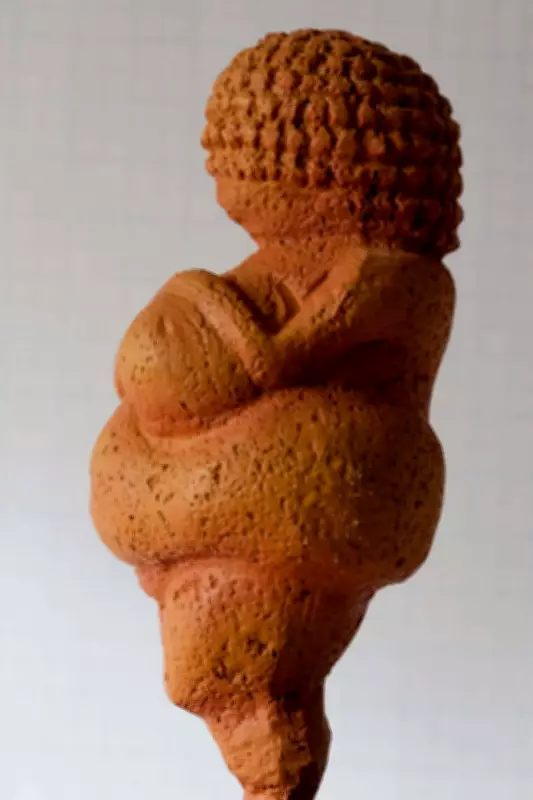
In some cases, the turning points in the course of history take place not in royal castles, but rather in the mud on a modest construction site. On August 7, 1908, a group of workers had been busy digging up loose sediment, which had lain untouched for almost 30,000 years, on the outskirts of the Austrian village of Willendorf. The man responsible for the section where this discovery was made was one Johann Veran, who noticed an interesting item among his finds.
Thus, Veran discovered the Venus of Willendorf, an 11-centimeter-tall statue that became one of the most famous pieces of ancient art, its popularity skyrocketing over time. Contrary to the majority of artifacts discovered by accident without any context, the discovery of the Venus of Willendorf took place as part of a systematic archaeological expedition. The precise geographic coordinates suggest that the Venus of Willendorf was made by the Gravettian people, hunters and gatherers living during the Last Ice Age.
A Travel Masterpiece and Hidden Features
For a long time, the origin of the Venus of Willendorf was considered to be local stone carving. However, due to technological advancements, it is now possible to see the inner structure of the object without harming it. Research carried out by scientists from the University of Innsbruck and published in Scientific Reports in 2022 revealed that the Venus of Willendorf consists of oolite, a specific kind of limestone with a pattern resembling eggs. There are no similar stones at the location where the Venus of Willendorf was found.

Thanks to high-quality scanning methods, it became possible to prove that the composition of this object fully matches the composition of rocks taken from over 450 miles away, near Lake Garda in Italy. Therefore, whether considering the completed figurine itself or the rock on which it was made, this material was transported across a distance of up to 450 miles over rough terrain. This discovery has radically changed our view of the way of life of Ice Age people. It turns out that they did not settle only in valleys; they wandered freely. New research shows its composition matches rock from Italy. The figurine's unique features and origin highlight the advanced skills and extensive travel of Gravettian hunters and gatherers.
Mystery of the Faceless Statue
It is worth mentioning that the Venus sculpture is rather unique in this respect because there are many distinctive details regarding what it highlights and what it neglects. First of all, the face, legs, and hands of the woman are not shown. Instead, the artist drew two simple lines above the breasts. However, she has well-combed hair and the rounded body of a woman. Research carried out at the Natural History Museum in Vienna suggests that the Venus statuette was originally covered in red ochre, which signifies blood.
Moreover, the research in Scientific Reports helped solve an age-old enigma connected to the so-called navel of the figurine. As revealed by the scans, the creator of the artifact proved to be quite adept at turning a disadvantage into an advantage. While trying to cut into the stone, the sculptor likely stumbled upon one of the iron-rich grains, known as limonites. Instead of discarding the item due to its hardness, the creator decided to place the figurine's belly button precisely at the location of such a grain.
At present, the Venus is kept in a special case at a museum in Vienna, which hardly adds any value to its historical importance. It serves as a reminder that the tendency to create, commemorate, and symbolize has always been an integral part of our history. Far from being merely a "fertility symbol" or a "mother goddess," the sculpture is tangible evidence of someone's talent and of many people's struggle through the ages.
It is an awe-inspiring notion that this figurine was held in a human hand 30,000 years ago and remained preserved in the mud for just the right amount of time for Johann Veran to unearth it one morning on a Tuesday in 1908.






