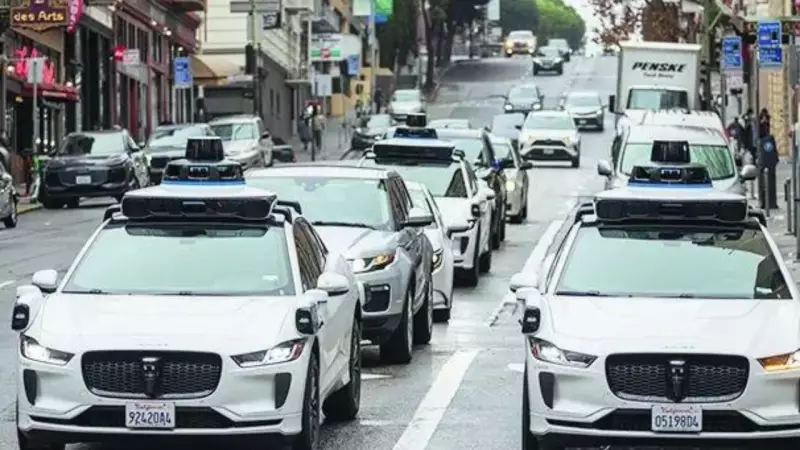
San Francisco city authorities have formally called for an investigation into Waymo's autonomous taxi operations after a widespread power outage over the weekend led to a fleet-wide meltdown, causing significant traffic disruptions and raising serious safety alarms.
City Officials Sound Alarm After Fleet-Wide Failure
The incident, which occurred during an hours-long power outage, saw numerous Waymo robotaxis stalling and blocking key intersections, effectively snarling traffic across parts of the city. This marked perhaps the first instance where Waymo taxis failed on such a massive scale, prompting immediate concern from local leaders. Supervisor Bilal Mahmood, who announced plans to hold a hearing on the matter, stated, "We haven't seen a situation before where Waymos have stalled en masse across the city."
The situation escalated to the point where stalled Waymo vehicles reportedly blocked fire trucks from quickly reaching a burning PG&E substation, one of the sources of the extended outage. Following outreach from Mayor Daniel Lurie's office about the gridlock, Waymo agreed to temporarily suspend its service. The company resumed operations by Sunday afternoon.

Emergency Response Capabilities Under Scrutiny
The episode has intensified the debate about the readiness of autonomous vehicles for real-world crises, especially in a disaster-prone city like San Francisco. Former Fire Chief Jeanine Nicholson, who retired last year after five years of service, highlighted the potential dangers. "They don't have them programmed for when there's a power outage, never mind when there's an earthquake and there's rubble in the street and all the power is out," she remarked, adding, "They're still building the plane while they're flying it."
San Francisco, the epicentre of the US driverless car experiment, has seen Waymo's distinctive white Jaguars become ubiquitous over the past year. The Google-parent Alphabet-owned company launched its commercial robotaxi service in the tech capital in 2023 and now operates roughly 1,000 vehicles in the city. While initial public hesitation has given way to growing reliance—with some residents citing safety and convenience for tasks like school pickups—recent events have sparked outrage.
Uncertain Cause and Industry Reactions
The exact technical reason for the mass stall remains unclear. Experts have speculated that the vehicles, which may rely on cellular networks to communicate with remote operators in emergencies, could have lost connectivity. Others suggest Waymo may have proactively halted the fleet, deeming it too risky to navigate through numerous dead traffic lights.
In a statement, Waymo explained that while its vehicles are designed to treat non-functional traffic signals as four-way stops, "the sheer scale of the outage led to instances where vehicles remained stationary longer than usual to confirm the state of the affected intersections." The company added it is "focused on rapidly integrating the lessons learned from the event."
In contrast, Elon Musk noted that Tesla's robotaxi service, which operates in a limited capacity in the city and requires a human safety driver onboard, was unaffected by the outage. This weekend's failure follows another controversial incident in October where a Waymo vehicle struck and killed a popular bodega cat, further fueling public debate about the technology's integration into urban life.