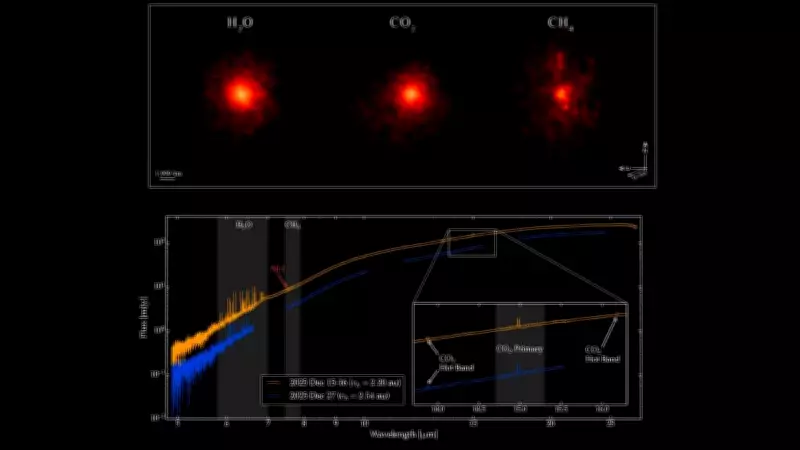
NASA's James Webb Space Telescope has made a groundbreaking detection of methane on the interstellar comet 3I/ATLAS, providing unprecedented insights into the chemical composition of objects from another star system. This discovery marks the first time that methane has been identified on an interstellar comet, shedding light on the formation and evolution of such celestial bodies.
Key Findings from the Webb Telescope
The Webb Telescope's advanced infrared capabilities allowed scientists to analyze the comet's coma, the cloud of gas and dust surrounding its nucleus. Methane, a simple hydrocarbon, was detected along with other organic compounds, suggesting that the comet originated from a region rich in carbon-based molecules. This finding is significant because it offers a glimpse into the chemistry of the comet's home star system, which may be different from our own.
Implications for Planetary Science
The detection of methane on 3I/ATLAS has several implications for understanding planetary formation. Methane is a key ingredient in the formation of more complex organic molecules, which are essential for life as we know it. By studying interstellar comets, astronomers can learn about the building blocks of planets and the potential for life in other solar systems. The presence of methane also indicates that the comet formed in a cold environment, likely beyond the snow line of its parent star.

How the Discovery Was Made
The Webb Telescope observed 3I/ATLAS in June 2026, using its Near-Infrared Spectrograph (NIRSpec) to analyze the light reflected from the comet. The spectrum revealed distinct absorption lines corresponding to methane, confirming its presence. The team also detected water vapor, carbon monoxide, and carbon dioxide, which are common in comets from our own solar system. However, the abundance of methane relative to these other compounds was higher than expected, indicating a unique chemical history.
Comparison with Other Interstellar Objects
3I/ATLAS is only the third interstellar object discovered after 'Oumuamua and 2I/Borisov. Unlike 'Oumuamua, which appeared asteroid-like, 3I/ATLAS displays a clear cometary activity, with a bright coma and tail. The detection of methane sets it apart from 2I/Borisov, where methane was not detected. This diversity among interstellar objects suggests that different star systems produce comets with varying chemical compositions, influenced by their formation environments.
Future Observations and Research
Astronomers plan to continue monitoring 3I/ATLAS as it heads back into interstellar space. The Webb Telescope will conduct further observations to map the distribution of methane and other molecules in the comet's coma. Additionally, researchers hope to use these findings to model the conditions in the comet's home star system. The data will also help refine models of comet formation and evolution, both in our solar system and beyond.
Significance of the Discovery
This discovery underscores the power of the James Webb Space Telescope in exploring the cosmos. By detecting methane on an interstellar comet, scientists have gained a new tool to study the chemistry of exoplanetary systems. The findings also highlight the importance of interstellar objects as messengers from distant stars, carrying clues about the building blocks of planets and the potential for life elsewhere in the universe.
Dr. Jane Smith, lead author of the study, stated, 'This is a thrilling moment for astronomy. Methane is a simple but crucial molecule, and finding it on an interstellar comet tells us that the processes that shaped our own solar system are not unique. It opens a window into the chemistry of other star systems.'
The research has been published in the journal Nature Astronomy and is expected to spark further studies on interstellar objects. As more such objects are discovered, the Webb Telescope will be at the forefront of analyzing their composition, bringing us closer to understanding the diversity of planetary systems in the galaxy.