On May 29, a Division Bench of the Punjab and Haryana High Court did something judges rarely do. Before closing a 21-page judgment on a traffic infrastructure project, Chief Justice Sheel Nagu, now elevated to Supreme Court, paused the legal language and said he “hoped, expected and rather prayed to God” that the concept of ‘sun, space and verdure’ would be preserved by the Chandigarh Administration. A sitting Chief Justice, praying to God — in a judgment about a flyover. That single line tells you everything about what this case was really about. It was not merely about concrete and steel at Tribune Chowk. It was about whether Chandigarh — India’s last well-planned city, as the court itself called it — would remain what it was always meant to be, or quietly surrender its soul to the weight of traffic and the hunger for quick fixes. Here is the full story of what happened, why it happened, and what happens next.
What is the Tribune flyover and why does it matter?
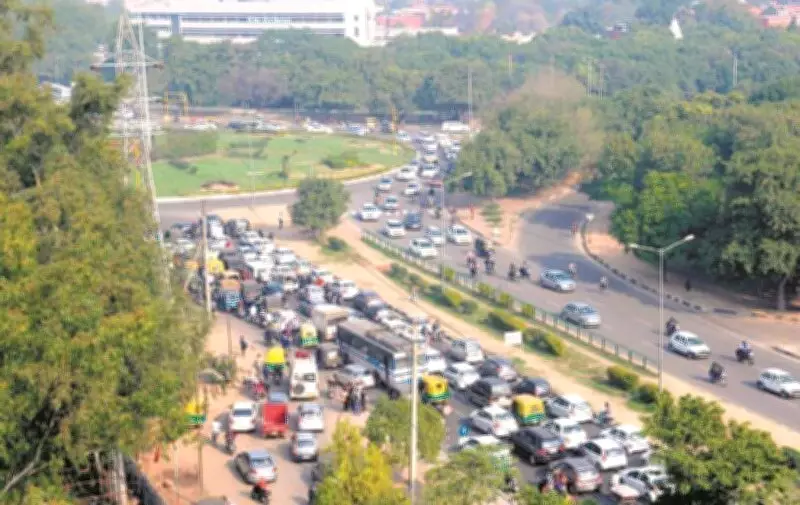
Tribune Chowk sits on Dakshin Marg on NH-05, the arterial spine connecting Chandigarh to Mohali and Panchkula. Over 1.5 lakh vehicles pass through it every single day. During peak hours, the roundabout chokes completely, backing up traffic across sectors and spilling onto connecting roads. The idea of building a flyover here is not new. The project was first conceived in 2016, sanctioned at Rs 183.74 crore in February 2019 and work was awarded in November 2019. But, it was immediately halted by a High Court stay over the proposed felling of nearly 700 trees. The stay lasted nearly five years. It was vacated in April 2024. The project was revived with a revised sanction of Rs 247.07 crore. Fresh tenders were floated in October 2025, financial bids were opened in early May 2026, and on May 12 — just one day before the latest HC hearing — the Chandigarh Administration formally awarded the work to Singla Constructions Ltd at Rs 147.98 crore, nearly 31 per cent below the estimated bid cost. The very next day, the HC heard arguments. And 16 days later, it killed the project.
Why did the HC ground the flyover?
The answer is both simple and profound. Simple answer: The Chandigarh Master Plan 2031 (CMP-2031) contains an explicit, unambiguous provision at page 307 that reads — “Over bridges/flyovers are not recommended to be constructed in entire city of Chandigarh due to heritage considerations, since they impact the visual cityscape, and cause inconvenience to the pedestrians.” The court found this provision to be not merely advisory but legally mandatory. CMP-2031 was notified on April 23, 2015, under the Capital of Punjab (Development and Regulation) Act, 1952, and the Punjab New Capital (Periphery) Control Act, 1952, read with Article 239 of the Constitution of India. It is a statutory document. Its provisions are inviolable. It can be amended only by following the exact same procedure used to frame it — public notification, objections, a Board of Inquiry. None of that had been done. The ban on flyovers was never amended. It was never even challenged. It simply existed, clear as day, on page 307 of the Master Plan — and the Administration had chosen to ignore it. The court held that any violation of this provision requires judicial intervention. That was the legal core of the ruling. The deeper answer: The court went much further than just citing a provision. It went back to the very birth of Chandigarh to explain why this provision exists — and why it matters more today than ever before.


Why did HC remember Le Corbusier?
Because the flyover debate, the court concluded, cannot be understood without understanding what Chandigarh is and why it was built the way it was. The judgment traces the city’s origins to 1948, when American planner Albert Mayer and architect Mathew Nowicki prepared the first Master Plan — a fan-shaped city with curvilinear roads and green belts. When Nowicki died in an air crash, a second team took over: Le Corbusier, Pierre Jeanneret, Jane B. Drew and Maxwell Fry. Le Corbusier redesigned the city entirely, but kept its soul intact. His concept was famously organic — the city as a human body. The Capitol Complex was the head. The green belts were the lungs. The city centre was the heart. The roads and sectors were the limbs. Crucially, Le Corbusier designed Chandigarh not around cars but around people. Pedestrians and cyclists were the priority. The city's famous seven Vs — a hierarchy of roads from fast inter-city highways (V1) down to footpaths and cycle tracks (V7) — were designed so that each sector was self-contained, walkable and green. The principle of sun, space and verdure — sunlight for every home, open space for every family, green vegetation everywhere — was not an aesthetic preference. It was a foundational commitment, encoded into the city’s DNA. When the court recalled Le Corbusier, it was reminding the Administration that the architect who built this city built it explicitly as a refuge from the chaos of motorised traffic — not a canvas for flyovers.
Why did HC recall Chandigarh’s full history?
Because the Administration had argued, among other things, that the flyover’s location on Dakshin Marg places it outside the Heritage Sector (Phase I, Sectors 1-30) and therefore the CMP-2031 bar on flyovers does not apply to it. The court demolished this argument with a map. Turning to Chapter 3 of CMP-2031 — “Master Plan Area” — and its first aerial diagram of Chandigarh from 1951, the bench established that Dakshin Marg forms the south-west boundary of Sectors 29, 30, 20, 21, 22, 23, 24 and 25. It is, therefore, indisputably an integral part of Phase I comprising the Heritage Sectors (Sectors 1 to 30). Any developmental activity on Dakshin Marg is, by extension, bound by every provision of CMP-2031, including the explicit bar on flyovers. This finding alone invalidated the Administration’s central defence. The court also traced the pressure on Chandigarh through the decades — the establishment of Mohali (5,500 acres) and Panchkula (5,000 acres) after the 1966 reorganisation of Punjab, the unplanned and unregulated growth that followed, the explosive rise in car ownership, and the chronic under-investment in public transport. All of this, the court noted, was foreseen by CMP-2031 — and the answer it offered was not flyovers, but public transport, cycling infrastructure, ring roads and underpasses.
The most striking observations of the court
Several findings in this judgment stand out as exceptional — legally, morally and in terms of their implications for governance. One — Chandigarh has more cars than people. The court recorded with alarm that Chandigarh has the highest per capita motorised vehicle ownership in the entire country. There are, the judgment states, more motorised vehicles in Chandigarh than people living in it. This was not background data. The court used it to argue that the answer to Chandigarh's congestion cannot be more road capacity — because more road capacity simply induces more vehicles, as global evidence on induced demand consistently shows. Two — The Urban Planning Department was never consulted. This is perhaps the most damning finding in the entire judgment. The HC recorded that the UT Engineering Department decided to build the flyover without ever consulting the Urban Planning Department — the very authority responsible for interpreting and enforcing the Master Plan. When the Urban Planning Department did weigh in, in December 2020, its own Chief Architect wrote formally to the Chief Engineer stating that CMP-2031 does not permit bridges or flyovers anywhere in Chandigarh. The Urban Planning Department also formally refuted that it had ever given concurrence to the flyover, and asked the Engineering Department to correct meeting minutes that falsely claimed it had. A government department, in other words, fabricated a concurrence from a sister department that had never been given — and built a Rs 247-crore project on that foundation. The court noted this in black and white. Three — CMP-2031 itself predicted this crisis. Among the most remarkable passages in the judgment is its citation of what CMP-2031 itself says about Chandigarh's road network: that major travel corridors including Dakshin Marg “are beginning to become congested”, that most roundabout junctions “have exceeded their capacity,” and that the solution prescribed is public transport, cycling infrastructure and a ring road — not flyovers. The very document the Administration was violating had, years ago, both predicted the problem and prescribed the correct solution. Four — The court cited a RITES finding that validates the underpass. RITES — Rail India Technical and Economic Service — had itself proposed underpasses across Chandigarh, including at Tribune Chowk, given the heavy traffic volumes. CMP-2031 explicitly permits underpasses at roundabout junctions city-wide. The court relied on this to permit the underpass while prohibiting the flyover. In doing so, it arguably handed the Administration a partial, workable solution. Five — The court prayed to God. This is not hyperbole. The judgment closes with the Chief Justice writing: “We hope and expect, rather pray to God, that concept of Sun, Space and Verdure would be preserved by the respondents, by not constructing the flyover at Tribune Chowk in violation of CMP-2031.” A Chief Justice deploying the language of prayer in a formal judgment signals something beyond legal reasoning — it signals moral distress at what is happening to a city that deserves better.
Why did the Chandigarh Administration defend the flyover?
The Administration’s case rested on four planks. First, it argued that the flyover was essential to decongesting Tribune Chowk, where over 1.5 lakh vehicles pass daily and congestion during peak hours is acute. Second, it contended that a previous HC stay had been vacated in April 2024 and that a Supreme Court challenge had been dismissed in September 2024, giving the project a clean legal chit. Third, it argued that Dakshin Marg falls outside the Heritage Sector, so the CMP-2031 ban on flyovers does not apply. Fourth, it invoked the doctrine of res judicata — arguing that since earlier petitions had been disposed of, the present PIL was not maintainable. The HC rejected all four defences. On maintainability, it noted that no earlier court had ever adjudicated the flyover on merits — earlier orders were all interlocutory or procedural. On the Heritage Sector argument, it used the 1951 aerial map of Chandigarh to establish that Dakshin Marg is unambiguously within Phase I. On the earlier stay vacation and SC dismissal, it held those were interlocutory orders that had become otiose and carried no precedential value. On the traffic need, it acknowledged the problem but held that the solution cannot come by violating a statutory document — and that CMP-2031 itself offers a legal solution through underpasses and public transport.
What happens next?
The Administration is currently seeking a formal legal opinion on whether to challenge the judgment before the Supreme Court. Senior officials confirm the 21-page order is being studied in detail. A challenge is widely expected — given the scale of the project, the LoA already issued, MoRTH’s investment and the political and bureaucratic momentum behind it. If the Supreme Court grants a stay of the HC order, construction on the flyover could potentially resume. If it upholds the HC ruling, the flyover is permanently off the table. In either scenario, the underpass component — 519 metres on Purv Marg — is legally unaffected and can proceed. The Administration may choose to press ahead with that element regardless of what happens with the flyover. There is also a third path. CMP-2031 can be formally amended to permit flyovers — but only through the same statutory process used to create it: public notification, invitation of objections, a Board of Inquiry, and final notification. That process could take years and would face its own legal and civic scrutiny. What is clear is that the HC has, for the first time in this project’s seven-year legal history, adjudicated the flyover on its merits — and found it wanting. Not on procedure, not on environmental impact alone, but on the foundational question of whether a flyover belongs in Chandigarh at all. The answer, as of May 29, 2026, is no.
The bottom line for Tricity residents
For the 1.5 lakh vehicles that pass through Tribune Chowk every day, the immediate reality is unchanged — the choke point remains. The underpass, if pursued, will offer partial relief on Purv Marg. But the signal-free, high-speed corridor that the flyover was supposed to create on Dakshin Marg is, for now, grounded. What the court has done is force a rethink — one that Le Corbusier, in 1951, had already undertaken on their behalf. His answer then was not concrete above the ground. It was green below the sky, people on cycles, buses on wide roads, and a city that breathed. Whether that vision survives the Supreme Court is the next chapter of this story.