Astronomers Spot Unusual 'Moth-Shaped' Bubble Around Young Sun-Like Star
Astronomers have made a remarkable discovery, observing something highly unusual in the cosmos. A star, strikingly similar to our own Sun during its youthful phase, is actively blowing a massive bubble through the vast expanse of space. This star, identified as HD 61005, resides approximately 120 light-years away from Earth. At first glance, it appears ordinary, sharing the same mass and temperature as the Sun. However, with an age of only about 100 million years, it is considered a mere teenager in stellar terms, offering a rare window into the early life of stars like our Sun.
NASA's Chandra Captures Detailed View of the Astrosphere
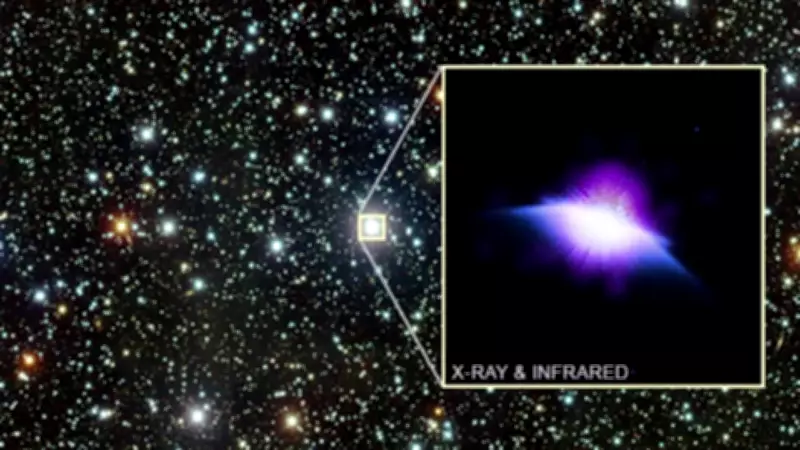
NASA's Chandra X-ray Observatory has successfully captured the star's "astrosphere," a wind-blown bubble composed of hot gas that is expanding into cooler surrounding material. Experts emphasize that this provides an invaluable glimpse into what the environment around the early Sun might have resembled. The astrosphere is not just a simple bubble; it features distinctive wings of dusty debris, giving it a unique "moth-like" shape that has captivated astronomers.
The discovery reportedly required decades of meticulous searching and precision imaging. By combining Chandra's advanced X-ray vision with infrared and optical data, scientists have achieved an unprecedented detailed view of the star and its surrounding bubble. Observers describe the scene as almost akin to watching a young Sun at play, highlighting the dynamic nature of stellar evolution.

Massive Scale and Dynamic Characteristics of the Astrosphere
The astrosphere encircling HD 61005 is immense, spanning about 200 times the distance from Earth to the Sun. Winds emanating from the star's surface are three times faster and 25 times denser than those produced by our Sun today. These powerful winds blow hot gas into the surrounding space, meticulously shaping the bubble. Scientists speculate that it might even bear a resemblance to the heliosphere, the protective bubble our Sun creates around itself.
The dusty wings trailing the star contribute to its moth-like appearance, a feature that inspired astronomers to bestow it with this nickname. Infrared data reveal the material sweeping backwards as the star moves through space, creating a delicate yet incredibly dynamic structure. Researchers note that this young star exhibits a distinct personality, showcasing intense activity while maintaining a strange balance with its interstellar surroundings.
Decades of Research Culminate in Groundbreaking Findings
Researchers have been actively hunting for astrospheres around Sun-like stars since the 1990s, and Chandra's high-resolution X-ray imaging has finally made this breakthrough possible. The proximity of HD 61005 and the dense interstellar matter surrounding it were crucial factors in this discovery. The material around the star is approximately a thousand times denser than that found near the Sun, providing an ideal environment for such observations.
A team led by Casey Lisse at Johns Hopkins University meticulously examined the star's X-ray emissions, allowing them to visualize where the stellar wind interacts with cooler gas and dust. The resulting view is reportedly spectacular, featuring bright X-rays at the center, wings of infrared light stretching outward, and a broader optical field that displays the surrounding stars, offering a comprehensive picture of this celestial phenomenon.
Insights into Our Sun's Youth and Planetary Formation
HD 61005 serves as a fascinating glimpse into our Sun's youth, with its winds, debris, and astrosphere providing hints about what our solar system might have experienced billions of years ago. Scientists believe that studying this star could significantly enhance our understanding of how planets and atmospheres formed in the early universe. The star's intense activity, coupled with its balanced interaction with space, underscores the complex processes at play during stellar development.