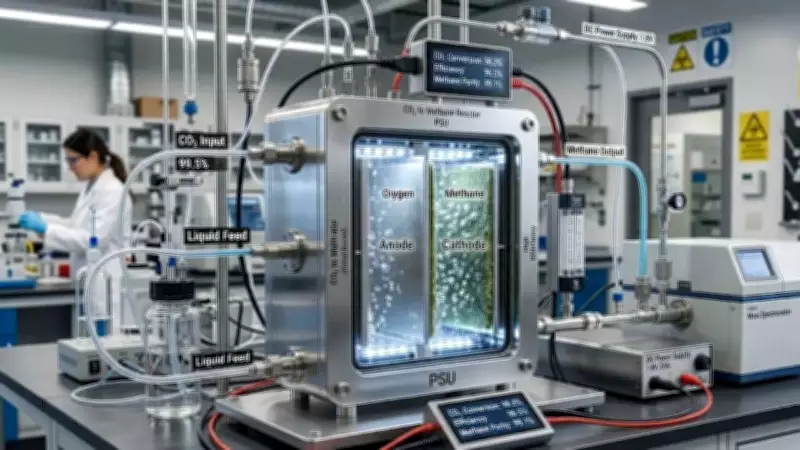
Scientists at Pennsylvania State University have developed an innovative 'zero-gap' microbial electrosynthesis reactor that converts carbon dioxide into methane with an efficiency exceeding 95 percent. This device addresses a critical challenge in renewable energy storage by integrating water electrolysis and biological methanation into a single, powerful unit. The reactor employs a membrane-separated electrode configuration that minimizes electrical resistance, facilitating rapid electron transfer and stable reactions.
Renewable Methane as a Carbon-Neutral Fuel
The methane produced is renewable and can serve as a carbon-neutral alternative to fossil fuels. It seamlessly integrates into existing natural gas infrastructure for easy transportation and storage. This breakthrough represents a significant step toward establishing a circular carbon economy, transforming a major greenhouse gas into a high-energy fuel that is easy to store and scalable for industrial applications.
Design and Efficiency of the Zero-Gap Reactor
The 'zero-gap' design optimizes the structure by placing a thin membrane between the electrodes, shortening the path for ion travel. Research led by Bruce Logan at Penn State demonstrates that this configuration reduces internal resistance and energy loss, achieving a Coulombic efficiency of over 95 percent, as reported by Pennsylvania State University. This means nearly all electrical energy is used for chemical conversion rather than being dissipated as heat or lost in side reactions.

Enhanced Kinetics through Localized Gas Production
Traditional methods often struggle with slow electron transfer to microbes. This reactor takes a different approach: renewable electricity first splits water into hydrogen gas. Nearby, methanogenic microorganisms at the cathode immediately use this hydrogen to reduce carbon dioxide into methane. The close proximity of these organisms accelerates the process by eliminating delays caused by diffusion.
Net-Zero Solution for Long-Duration Energy Storage
According to a report by Bioengineer, the reactor produces nearly 7 liters of methane per liter of its volume each day. This high output is crucial for industrial practicality. Since the end product is methane, it is fully compatible with existing global natural gas pipelines and storage systems. This provides a net-zero method for long-duration energy storage without requiring new distribution networks.
The TOI Science Desk, an inquisitive team of journalists, continuously explores the realms of discovery to curate a captivating collection of news, features, and articles from the ever-evolving world of science for the readers of The Times of India. Consider us your scientific companion, delivering a daily dose of wonder and enlightenment. Whether it is the intricacies of genetic engineering, the marvels of space exploration, or the latest in artificial intelligence, the TOI Science Desk ensures you stay connected to the pulse of the scientific world. At the TOI Science Desk, we are not just reporters; we are storytellers of scientific narratives. We are committed to demystifying the intricacies of science, making it accessible and engaging for readers of all backgrounds. Join us as we craft knowledge with precision and passion, bringing you on a journey where the mysteries of the universe unfold with every word.