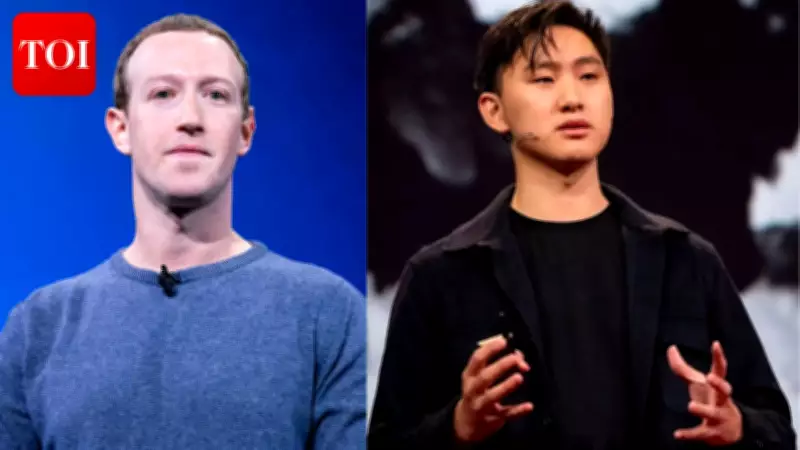
Meta CEO Mark Zuckerberg Quietly Undermines AI Leader Alexandr Wang's Authority
Meta CEO Mark Zuckerberg has discreetly initiated the dismantling of the power structure he established around Alexandr Wang, his $14 billion investment to spearhead the company's artificial intelligence initiatives. This move indicates the billionaire entrepreneur is losing confidence in the 28-year-old data labeling entrepreneur, whom he once wooed with personal gestures like homemade soup deliveries and compensation packages worth hundreds of millions of dollars.
Nine Months of Centralized Control Now Fragmenting
Nine months after Wang joined Meta to oversee the Superintelligence Labs with absolute authority over frontier AI models, Zuckerberg is now rerouting engineering talent, data pipelines, and model evaluations entirely around him. The Avocado and Mango models that Wang promised will be constructed on infrastructure he no longer controls. Researchers he hired now report to other executives, and Zuckerberg is quietly developing a backup plan, suggesting the entire experiment may have already failed.
New Applied AI Engineering Organization Signals Shift
The shift became evident on Tuesday when Meta announced a new applied AI engineering organization led by Maher Saba, a long-time Reality Labs executive who now reports directly to Chief Technology Officer Andrew Bosworth. This structure reveals Zuckerberg's strategy: bypassing Wang's Superintelligence Labs to create a parallel engineering powerhouse designed to supply core AI models with data, tooling, and evaluations faster than Wang's team can process them. It represents organizational restructuring as a soft firing—Wang retains his title and access but loses all meaningful influence.

Parallel Org Charts Expose Power Dynamics
When Zuckerberg hired Wang in June to lead Meta Superintelligence Labs, the setup appeared streamlined, with Wang owning the entire AI research and development stack. Today, that model is fragmenting. Saba's new team features a deliberately flat structure—with up to 50 individual contributors per manager—aimed at moving faster than traditional bureaucracy allows. This contrasts sharply with the centralized, ego-driven approach Wang introduced.
An internal memo reported by The Wall Street Journal outlines Saba's mandate: to build "the data engine that helps our models get better, faster." This language is significant. Zuckerberg isn't merely forming another team; he's creating an engine that makes Wang's job more challenging if he underperforms and easier to replace him if necessary.
Internal Conflicts and Questioning of Wang's Hire
This reorganization follows nine months during which Zuckerberg began questioning whether hiring Wang was a mistake. According to reports from the Financial Times and New York Times, Wang quickly clashed with longtime Meta executives Chris Cox and Andrew Bosworth. Wang focused on catching up to OpenAI and Google's models, while Cox and Bosworth prioritized using Instagram and Facebook data to build practical products. Wang expressed frustration to associates about Zuckerberg's suffocating oversight, and Yann LeCun, Meta's chief AI scientist and Wang's theoretical superior, walked out in November rather than report to him.
Isolation Replaces Influence for Highest-Paid Executive
Initially, Zuckerberg positioned Wang as untouchable—the genius billionaire who would unlock superintelligence, offering compensation packages worth hundreds of millions to top researchers. Instead, Wang has become isolated. His TBD Lab is located in a glass box near Zuckerberg's office, and only two of approximately 100 researchers left when their equity vested in November. While low turnover might seem positive on paper, it reflects a team that feels trapped.
With Saba's new organization reporting to Bosworth instead of Wang, engineering talent will flow around Wang rather than through him. The Avocado and Mango models Wang was promised will be trained on data pipelines controlled by Saba's team. The tooling researchers use and the feedback loops essential for turning capable models into leading ones will be managed below Wang's authority.

Zuckerberg's Pattern of Reclaiming Control
Zuckerberg has consistently favored control over decentralization. When his bets, such as the metaverse or early Llama iterations, falter, he reorganizes to reclaim power. With Wang, he is executing a similar strategy, albeit quietly enough that the young entrepreneur might not realize it until he attempts to make a move.
This reorganization demonstrates that Zuckerberg is already planning for a Meta AI future that does not rely on the man he paid more to hire than the value of most companies.