

Digital Arrest Scam: ATS Impersonators Swindle Over ₹55 Lakh from Vizag Victims
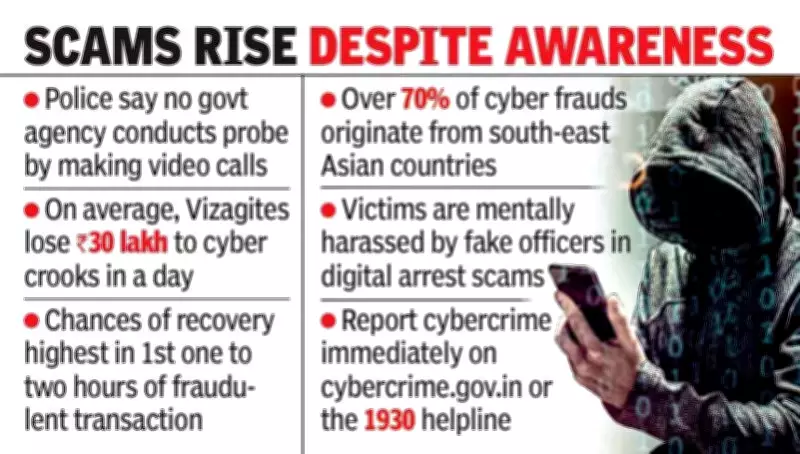
In a disturbing escalation of cyber fraud, criminals impersonating officials of the Anti-Terrorist Squad (ATS) successfully duped more than seven individuals, including a chief general manager of a government organization, of over ₹55 lakh through a sophisticated "digital arrest" scam during the second week of March. This incident occurred in Visakhapatnam, Andhra Pradesh, despite repeated police advisories, viral social media warnings, and extensive media coverage about such fraudulent schemes.
How the Elaborate Scam Unfolded
The primary victim, a 58-year-old Vizag-based general manager, suffered a staggering loss of ₹30 lakh after fraudsters claimed he was linked to a money-laundering case connected to terrorism. The elaborate deception began when the victim received a WhatsApp call from unknown individuals posing as ATS officials. This was followed by a video call that allegedly appeared to originate from a Delhi police station, complete with convincing background details.
The callers aggressively accused him of criminal involvement, demanded his Aadhaar card and other personal identification details, and threatened immediate arrest under stringent anti-terrorism laws if he failed to cooperate fully with their investigation. Exploiting the victim's understandable fear, the fraudsters then instructed him to isolate himself in a locked room, effectively placing him under a fabricated "digital arrest" scenario.

The Psychological Manipulation and Financial Extraction
While the victim was in this isolated and vulnerable state, the criminals coerced him into sharing sensitive bank account details and demanded ₹30 lakh for what they described as a "confidential investigation" to prove his innocence. Terrified by the prospect of legal consequences and public humiliation, the victim complied and transferred the substantial amount before realizing he had fallen victim to an elaborate scam.
Only when the threatening calls abruptly stopped did the victim approach the Vizag cybercrime police station to lodge an official complaint. Meanwhile, six additional victims within Vizag city reportedly transferred approximately ₹25 lakh under similar threatening circumstances, bringing the total confirmed losses to over ₹55 lakh.
The Modus Operandi of Digital Arrest Scams
Police officials explained that digital arrest scams typically involve sophisticated impersonation of various authorities, including police officers, Central Bureau of Investigation (CBI) officials, Narcotics Control Bureau (NCB) agents, Supreme Court representatives, or telecom regulatory authorities. The criminals meticulously research their targets and craft believable narratives involving alleged links to criminal activities such as drug trafficking, money laundering, or terrorism financing.
Victims are then placed under a fake "digital arrest" through continuous video calls, during which they are psychologically isolated, systematically intimidated, and methodically coerced into transferring money. The scammers create an atmosphere of urgency and fear, convincing targets that immediate financial payment represents their only viable path to avoid severe legal consequences and public exposure.
Official Response and Public Advisory
Cybercrime officials have noted with concern that despite ongoing awareness campaigns and public service announcements, fear and sophisticated technological manipulation continue to drive victims into substantial financial losses. These scams specifically exploit psychological pressure points, using convincing documentation, official-sounding terminology, and threats of immediate arrest to override victims' critical thinking.
Authorities have urgently reiterated their advisory to the public, emphasizing several crucial precautions:

- Remain vigilant against unsolicited calls claiming to be from law enforcement agencies
- Avoid sharing personal identification documents or financial details over phone or video calls
- Immediately report any suspicious communication to local cybercrime authorities
Police have stressed unequivocally that genuine law-enforcement agencies never demand money transfers, never request isolation through video calls, and always follow proper legal procedures through official channels. The growing number of victims highlights the pressing need for stronger public awareness initiatives, rapid reporting mechanisms, and coordinated action between law enforcement agencies to effectively curb these digital arrest frauds that prey specifically on fear and confusion.





