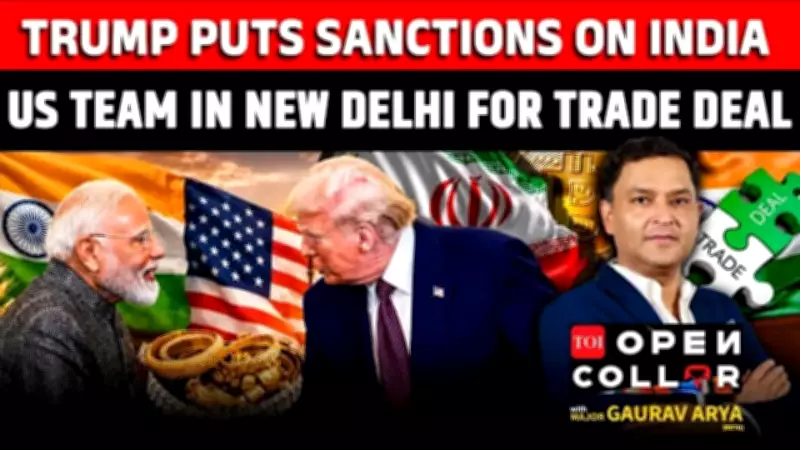
The United States is using sanctions and economic pressure to achieve in Iran what it could not accomplish through military strikes and bombings. Months after launching Operation Epic Fury in late February, the US has now imposed sanctions on Iran's largest cryptocurrency exchange, Nobitex, and several of its senior executives, accusing the platform of helping the Iranian government and other sanctioned entities bypass Western restrictions.
Economic Strangulation Over Military Action
Major Gaurav Arya (Retd.) explains that Washington's move makes it extremely difficult—almost impossible—for Iran to conduct business with the outside world. He also cites the India-US trade deal negotiations to assert that Operation Epic Fury could not deliver desired results. Therefore, with midterms coming up in November, Trump is desperate to show a win.
There isn't very much of manufacturing outside weaponry that is going on in Iran. So Iran depends upon these routes. Why all of a sudden does Donald Trump try to pull a rabbit out of his hat and say that 12.5% to India and Japan and South Korea, etc.? Why?

Now we cannot buy oil from GCC countries because pretty much the Strait of Hormuz is blocked. So on the American request, India started buying more and more Russian oil. And then suddenly Donald Trump wins the elections and he says, "No, don't buy oil." It's going to be some aircraft, it's going to be some agricultural produce, but largely it's going to be energy purchases.
So ladies and gentlemen, Epic Fury is out and economic fury is in. What the United States of America could not achieve through missiles and bombs in Iran, it is now trying to do through sanctions and through economic strangulation.
Details of the Sanctions
Hi, my name is Gaurav Arya, and you're watching Open Collar. Economic fury on Iran, US seizes Tehran's biggest crypto network amid peace talks. So this is what is happening. Reports say Iran's crypto market $7.7 billion amid sanctions pressure. Every dollar counts for Iran because Iran is under heavy sanctions. It's not being allowed to sell its oil anywhere, which is pretty much all that Iran produces.
Now, what is happening here is, after unleashing Epic Fury in Iran, the United States has launched another front to step up its pressure on the country. The US on Tuesday imposed sanctions on Iran's largest cryptocurrency exchange, Nobitex, and several of its senior executives, accusing the platform of helping the Iranian government and sanctioned entities bypass Western restrictions.
What they're saying is that you're using the crypto route. Now, we have placed certain sanctions on Iran, which makes it extremely difficult, almost impossible for Iran to conduct business with the outside world. Now, Iran chooses to do this through the crypto route. Now, the Americans are sanctioning the crypto route so that they strangulate or try to economically strangulate Iran, and they're saying that Nobitex is Iran's largest company, largest crypto company, and now they have put sanctions on Nobitex and some of its senior executives.
The move is part of Trump administration's efforts to increase economic pressure on Tehran amid ongoing conflict. According to the US Treasury Department, Nobitex processed more than half of Iran's digital asset income last year and played a key role in the country's sanctions evasion network.
So more than 50%, more than 50% of Iran's digital asset income last year was processed through Nobitex alone. One entity processed more than 50%, and the Americans say they allege that Nobitex is responsible for evasion of sanctions. Using the crypto route, this is what Nobitex does. So let's put Nobitex, for all practical purposes, out of business. Iran's largest digital asset exchange, handling over 50% of the country's crypto inflows in 2025. The US alleges it facilitated transactions linked to the Islamic Revolutionary Guard Corps, helped sanctions evasion, and enabled regime insiders to access international crypto markets.
So all that ends as of day before yesterday. That is what the US did. And the Americans are absolutely clear. Epic Fury hasn't worked. They're hoping that economic fury will work. And ladies and gentlemen, Donald Trump is again having one of his famous mood swings.

India-US Trade Deal and Tariffs
This is the India-US trade deal. Now, these are the main points, and of course, the American team is in New Delhi, and the American team is trying to get the trade deal signed or a part of the trade deal signed. I will tell you exactly about that deal. But before that, Trump plans new tariffs on India over forced labour. Now, what is forced labour? Does it mean that India is using forced labour to manufacture goods? No. What Trump is saying is that India imports stuff from other countries and those countries use forced labour, therefore there should be tariffs on India.
So, it is on 60 countries. As we speak, the United States is planning to impose new tariffs on at least 60 trading partners for alleged failures to act against forced labour. And, the tariffs proposed by the US trade representative range from 10% to 12.5%, according to a government filing. According to the USTR report released early Wednesday, Canada, Mexico, Taiwan, and the United Kingdom would face 10% tariffs for allegedly failing to enforce a forced labour import ban. A 12.5% additional tariff would be imposed on China, Japan, India, South Korea, Brazil, and Switzerland, among other nations. So India is there in the 12.5% tariff list.
And why is Donald Trump doing all of this? This is simply because the US Supreme Court told Donald Trump that your tariffs are illegal, and you've got to return money. This came in two separate landmark judgments. One was tariffs are illegal, and the next one was you've got to return the money. Now, Donald Trump needs a win desperately.
Now, if India was buying stuff from markets that use forced labour or slave labour, if India was doing that, I'm sure India was doing it last year too. Why weren't these tariffs put last year? Why all of a sudden does Donald Trump try to pull a rabbit out of his hat and say that 12.5% to India and Japan and South Korea, etc.? Why? He needs a win. And that, my friends, is the crux of this entire argument that I'm making. Donald Trump needs a desperate win. He has failed everywhere as a president. The only thing which can be called a success was his operation in Venezuela, where they lifted a president, they brought him to the United States, literally kidnapped the poor guy. And apart from that, Trump has not been able to control the stock market in the sense of positively influencing it, apart from some of his very close friends. He's not done well for the US economy. His war in Iran is an absolute epic failure. Epic Fury is actually Operation epic failure. And he does not know how to get out of this. Because of Donald Trump, oil prices are rising, energy prices are rising. We are being hit by inflation like crazy, and Donald Trump is responsible. This man desperately needs a win. So, ladies and gentlemen, as I never tire of repeating this line again and again, Trump is doing this because the US is headed towards the midterm poll in November 2026, and Trump's chances are pretty low. His ratings are dropping like a stone, and Donald Trump needs a win. He needs to be able to stand up in front of the American people and tell them that, "Listen, this is what I've done and this is what I'm capable of doing." The new tariffs would not take effect immediately. They are subject to public comment and review, but if implemented, the move would enable US President Donald Trump to skirt limits on his tariff imposed by the Supreme Court.
So the Supreme Court said, "Your tariffs are illegal." What Donald Trump has done is he's found loophole in the law, and using that loophole in the law, Donald Trump says, "I'm going put tariffs on 60 plus countries." I'm going to explain that also.
Now, a team of officials from the United States trade representative, led by chief negotiator Brendan Lynch, are in New Delhi for trade talks. So today, as I record this video, the American team is in New Delhi. On one hand, US says it wants to sign a trade deal with India, which many Americans called the father of all deals because obviously what we signed with the EU was the mother of all deals, and the Americans had to be one up. They couldn't be seen one down, so they said, "If this is American logic. I have no explanation for you, but all right. That was the mother of all deals, and this is the father of all deals." So what happens with the father of all deals is while India and the US are working on the various components of this deal, very important deal. At the same time, India is again being hit with sanctions by Donald Trump.
So here is a list. Amid trade deal talks, US names India in its Section 301 findings proposes additional duties. Now, what is Section 301? Let me clarify this first, then I move to this part of the slide. A provision under the US Trade Act of 1974 allows US to investigate foreign trade practices it considers unfair, discriminatory, or harmful to US commerce. If violations found, US can impose higher tariffs, trade restrictions, other retaliatory measures. Conducted sixty Section 301 investigations. This is what this is. We're talking about this one here. Investigations were launched on March 12, 2026. And, countries allegedly failing to ban or effectively prevent imports of goods made with forced labour. So wherever forced labour is used, we in Hindi call it Bandhua Mazdoori, which is forced labour. So if they feel that forced labour has been used somewhere and countries like India and China are importing those goods from those countries, in this case not India, it is about a third country. So if India imports from a third country, then they can impose these tariffs on India.
So, I mean, the US Supreme Court said his tariffs are illegal, so he found Section 301, and he's doing the same thing, circumventing the authority of the US Supreme Court. And, according to USTR, the following 54 economies have failed to impose and effectively enforce a prohibition on the importation of goods produced with forced labour. And those countries are Algeria, Angola, Argentina, Australia, The Bahamas, Bahrain, Bangladesh, Brazil, et cetera, et cetera. There is China, there is Ghana, there is Malaysia, and of course, there is India and Iraq, Israel, Oman, Peru, Philippines. This is the whole list of countries which they say that have not done enough to stop imports from third countries that have forced labour.
Now the India-US trade three-day talks. Under the agreed framework, India proposed to eliminate or reduce tariffs on all US industrial goods and a wide range of food and agricultural products, including dried distillers grains, red sorghum for animal feed, tree nuts, fresh and processed fruits, soybean oil, wine and spirits, and additional products.
So a lot of people are saying, "Oh, has India finally relented on agricultural produce?" No, absolutely not. For example, tree nuts. You're aware of California almonds, which have been sold in this country for donkey's years? Or something like that. So India has already been importing from the United States of America all these things that we're talking about right now.
New Delhi has also expressed its intentions to purchase $500 billion of US energy products, aircraft and aircraft parts, precious metals, technology products, and coking coal over the next five years.
So in the next five years, India will spend $500 billion. India will spend approximately a hundred billion dollars a year buying from the US. And what's it going to buy? US energy products. Now, this is a little bit of a coincidence, ladies and gentlemen. We can't buy oil from the Russians according to the Americans, and we can't buy oil from Iran, according to the Americans. Till very recently, Venezuelan oil was off-limits. Now, of course, the head of state, Delcy Rodriguez, is here for oil.
Now, we cannot buy oil from GCC countries because pretty much the Strait of Hormuz is blocked. Where does that leave an energy-hungry country like India? Think about it. What the US wants is the world should start buying American oil. There is chaos everywhere else. There is absolute chaos. You know, with the Strait of Hormuz closed, Iran is threatening to close Bab el-Mandeb. So where does it leave India? We will have to get oil from somewhere. We are of course buying oil from the Russians. We have not stopped buying oil in spite of whatever the Americans have been saying. We've been buying Russian oil. But we need a diversified portfolio. We can't depend on two or three or four suppliers. Today, we have more than 40 suppliers, but unfortunately, a large part of those suppliers are unable to supply oil and gas to India because of the Strait of Hormuz.
The US was India's second-largest trading partner in India in 2025 and 2026. India's outbound shipments to the US grew marginally, at 0.92% to $87.3 billion during the last fiscal year, while imports increased 15.95% to $52.9 billion. Trade surplus declined to $34.4 billion. Now, this $34.4 billion is in favour of India, which means that India sells more to the US than the US sells to India. Now, what's happening is that the Americans are absolutely displeased with this figure. But one never knows what the Americans are up to. I mean, they put sanctions on Brazil, and Brazil is one of the very, very few countries with whom America actually has a trade surplus.
Trump did not like or does not like the president of Brazil, so he put massive tariffs on them. Here the US is saying that, you know, we don't want the world to buy Russian oil. Actually, when Putin invaded Ukraine in twenty twenty-two, it was the month of February, it shocked the markets and oil went into a tailspin. The Americans requested the Indians to buy more of Russian oil because it would help stabilize the markets, and India said, "Okay." So on the American request, India started buying more and more Russian oil. And then suddenly Donald Trump wins the elections and he says, "No, don't buy oil." Then one fine morning, America decides to bomb Tehran, and then they say, "Please buy Russian oil." And now again, America is saying, "Don't buy Russian oil." They're going back and forth, back and forth.
The remarks made during a Senate Foreign Relations Committee hearing on Tuesday have revived a long-running point of friction between New Delhi and Washington. The US has repeatedly criticized purchase of Russian oil since the Ukraine conflict began, claiming that revenues from crude exports help fund Moscow's military campaign. India is among the biggest beneficiaries of the arrangement since sanctions were imposed on Moscow by the US and the West. India has emerged as a major buyer of discounted Russian crude.
Now, again, US is saying, "Don't buy Russian oil." India is still buying Russian oil. US is saying, "Don't buy." India is saying, "We'll buy." But this is Donald Trump's Truth Social post, and this is dated 2nd February 2026, right? 2nd of February 2026, this year. Now, don't buy Russian oil, don't buy Iranian oil, don't buy this oil and that oil. And now they say that the prime minister also committed to buy American at a much higher level in addition to over $500 billion of US energy, technology, agricultural, coal, and many other products.
Basically, it is US energy. So they are saying that India will now aggressively buy more and more American oil and gas, and this pretty much is what this entire war was about, right? And this pretty much is what, you know, India is going to buy from the United States of America. It's going to be some aircraft, it's going to be some agricultural produce, but largely it's going to be energy purchases.
I hope you enjoyed this video. I'll be back soon with another video. Till then, take care. Jai Hind.