Madhya Pradesh's Digital Divide: Over 15% Households Lack Smartphones and Internet Access
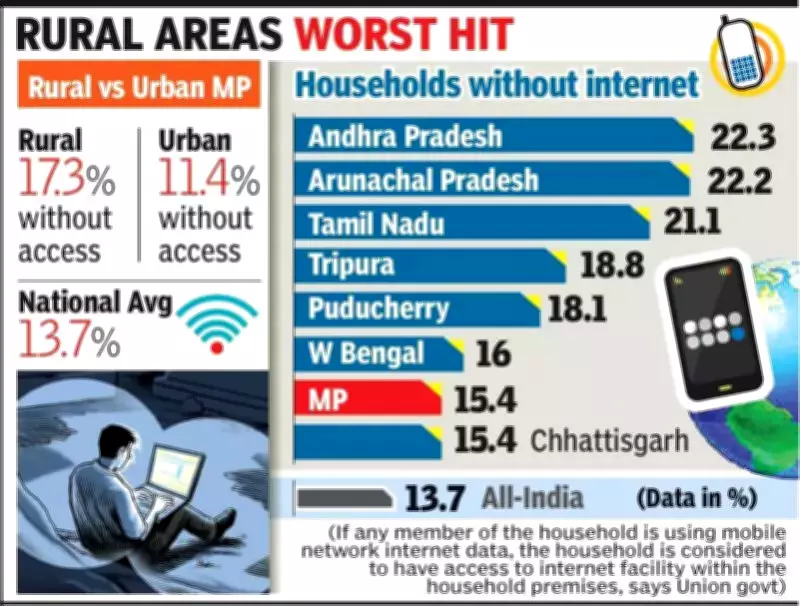
In a concerning revelation about digital infrastructure, Madhya Pradesh has emerged as one of the states with significant gaps in internet connectivity and smartphone penetration. According to recent government data, over 15% of households in the state do not possess a smartphone, highlighting a substantial digital divide that affects both rural and urban populations.
Alarming Statistics on Internet Connectivity
The data, shared by the Union Government in a written reply to the Rajya Sabha on January 29, indicates that Madhya Pradesh has the seventh lowest internet connectivity in India. Specifically, 15.4% of households in the state lack internet access entirely, whether through wired or wireless means. This percentage translates to approximately 22.5 lakh households out of the state's total 1.5 crore households being disconnected from the digital world.
Breaking down the figures further reveals a stark urban-rural disparity:

- Rural Madhya Pradesh: 17.3% of households are without internet facility.
- Urban Madhya Pradesh: 11.4% of households lack internet access.
This overall rate of 15.4% is slightly higher than the national average of 13.7%, underscoring the state's lag in digital inclusion efforts. The government's definition considers a household to have internet access if any member uses mobile network data within the premises, making the absence of connectivity in these households particularly significant.
Government Survey and Data Collection
The statistics were derived from the Comprehensive Modular Survey: Telecom (CMS:T), conducted by the National Statistics Office (NSO) under the Ministry of Statistics and Programme Implementation (MoSPI). This survey was part of the 80th round of the National Sample Survey (NSS), carried out from January to March 2025. It collected detailed data on mobile and internet usage at both household and individual levels, providing a comprehensive picture of digital access across states.
Minister of State for Communications and Rural Development, Pemmasani Chandra Sekhar, presented this state-wise data in Parliament, emphasizing the need for targeted interventions to bridge the digital gap.
Initiatives to Bridge the Digital Divide
In response to these findings, the government has outlined several measures aimed at ensuring universal access to reliable and affordable internet services. Key initiatives include:
- Digital Bharat Nidhi (DBN) funding: This program supports projects in underserved regions to enhance internet connectivity.
- Amended BharatNet program: Focused on providing broadband connectivity to all gram panchayats, this initiative aims to extend digital infrastructure to rural areas.
These efforts are crucial for Madhya Pradesh, where the lack of smartphones and internet access not only limits communication but also hinders access to essential services, education, and economic opportunities. As India advances digitally, addressing such disparities remains a priority for inclusive growth.