Noida's Electric Bus Ambitions Stalled as Delhi Charges Ahead
While Delhi has dramatically accelerated its transition to electric public transport, with e-buses now constituting approximately 40% of the Delhi Transport Corporation's daily ridership, Noida's journey toward cleaner mobility remains frustratingly slow and fragmented. Despite years of policy declarations, pilot initiatives, and announced rollout plans, Noida's electric vehicle adoption continues to be predominantly limited to cabs, private cars, and two-wheelers, with public transport electrification lagging significantly behind.
The Stark Numbers: A Glaring Contrast in EV Adoption
Transport department statistics reveal a telling disparity between the two urban centers. Noida boasts more than 12 lakh registered vehicles, yet electric vehicles account for a mere 2.5% of this total, translating to just 30,000 units. Breaking down these figures further, the city has over 500 electric taxis, 3,400 electric cars, 12,000 electric three-wheelers, 14,000 private electric cars, and a strikingly low count of only nine privately operated electric buses.
In stark contrast, Delhi's electric bus fleet has experienced exponential growth, expanding from around 300 vehicles in 2022 to an impressive 1,725 by 2026. This rapid scaling underscores Delhi's commitment to transforming its public transportation system, while Noida's efforts appear mired in planning and procedural delays.

Official Perspectives and Gradual Progress
Assistant Regional Transport Officer Nand Kumar acknowledged the gradual nature of electric vehicle uptake in Noida, noting that while registration processes have been slow, the government is actively offering exemptions in registration fees and working to expedite procedures. However, this incremental progress stands in sharp relief against the backdrop of multiple stalled e-bus proposals that have largely remained confined to paper.
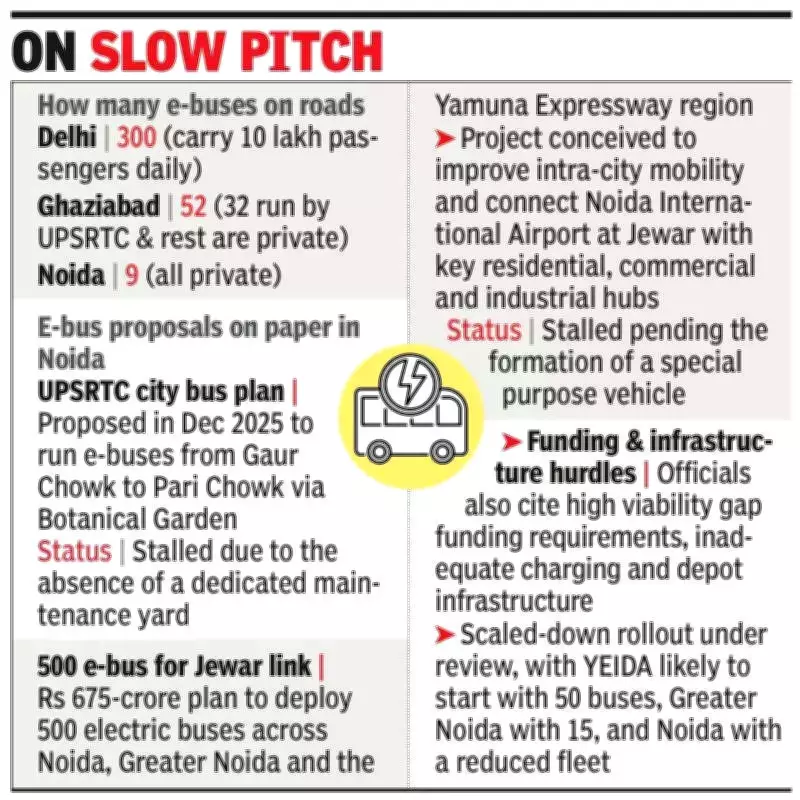
One such initiative involved the Uttar Pradesh State Road Transport Corporation and Switch Mobility, an electric bus manufacturer, proposing to operate city buses from Gaur Chowk to Pari Chowk via the Botanical Garden bus stand, covering approximately 40 kilometers. Despite an electric bus being stationed at the Morna depot, operational commencement has been delayed due to the absence of a dedicated maintenance yard. Currently, the UPSRTC's Noida depot operates 188 CNG buses, connecting Noida with Ghaziabad, Bulandshahr, Meerut, Agra, Aligarh, and long-distance routes to Lucknow and Dehradun.
Ambitious Plans and Persistent Roadblocks
A far more comprehensive proposal to deploy 500 electric buses across Noida, Greater Noida, and the Yamuna Expressway region has similarly encountered significant obstacles at the planning stage. This Rs 675-crore project, conceived to enhance intra-city connectivity and link the upcoming Noida International Airport in Jewar with major residential, commercial, and industrial hubs, hinges on the formation of a special purpose vehicle that has yet to materialize.
Officials have identified multiple challenges impeding this ambitious initiative, including concerns about the high viability gap funding burden, insufficient charging and depot infrastructure, and delays in establishing the SPV. The three industrial development authorities involved have shown reluctance to procure all 500 e-buses in a single phase, prompting a revised assessment approach.
Revised Strategies and Historical Caution
Under this modified strategy, the Yamuna Expressway Industrial Development Authority may commence with approximately 50 buses, Greater Noida with about 15, and Noida with a reduced fleet, rather than pursuing a large-scale simultaneous rollout. Originally proposed in 2024 and designed to operate on 25 routes—15 under Noida Authority, seven under Greater Noida, and the remainder in YEIDA areas—the project saw the Directorate of Urban Transport select two operators, Travel Time Mobility India and Delbus Mobility, to run services under a gross cost contract model in June of that year.

Historical experiences have contributed to the authorities' cautious approach. In 2016, the Noida Metro Rail Corporation launched 50 feeder buses to support metro services, only to scrap the project in 2020 due to low ridership averaging about 10,000 passengers daily, which generated revenues significantly below the monthly operating costs of Rs 3 crore.
Neighboring Progress and Private Sector Hesitation
Meanwhile, Ghaziabad has demonstrated relatively more advancement in electric bus adoption. UPSRTC currently operates 38 e-buses in the district, with an additional 14 services run by private operators. ARTO Ghaziabad Ashok Kumar Shrivastava reported that the district has approximately 8.5 lakh registered vehicles, including nearly 15,000 EVs excluding e-rickshaws, comprising more than 6,000 e-carts, 5,000 two-wheelers, 3,000 three-wheelers, 1,600 four-wheelers, and 52 buses. E-buses in Ghaziabad enjoy full exemption from registration fees and do not require permits, facilitating freer operation within the city.
UPSRTC Regional Manager KN Choudhary noted that while 10 of the 38 e-buses are currently operational from the Sahibabad bus depot, the remaining vehicles will become operational within a week as EV charging stations are being installed. However, private operators remain wary of entering the electric city bus market. Bus associations argue that such services are not financially viable without substantial government support, citing significant capital cost disparities.
Financial Realities and Infrastructure Gaps
Noida Bus Association president Sandeep Dhupar highlighted the economic challenges, noting that while a CNG bus costs around Rs 50 lakh, an electric bus approaches Rs 1 crore, making investment recovery difficult as corporate clients, private companies, and schools resist higher fares. He emphasized that Delhi's electric bus success is largely attributable to government funding.
Shyam Lal Gola, general secretary of the Delhi Interstate Bus Operators Sangh, further elaborated that e-buses can range from Rs 1 crore to Rs 1.8 crore, with costs remaining approximately double those of CNG buses despite announced subsidies and charging infrastructure. He pointed out that charging stations for private operators remain inadequate in both Delhi and Noida, concluding that without reduced capital costs and improved infrastructure, private investment is unlikely to materialize.
As Noida grapples with these multifaceted challenges, the contrast with Delhi's accelerating electric bus adoption becomes increasingly pronounced, highlighting the complex interplay of policy, infrastructure, and economic factors shaping India's urban transportation evolution.