

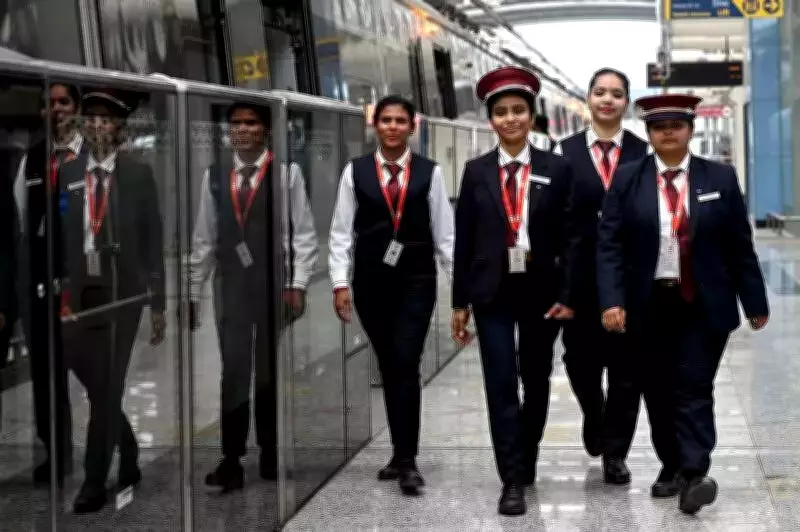
From Rural Roots to High-Speed Rails: Young Women Power India's Namo Bharat Trains
In a remarkable transformation, young women from the rural heartlands of Uttar Pradesh are now at the helm of one of India's most advanced transit systems. The Namo Bharat trains on the Delhi–Ghaziabad–Meerut RRTS corridor, designed to operate at speeds up to 160 kmph, are being driven by operators like 24-year-old Shivani, who once cycled to college from her family's farm in Bareilly.
Shivani's Journey: From Diploma to Driver's Cabin
After completing a diploma in electrical engineering, Shivani joined the Namo Bharat project without anticipating she would become a train operator. "I didn't know the job would involve operating trains. The responsibility came later, after medical and other tests," she shared. Despite never having driven a scooter or car, she now navigates a sophisticated semi high-speed system daily, covering 400–500 km. "Initially, I was scared and nervous. During training, some people would wonder how a petite girl like me could drive such a train. Today, I feel proud to operate it," she told TOI.
Priyanka Awasthi: Breaking Village Norms
Priyanka Awasthi, 25, from Unnao, has been steering Namo Bharat trains since the inaugural run in October 2023. As the first woman in her village to work outside it, she supports her family, including four younger siblings. Her father, a bus conductor, faces challenges with unpaid fares, motivating her to seek stable employment. "I used to think I'd do a job where payment is made first," she said. A cherished moment was when her family rode a train she drove, feeling immense pride. "They couldn't enter the operator's cabin, but they kept asking each other whether I was at the controls," she recalled.

Isha Dheerwan and Kanchan: Overcoming Adversity
Isha Dheerwan, 23, from Meerut, became the primary support for her family after her father's death two years ago. "As the eldest child, I took responsibility. Working here makes me feel proud that I'm breaking barriers," she stated. Kanchan, 24, from Modinagar, has operated trains for nearly a year, facing technical snags and delays. "The early months were tough, but I learned so much. The experience has made me stronger," she emphasized, highlighting that women can excel with dedication.
Poonam Verma and Aanchal Sharma: Dreams Realized on Rails
Poonam Verma, 24, from Azadpur in north Delhi, once aspired to be an air hostess but joined the Namo Bharat project after her father's accident for financial stability. As a train attendant, she ensures passenger safety and comfort. "I feel I'm living my dream by guiding children and assisting elderly passengers. Many senior citizens give blessings—that's the best part of my day," she said. Aanchal Sharma, 26, a former Delhi University student who commuted on the trains, now works on them. "Sometimes I find neighbours and relatives onboard. They're thrilled to see me," she noted.
Empowerment and Impact on the RRTS Corridor
Women now constitute nearly 30% of the operational staff on the Delhi–Ghaziabad–Meerut RRTS corridor, which reduces travel time from Delhi's Sarai Kale Khan to Meerut's Modipuram to just 58 minutes. This shift not only showcases technological adoption but also empowers rural women, transforming their lives and communities. Small gestures, like a passenger's thumbs-up, brighten their days, reinforcing their roles in India's transit evolution.






