

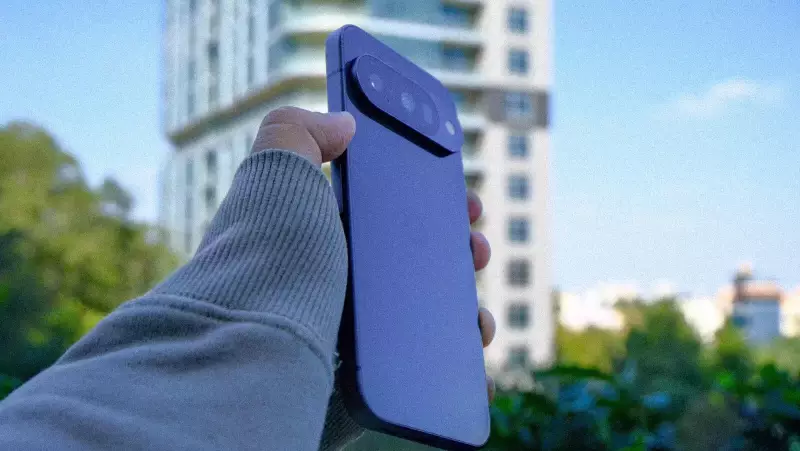
For years, Google's standard Pixel smartphone has lived in the shadow of its Pro sibling, feeling like a compromise for those who couldn't stretch their budget. The Google Pixel 10 aims to rewrite that narrative. Priced at Rs 79,999, it introduces significant upgrades like a telephoto camera and Qi2 charging, but also makes curious trade-offs. After extensive testing, does it finally stand as a confident flagship on its own merits for Indian users?
Design & Display: Familiar Yet Refined
The Pixel 10 retains the successful design language of its predecessor. It features a flat aluminium frame with a satin finish and a glass back, resulting in a solid, premium feel. The Obsidian (black) variant, however, is a fingerprint magnet. As the smallest in the Pixel 10 lineup, it remains highly pocketable and easy for one-handed use, though its screen bezels are noticeably thicker than the Pro models.
Durability is robust with Gorilla Glass Victus 2 on both sides and an IP68 rating for water resistance. A hidden but major upgrade is the integration of magnets in the back for Qi2 wireless charging and Pixelsnap. This system is fully compatible with MagSafe accessories, allowing wallets, chargers, and car mounts to snap on securely without a special case.

The 6.3-inch OLED display is a highlight. It's bright, vibrant, and sharp at 1080p resolution (422 PPI), with claimed peaks of 2,000 nits (high brightness) and 3,000 nits for HDR. The 120Hz refresh rate ensures smooth scrolling, but it lacks the Pro's LTPO technology, meaning it can't dynamically scale down to 1Hz for static content, impacting battery efficiency. Notably, the phone ships with the refresh rate set to 60Hz by default, requiring manual adjustment to 120Hz.
Performance & AI: Tensor G5's Mixed Bag
At its core lies the new Tensor G5 chipset. Google promises a 34% faster CPU and a 60% faster Neural Processing Unit (NPU). Day-to-day performance is snappy, with smooth app launches, multitasking aided by 12GB RAM, and fluid social media browsing. However, under sustained load—like playing Genshin Impact or using navigation outdoors—the phone gets warm, partly due to the absence of the vapor chamber cooling found in Pro models.
The AI experience, built around Gemini, is a central selling point. Gemini Live works well as a conversational assistant. However, many promised AI features feel half-baked for the Indian market. Call Screen arrived four months post-launch as a manual beta, supporting Hindi and English, but its utility is limited by the impatience of typical callers in India. The real-time translation feature notably does not support Hindi, a significant oversight. Features like Magic Cue, designed to surface contextual info, were largely inactive during testing.
It's crucial to note: most advanced AI features require a Google AI Pro subscription. The Pixel 10 includes six months free, after which users must pay a minimum of Rs 1,999 to continue access.
Cameras: A Step Forward, A Step Back
The camera system sees the biggest change. The Pixel 10 now has a triple-camera array, adding a 5x optical telephoto lens (10.8MP). The trade-off? The main and ultra-wide sensors have been downgraded to 48MP and 13MP units, similar to the mid-range Pixel 9a.
The main camera takes good photos in daylight with natural colours and solid dynamic range, but images are softer with less fine detail compared to previous Pixels or the Pro models. The ultra-wide struggles in low light, showing noise quickly. The telephoto is useful for portraits and bringing subjects closer, but lacks the high-res zoom of the Pros. Its 20x Super Res Zoom relies heavily on AI, with quality deteriorating significantly beyond 10x, especially in low light.

AI features dominate the camera experience. Best Take (for group photos) and the improved Add Me are practical. Magic Editor and conversational editing in Google Photos are powerful tools. However, Camera Coach, which suggests compositions, feels intrusive, replacing creative choice with AI instruction. Video performance is decent for static shots but shows stabilization wobble during motion, and it lacks the Pro's Video Boost feature.
Battery, Software & Verdict
The 4,970mAh battery delivers a full day with moderate use but demands a recharge by late afternoon under heavy loads. Charging is a weak point: 30W wired charging takes about 90 minutes for a full charge, while 15W Qi2 wireless charging exceeds three hours.
The phone runs Android 16, which feels more like thoughtful refinement than an overhaul. The Expressive design language, improved notification management, lock screen widgets, and Live Updates for deliveries enhance the experience. Google promises seven years of software updates, a major long-term value proposition.
So, does the Pixel 10 stand on its own? Mostly, yes. It makes a compelling case with its excellent display, solid design, useful telephoto, pure Android experience, and long-term support. The compromises—downgraded primary sensors, incomplete AI features for India, and average charging—are real. However, for Rs 79,999, it finally feels like a complete, confident flagship that doesn't just live in the Pro's shadow. It's a strong all-rounder for those seeking the core Pixel experience without the Pro price tag.





