

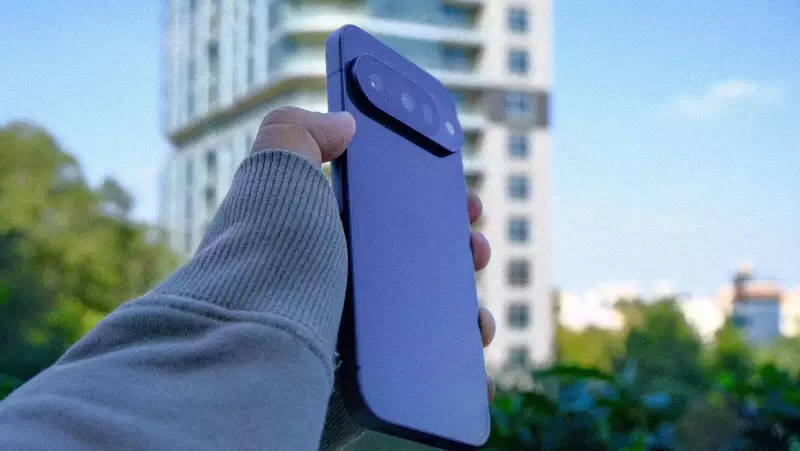
For years, the regular Google Pixel has lived in the shadow of its Pro sibling, often feeling like a slightly incomplete package. The launch of the Pixel 10 aims to rewrite that narrative. Priced at Rs 79,999, it brings significant upgrades like a proper telephoto camera and the new Tensor G5 chip, but also makes some surprising trade-offs. Does this finally make the standard Pixel a confident standalone flagship for the Indian market? We've used it for over three months to find out.
Design & Display: Familiar Yet Refined
The Pixel 10's design is nearly identical to its predecessor, the Pixel 9, and that's not a bad thing. Google perfected its aesthetic last year with flat edges, rounded corners, and the signature camera bar. The satin aluminium frame and glass back feel premium, though the glossy rear is a fingerprint magnet, especially in the Obsidian (black) colour. It remains the most pocket-friendly and one-hand-friendly model among the slab Pixels.
Durability is strong on paper with Gorilla Glass Victus 2 on both sides and an IP68 rating. However, the screen showed minor scratches more easily than expected during our testing. A hidden but major upgrade is the integration of Qi2 magnetic charging (Pixelsnap). This allows the phone to work seamlessly with MagSafe accessories like chargers, wallets, and car mounts without needing a special case.

The 6.3-inch OLED display is a highlight. It's bright, vibrant, and sharp at 1080p (422 PPI), with Google claiming up to 3,000 nits for HDR. Visibility in direct sunlight is excellent. The 120Hz refresh rate ensures smooth scrolling, but there's a catch: it's not an LTPO panel like the Pros. This means it can't dynamically scale down to 1Hz for static content, potentially impacting battery efficiency. Note that the phone ships with the refresh rate set to 60Hz by default, so users need to manually enable 120Hz.
Performance & AI: Tensor G5's Mixed Bag
At its core is Google's latest Tensor G5 chip paired with 12GB of RAM. Google promises a 34% faster CPU, and in daily use, the phone feels snappy for apps, multitasking, and browsing. However, under sustained load like gaming (Genshin Impact) or outdoor navigation, the phone gets noticeably warm, likely due to the absence of the vapor chamber cooling found in Pro models.
The chip's real strength is AI processing, with a neural unit claimed to be 60% faster. The Pixel 10 is packed with AI features, but their utility in India is inconsistent. Gemini works well as a conversational assistant. However, features like Magic Cue proved unreliable, failing to surface useful information proactively even after months of use.
Critical AI features for the Indian context are either missing or limited. The much-touted real-time translation does not support Hindi, a glaring omission. Call Screen arrived four months post-launch as a manual beta, supporting Hindi and English, but its utility is reduced by the impatience of typical callers in India. Call Notes is still "coming soon." Most of these premium AI features require a Google AI Pro subscription after the bundled six-month free trial, costing at least Rs 1,999 annually.
Beyond AI, Android 16 feels like thoughtful housekeeping. The Expressive design language refreshes the interface with bolder colours and smoother animations. Useful additions include Live updates for ride-shares, an Expanded Dark Mode, lock-screen widgets, and Advanced Protection—a security toggle bundling scam and phishing defences. Google's promise of seven years of software updates is a major long-term value.
Cameras: A Step Forward, A Step Back
The camera system sees the biggest change. The Pixel 10 finally gets a three-camera setup, adding a 5x optical telephoto lens (10.8MP). However, to accommodate it, Google downgraded the main and ultra-wide sensors to the 48MP and 13MP units from the mid-range Pixel 9a.

The main camera still takes good pictures in daylight with natural colours, but compared to the Pros or Pixel 9, images are softer with less fine detail. The ultra-wide performs adequately in good light but struggles with noise in dim scenes. The telephoto is useful for portraits and bringing subjects closer, but it lacks the high-res zoom of the Pros, maxing out at a 20x digital zoom where quality deteriorates significantly. Low-light performance across all sensors is noisier due to their smaller size.
AI camera features are a mixed bag. Best Take and the improved Add Me are practical for group photos. Magic Editor is genuinely useful for quick, powerful edits. However, Camera Coach, which suggests compositions, feels intrusive, replacing creative choice with AI instruction. Video quality is decent for static shots but shows stabilisation wobble during motion, and it lacks the Pro's Video Boost feature.
Battery Life & Verdict
The 4,970mAh battery delivers a full day with moderate use but demands a recharge by late afternoon under heavy loads. Charging is a weak point. Despite 30W wired charging support, a full charge takes about 90 minutes. The 15W Qi2 wireless charging is painfully slow (over 3 hours), though the magnetic snap functionality is highly convenient.
So, does the Pixel 10 stand on its own? Mostly, yes. It's a well-built, capable Android flagship with an excellent display, solid performance, and the purest software experience. The telephoto adds real value, and Pixelsnap is a great addition.
The compromises are clear: downgraded primary cameras, limited AI feature availability in India, and no LTPO display. If you've craved a telephoto lens without going Pro, the Pixel 10 makes sense. If you're an AI power user, wait for features to mature. For Rs 79,999, it finally feels like a confident, well-rounded flagship that can stand beside the Pros without seeming like a budget alternative.





