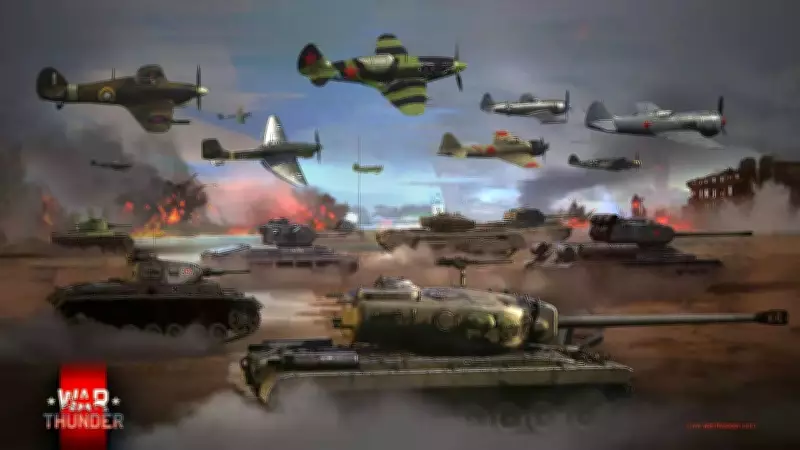
War Thunder Gameplay Mistaken for Real Iran-Israel Conflict Footage
European gaming company Gaijin Entertainment has officially responded to a video circulating online that was falsely presented as authentic combat footage from the ongoing tensions between Iran, the United States, and Israel. The footage, which shows thick black smoke rising after an alleged strike and claims to depict a US warship shooting down an Iranian fighter jet, has been widely shared across social media platforms as real conflict imagery.
Developer Confirms Video Game Origin
Konstantin Govorun, head of public relations for the Hungarian-based Gaijin Entertainment, confirmed in an email to Agence France-Presse that the viral clip appears to be from the company's military simulation game, War Thunder. "Yes, this looks like 'War Thunder' footage," Govorun stated, addressing the millions of views the video has accumulated on platforms like X (formerly Twitter) and Instagram.
An investigation by AFP revealed that the footage does not show contemporary military engagements but instead features historical assets from the game. The video depicts the USS Tennessee (BB-43), a battleship built in the early 20th century and later decommissioned, alongside a Messerschmitt Me 163B-1a Komet aircraft used during World War II. This anachronistic combination further confirms its origin as gameplay rather than real-world events.

Multiple Fake Videos Circulate During Middle East Conflict
A BBC report highlighted that this is not an isolated incident. Another widely shared video, which claims to show a US fighter jet evading Iranian missiles during the current conflict, has also been identified as War Thunder gameplay. The Instagram post alone has reportedly been viewed nearly 80 million times, with many users mistakenly accepting it as genuine combat footage.
The publication used reverse image search technology to trace the video's source, which led to a YouTube video featuring gameplay from a military simulation. This method confirmed that the viral content was not from an actual incident but originated from a video game.
Company's Stance on Misinformation
Gaijin Entertainment has explicitly stated that it does not support the use of its gameplay footage to spread misinformation. However, the developers acknowledged their limited ability to prevent such content from being reused once it is shared online. The company also indicated that other videos circulating online, purportedly showing scenes from the US-Israel-Iran conflict, are similarly sourced from War Thunder.
This situation underscores a growing concern: the hyper-realistic visuals in modern video games can sometimes be misinterpreted or repurposed, leading to public confusion about real-world events. The line between simulation and reality becomes increasingly blurred as gaming technology advances.
Broader Trend of Game Footage Misuse
Apart from War Thunder, footage from other video games has been circulated online and presented as authentic conflict imagery. Last year, as tensions escalated in the Middle East, clips from both Arma 3 and War Thunder were shared as propaganda. In some instances, the Israeli military had to intervene publicly to clarify that "the footage is fake."
Arma 3's particularly realistic graphics have made it a frequent target for such misuse. In 2023, the game's developers at Bohemia Interactive expressed their dismay, stating, "It's disheartening for us to see the game we all love being used in this way." This sentiment reflects the broader challenge faced by gaming companies as their creations are weaponized for disinformation campaigns.
The proliferation of such fake videos highlights the critical need for media literacy and verification in the digital age. As conflict reporting becomes increasingly susceptible to manipulation, consumers must exercise caution and rely on credible sources to distinguish between simulated gameplay and actual events.