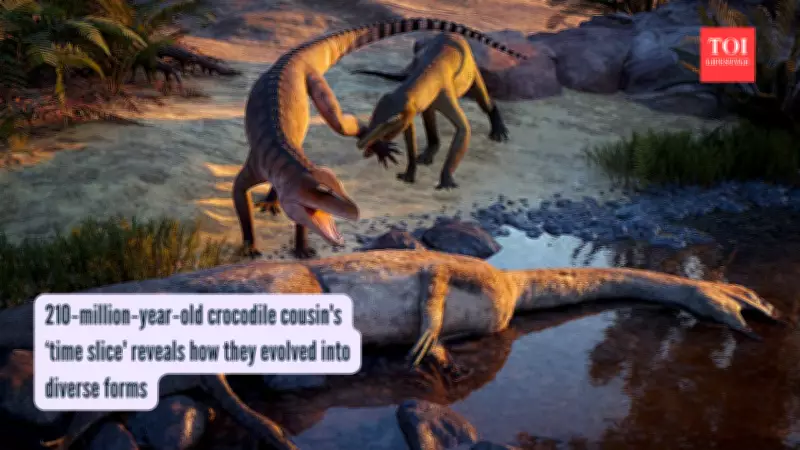
For about 210 million years, two crocodile-like cousins lay locked in stone, side by side, on a riverbank that would one day become northern New Mexico. When they died, they were ordinary predators in a humid, fern-filled world where dinosaurs had not yet taken over. Today, they are extraordinary, like a rare 'time slice' that lets scientists see how early crocodile relatives began diversifying long before crocodiles, as we know them, ever existed.
Two Crocodile Cousins Frozen in Time
In 1948, scientists discovered fossils of two crocodile relatives, about the size of jackals, standing side by side on a humid riverbank 210 million years ago. One of them, named Hesperosuchus agilis, had a long snout, slender arms, and strong back legs, built for quick movement on land and hunting near rivers and streams. Its partner, now named Eosphorosuchus lacrimosa, had a shorter snout, a stronger skull, and bigger jaw muscles that helped it bite down hard on larger animals. Even though they looked different, both were killed at the same time, probably by a sudden flash flood or mudslide that buried them together and kept their bones trapped in rock for millions of years.
A New Species from Old Museum Blocks
The fossils were excavated long ago from the Ghost Ranch deposits and have been part of the Peabody Museum of Natural History at Yale for decades, but researchers never fully studied them. 'I had been staring at this fossil for a while,' said Bhart-Anjan Bhullar, associate professor of Earth and planetary sciences in Yale's Faculty of Arts and Sciences, associate curator of vertebrate paleontology at the Peabody Museum, and senior author of the new study. 'For years, both Ghost Ranch crocs were thought to be examples of the same species, Hesperosuchus, but it looked like the Yale animal had a different facial structure,' he added. Using CT data, Margulis-Ohnuma digitally 'disassembled' the fossil, bone by bone, and found clear differences from known Hesperosuchus specimens, which led to the naming of Eosphorosuchus lacrimosa.

A 'Time Slice' from the Dawn of Crocodile Diversity
Eosphorosuchus is named after the Greek god Eosphorus, the 'dawn-bringer,' and the Greek word soukhos, meaning crocodile. 'Eosphorosuchus is one of only a handful of well-preserved early crocodile relatives, and its coexistence with Hesperosuchus represents the 'dawn' of functional diversification in the lineage that would give rise to modern crocodiles,' said Margulis-Ohnuma, first author of the study. According to the researchers, this 'time slice' shows that, even at this early stage, close relatives were already dividing up roles by adapting their feeding anatomy. Bhullar explained that the late Triassic was a period when 'two reptile dynasties vied for dominance: the line that would produce crocodiles and alligators on one side, and the line that would produce birds, which, of course, are dinosaurs, on the other.' At that time, dinosaurs were still slim, delicate, two-legged runners, while crocodile relatives were fast-running, low-slung, four-legged predators comparable to jackals or foxes.