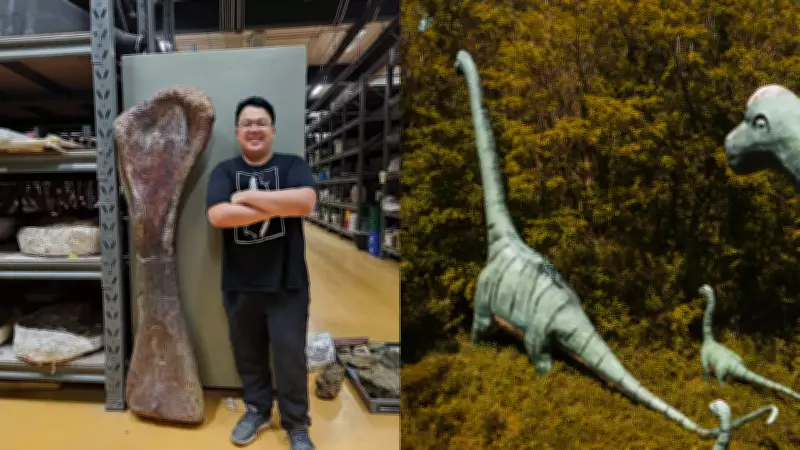
Scientists have confirmed the discovery of a massive 90-foot dinosaur in Thailand, marking the largest dinosaur ever found in Southeast Asia. The newly identified species, named Nagatitan chaiyaphumensis, is a giant sauropod that roamed the region approximately 113 million years ago during the Early Cretaceous period.
Discovery Details
Researchers from University College London, Mahasarakham University, and Thailand's Sirindhorn Museum estimate that the dinosaur weighed around 27 tonnes, equivalent to nine adult Asian elephants. The fossils were unearthed in Chaiyaphum province, offering valuable insights into dinosaur development and prehistoric environments.
Fossil Findings
The remains were initially discovered in 2016 by a local villager near a pond in northeastern Thailand. Excavations revealed vertebrae, ribs, pelvis fragments, and large limb bones, including a front leg bone measuring 1.78 meters in length. Nagatitan chaiyaphumensis belongs to the sauropod group—herbivorous dinosaurs characterized by long necks, tails, and towering bodies.

Scientific Significance
The study, published in Scientific Reports, highlights that the dinosaur lived in a warm, semi-arid climate with rivers, coniferous forests, and fern-covered floodplains. The region also housed crocodiles, fish, and predatory dinosaurs. Lead author Thitiwoot Sethapanichsakul of UCL emphasized that the dinosaur's immense size is among the most exciting aspects of the discovery.
Filling a Gap in Fossil Records
Scientists believe this find fills a critical gap in Southeast Asia's fossil records. While giant sauropod fossils have been found in South America and China, few have been identified in this region. The name Nagatitan chaiyaphumensis combines "Naga," a mythical snake from Southeast Asia, with "Titan," reflecting the creature's enormous size. The species name honors Chaiyaphum province, where the fossil was discovered.
Cultural and Geological Context
Nicknamed the "last titan," the dinosaur is considered remarkable because geological history suggests that such large dinosaurs could not have existed in the region due to rising sea levels millions of years ago. Palaeontologist Sita Manitkoon noted that initial bone measurements indicated this could be the largest dinosaur ever found in Southeast Asia.
Herbivorous Giant
Despite its massive body, Nagatitan chaiyaphumensis was a herbivore. Its long neck likely allowed it to feed on high-altitude plants like conifers and ferns, while its large size provided protection from predators. The dinosaur belongs to a sauropod subfamily with pneumatic skeletons, enabling such enormous growth.
Future Implications
This discovery is generating global interest, expanding knowledge about dinosaur migration and evolution across ancient continents. Experts believe it will spur further excavations in Thailand and neighboring regions. The giant dinosaur serves as a reminder that Southeast Asia still holds many prehistoric secrets beneath its soil.