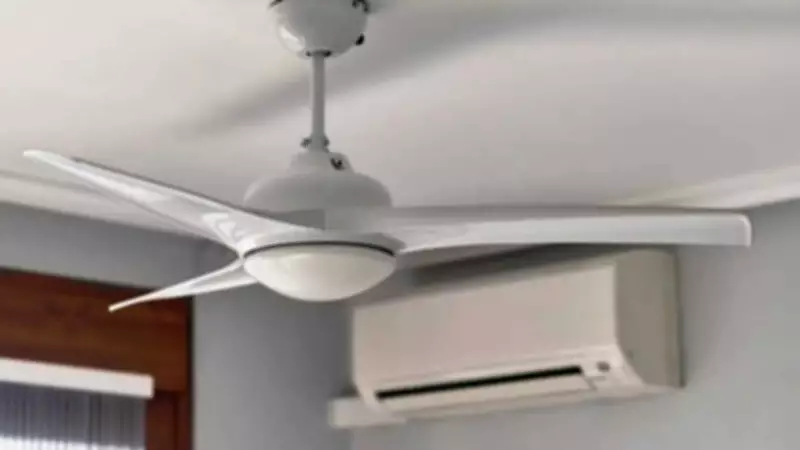
In view of growing electricity expenses for beating the heat, this age-old debate becomes more relevant today than ever before. Despite being similar in purpose and principle, fans and air conditioners differ vastly in terms of electricity consumption. Professionals believe that the discrepancy here is so big that it can influence the consumer's monthly bills considerably. Knowing the extent of electricity consumption by both devices will allow you to choose the right cooling appliance without compromising your comfort.
Basic Power Consumption Differentials
At their very core, air conditioners and fans differ greatly in power consumption rate. An ordinary ceiling fan consumes about 50 to 80 watts of energy hourly. Air conditioners, in turn, use from 1,000 to 2,500 watts in the same time span. Thus, an air conditioner can consume 30 times as much electricity as a ceiling fan does per hour. As a result, air conditioners belong among the biggest household electricity consumers.
Reasons Behind the Higher Power Consumption Rate in ACs
The reason why an air conditioner consumes so much power lies in its mode of operation. An air conditioner is a device that actively cools a room by absorbing excess heat using chemical substances, pumps, and other cooling mechanisms. Unlike fans, which merely circulate room air to keep you cool, air conditioners cool air actively, resulting in greater consumption of electrical power. In extreme heat, AC consumes more electricity since its compressor works nonstop.

Efficiency of Fan Cooling Appliances
On the contrary, fans use significantly less electricity because they do not actively cool air. They create airflow around your body to promote sweat evaporation and achieve the desired effects. As a result, the energy required to power an ordinary fan ranges from 50 to 100 watts, regardless of rotation speed. Fans thus belong among the most energy-efficient cooling devices in everyday life.
Influence of ACs and Fans on Monthly Bills
In practice, this difference results in higher electricity bills for those who own an AC. If an air conditioner runs for eight hours daily, it causes sharp increases in the electricity bill, which amounts to several thousand rupees. Running a fan for a similar amount of time barely leaves any trace on your utility bills. Therefore, if you have an AC at home, your electricity expenses will rise in summer.
Energy Efficiency Ratings for Different Appliances
Many air conditioners now carry energy efficiency ratings, which specify their power consumption. A 5-star rating, for instance, signifies that a particular model consumes less power than less efficient models. Even in the best cases, however, it still requires a few times more energy than a fan does. Similarly, fans have started featuring BLDC motors that minimize their already modest power demands.
Impact on the Environment of ACs and Fans
It is well known that generating electricity is usually associated with burning fossil fuels. The greater energy consumption rate by air conditioners thus means a greater carbon footprint is created by such devices. Fans require relatively little electricity and, consequently, have a rather limited environmental effect. Using a fan thus becomes a good way of saving on cooling while protecting our environment from pollution.
The Final Word on Who Uses More Electricity
The final verdict is rather obvious: a ceiling fan consumes far less energy than an air conditioner does. Still, an AC has certain benefits over a fan since it provides better cooling in extreme heat. You should be ready, however, for significantly higher electricity bills if you decide to rely on air conditioning in the summer months.