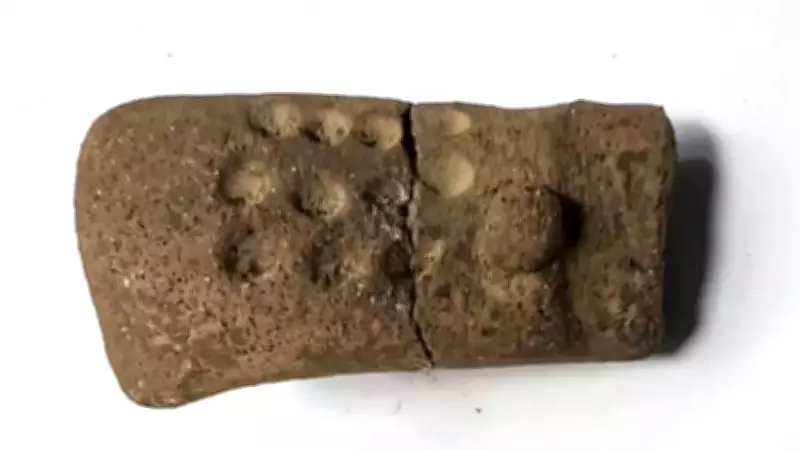
A small fragment of fired clay, no larger than a hand, is drawing attention away from the grand stone monuments typically linked to ancient Mesoamerica. Discovered decades ago among the remains of the La Blanca archaeological site in Guatemala, this object was once part of a network of early towns along the Pacific coast. At first glance, it appears unremarkable: a broken figurine with a flattened upper section and a face that never formed realistically. However, on that upper surface lie eleven shallow impressions, pressed into the clay before firing. These quiet, deliberate marks do not resemble typical decoration, raising questions about whether they counted something or reflected a thinking process that predates writing as we know it.
Tab Figurines of La Blanca: The Missing Facial Identity
A study published by researchers Julia Guernsey, Stephanie M. Strauss, and Michael Love in Cambridge University Press, titled 'Numbers and Bodies: Potential Early Numeration on a Middle Preclassic Figurine from La Blanca, Guatemala,' identifies the object as a tab figurine common at La Blanca during the Middle Preclassic period. These figurines typically show bodies without distinct faces, as if identity were meant to be added elsewhere or not tied to facial features. This example follows that pattern, with a flat projection for a head rather than a naturalistic form.
The standout feature is the cluster of dots on the upper surface: eleven in total. They were not scratched or painted after firing but pressed into the soft clay. The layout is uneven yet deliberate: three on one side, four in the middle, and four on the other. This arrangement suggests order rather than random scattering.

From Household Debris to History: Everyday Life at La Blanca
La Blanca was not a marginal settlement. Between roughly 1000 and 650 BC, it functioned as a local center with household compounds, structured neighborhoods, and steady production of small ceramic figures. Many figurines were broken before burial, and not all breakage appears accidental.
The dotted figurine was not found in a temple or offering cache but in a domestic area near the site's core architecture, among broken pottery, obsidian flakes, and everyday debris. This context shifts the object away from elite display toward household life. Thousands of figurine fragments have been recovered from La Blanca, mostly from refuse layers rather than carefully arranged deposits. Only a few survive intact, indicating repetitive use, possibly routine but not necessarily gentle.
The layer where this piece was found dates to around 650 BC, though the figurine likely predates that slightly, pushing it back to about 750 BC. This period saw many Mesoamerican societies still working out how symbols, numbers, and identity could be fixed into durable forms.
The Odd Business of Eleven Marks
Eleven is not a decorative number that repeats in ancient design systems, which is why this fragment has drawn attention. The impressions are asymmetrical and do not resolve into a purely ornamental pattern. If balance were intended, ten or twelve dots might have been chosen, or mirrored spacing. Instead, there is an awkward total held together by placement rather than symmetry.
As reported by Arkeonews, later Mesoamerican systems, especially among Maya and related cultures, used a dot-and-bar method where dots represented units and bars represented fives. No such formal structure is visible here—only dots, with no bars or obvious grouping devices beyond the arrangement itself. The possibility remains that eleven was meant as a count, not a symbol or decoration. However, ambiguity persists: a dot can be a number, a bead, a seed, a mark of emphasis, or something more abstract.

Numbers Before Writing Settles Down
Across Mesoamerica, counting systems and early writing did not evolve in a clean sequence; they grew alongside each other, sometimes overlapping. Long before fully formed inscriptions appear, there are scattered hints: grouped dots on carved objects, repeated marks on seals, and painted sequences that might be numerical. The earliest widely accepted calendar notation comes from much later, including fragments at sites such as San Bartolo showing named days tied to a numbered system. By then, numbers had become embedded in ritual calendars, tied to cycles of 13 and 20, shaping how time was structured.
Bodies, Identity, and Where Numbers Might Sit
The placement of the dots is significant: they are concentrated where a face or headdress would normally be expected. In later Mesoamerican art, this region of the body often declares identity through names, titles, or symbols of rank. There is also a broader thread in Mesoamerican thought about the body as a counting device. Fingers, toes, and limb structure often inform numerical systems. In some later languages, the concept of a complete person links conceptually to twenty, the total of digits on hands and feet. Whether this thinking existed in recognizable form this early is unconfirmed, but body-based counting was clearly available.
Fragments, Breaks, and Unfinished Meanings
La Blanca's figurines rarely survive intact; most are found in pieces, and the breakage pattern is consistent enough to suggest deliberate action in some cases. Whether this indicates ritual destruction, everyday discard, or something in between remains open to interpretation. This figurine, with its eleven enigmatic marks, offers a glimpse into early attempts to quantify and record, long before writing systems formalized such practices.