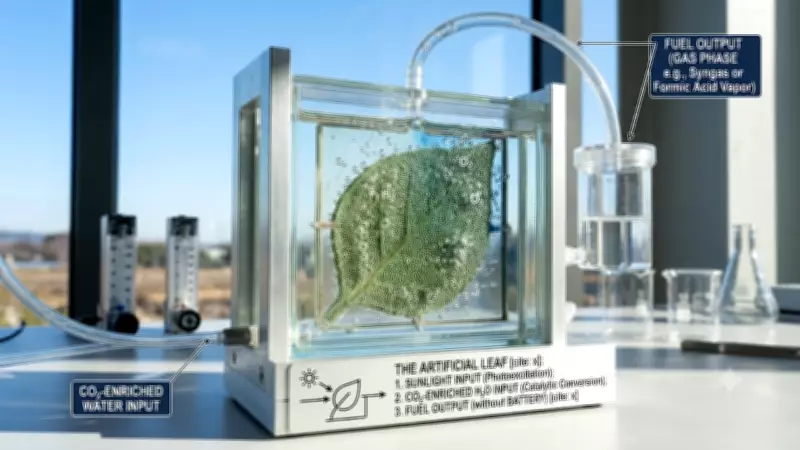
For decades, scientists have pursued a technological equivalent of a leaf: a device capable of capturing sunlight and transforming carbon dioxide and water into useful fuels. While significant advances have been made, most artificial photosynthesis systems have depended on batteries, electronic controllers, or external power management to maintain stable operation. Researchers at Osaka Metropolitan University have now taken a major step towards overcoming that challenge. Their newly developed battery-free artificial photosynthesis system can continuously convert sunlight, water, and carbon dioxide into formic acid, a valuable liquid fuel and energy-storage chemical, without relying on costly battery-based control mechanisms. The innovation could simplify solar fuel production, reduce system costs, and bring artificial photosynthesis closer to practical deployment in real-world energy infrastructure.
How the Self-Regulating Artificial Leaf Converts Carbon Dioxide into Usable Fuel
Artificial photosynthesis seeks to replicate the natural process used by plants, where sunlight drives chemical reactions that convert carbon dioxide and water into energy-rich compounds. In engineered systems, this usually involves photovoltaic cells supplying electricity to an electrolyser that produces fuel. The challenge is that solar power fluctuates throughout the day. To compensate, many systems require batteries or sophisticated electronic controllers to stabilise voltage and maintain fuel production. The Osaka Metropolitan University team redesigned the electrolyser itself, integrating a self-regulating chemical component that automatically responds to changing solar conditions. This approach eliminates the need for battery-powered control systems while maintaining stable fuel generation.
According to the university's research announcement, one of the primary goals of the proposed "chemical MPPT system" is to eliminate the redundancy and cost associated with conventional electronic MPPT systems, which typically require a battery as a storage component. Instead of using a battery, the device’s control and peripheral components are powered directly by the solar panels:

- Direct PV Powering: The electricity required for the pumps, pump controller, latching solenoid valve, and the microprocessor is provided by a buck-boost DC/DC converter.
- Parallel Connection: This converter is connected to the photovoltaic (PV) array panel in parallel with the electrolysers themselves.
- Low Power Consumption: The system utilises low-power-consumption components, such as piezoelectric pumps and a low-power microprocessor, to minimise the energy drawn from the PV array.
The result is a more streamlined architecture that reduces both complexity and cost while preserving operational stability across varying levels of sunlight.
Turning Carbon Dioxide into Formic Acid Using Only Sunlight
The battery-free system produces formic acid, a carbon-based liquid that can function as both a fuel and an energy carrier. Formic acid is attracting growing interest because it stores hydrogen in a stable liquid form and can be produced directly from captured carbon dioxide. In the Osaka system, solar-generated electricity drives electrochemical reactions that combine carbon dioxide and water, creating formic acid while storing solar energy in chemical bonds. Because the system can self-adjust to changes in sunlight, fuel production continues without external electronic intervention.
The device converts carbon dioxide (CO2) and pure water into a pure aqueous formic acid solution through an electrochemical process powered by solar energy. This conversion is achieved using a specialised three-compartment electrolyser designed for stand-alone, unmanned operation. The achievement reflects a broader trend in artificial photosynthesis research. Recent studies have demonstrated increasingly efficient solar-fuel systems capable of converting carbon dioxide into methane, methanol, hydrogen and other energy-rich compounds using sunlight as the sole energy source.

A Step Towards Practical Solar Fuels at Scale
The significance of the Osaka breakthrough lies not only in fuel production but also in system simplification. Batteries remain among the most expensive and maintenance-intensive components in renewable energy systems. Removing them could improve durability, reduce deployment costs, and simplify operation in remote locations. While the project was developed at the Research Centre for Artificial Photosynthesis at Osaka Metropolitan University and tested in Sugimoto, Osaka, Japan, in May 2024, the source material focuses on the technical details of the chemical maximum-power-point tracking (MPPT) system and its performance in producing formic acid.
Researchers demonstrated the system's performance by generating sufficient power to operate a display installation at Expo 2025 Osaka, highlighting its ability to function under practical conditions rather than purely controlled laboratory environments. The development arrives alongside several major advances in artificial photosynthesis. A Yale-led team recently reported a standalone artificial leaf that converts sunlight, water and carbon dioxide directly into methanol with record efficiency, while other researchers have demonstrated new methods for improving solar-driven carbon dioxide reduction through advanced photocatalytic materials.
As energy systems increasingly seek ways to store intermittent solar power in chemical form, battery-free artificial photosynthesis may offer a practical route towards carbon-neutral fuels produced directly from sunlight and atmospheric carbon dioxide. Instead of merely generating electricity, future solar technologies could manufacture transportable fuels, effectively turning sunlight into a storable energy resource.