

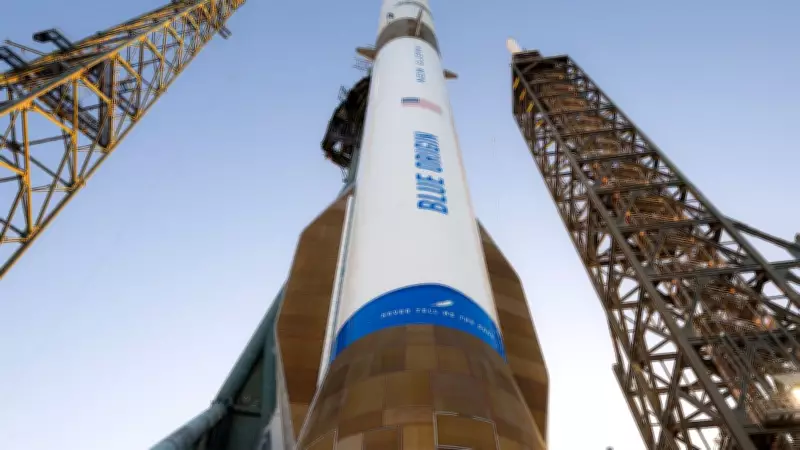
Blue Origin Shifts Focus from Space Tourism to Lunar Exploration
In a significant strategic move, Blue Origin, the aerospace manufacturer and spaceflight services company founded by billionaire Jeff Bezos, has announced a temporary halt to its New Shepard space tourism operations. The company revealed on Friday that it will pause launches of the New Shepard rocket for a minimum of two years, redirecting its efforts towards supporting NASA's ambitious Artemis program aimed at returning astronauts to the Moon.
New Shepard's Legacy and Hiatus
The New Shepard rocket, a small and reusable suborbital vehicle, has been instrumental in Blue Origin's foray into space tourism. Since its inception, it has conducted 38 successful flights, launching from the company's facility in West Texas. Notable passengers have included celebrities such as William Shatner, Michael Strahan, and Katy Perry, as well as historical figures like Wally Funk and Edward Dwight, who were pioneers in early space exploration efforts.
This rocket operates on a vertical takeoff and landing system, providing a brief journey to the edge of space—defined as an altitude above 62 miles—where passengers experience a few minutes of weightlessness before descending via parachute. To date, Blue Origin has transported 98 individuals on these flights, with some being repeat customers, all earning the prestigious title of astronauts.

Backlog and Financial Considerations
Despite the pause, Blue Origin confirmed that it has a substantial backlog of customers eagerly awaiting seats on New Shepard, stretching several years into the future. The company has never publicly disclosed the ticket prices for these flights, but estimates suggest that if an average seat cost around $1 million, the total revenue from the 98 passengers would be less than $100 million. This figure is relatively modest compared to Blue Origin's lucrative NASA contract, valued at $3.4 billion, for developing lunar landers as part of the Artemis missions.
Focus on NASA's Artemis Program
Blue Origin's decision to suspend New Shepard launches is driven by its commitment to NASA's Artemis program. The company holds a contract to supply landers for Artemis V, a mission likely scheduled for the 2030s. However, recent developments have prompted NASA to request accelerated efforts from both Blue Origin and SpaceX to expedite the development of landers for the earlier Artemis III mission. NASA Administrator Jared Isaacman emphasized the urgency, stating that the agency is pursuing multiple acceleration paths in parallel to meet the goal of launching Artemis III by the end of 2028, as targeted by President Donald Trump.
Challenges in the Space Tourism Sector
The pause in New Shepard operations highlights broader challenges within the suborbital space tourism industry. Both Blue Origin and Virgin Galactic, founded by Richard Branson, have struggled to ramp up launch frequencies, leaving many potential tourists grounded. In 2024, Virgin Galactic also halted flights of its operational space plane to focus on manufacturing next-generation vehicles designed for higher capacity and increased frequency. Virgin Galactic aims to resume operations with these new models later this year.
Technological Contributions and Future Prospects
Despite the hiatus, New Shepard has played a crucial role in advancing Blue Origin's technological capabilities. The rocket's engine design has been adapted for use in the second stage of the larger New Glenn rocket, and the experience gained from landing New Shepard boosters contributed to the successful landing of a New Glenn booster on a floating barge last year. This technological synergy underscores Blue Origin's long-term vision of integrating lessons from its tourism ventures into more ambitious space exploration projects.
As Blue Origin pivots towards lunar missions, the future of space tourism remains uncertain, but the company's strategic shift underscores its dedication to pushing the boundaries of human spaceflight beyond Earth's orbit.






