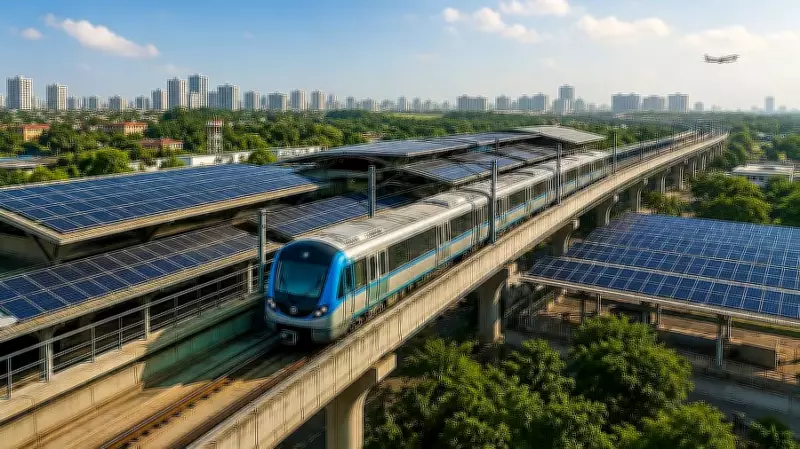
The Bangalore Metro Rail Corporation Limited (BMRCL) has stated that running the metro entirely on solar power would require significant policy and infrastructure changes. The Blue Line, scheduled for completion by December 2027, is projected to become one of Karnataka's largest public infrastructure electricity consumers, with an annual demand of 152 GWh under full operations.
Challenges in Achieving Solar-Powered Metro
BMRCL officials highlighted that while solar energy is a viable renewable source, integrating it fully into metro operations poses challenges. The intermittent nature of solar power requires robust energy storage systems and grid connectivity to ensure uninterrupted service. Policy support is needed to facilitate land acquisition for solar farms and to streamline approvals for renewable energy projects.
Blue Line's Energy Demand
The Blue Line, once operational, will be a major electricity consumer. Its annual energy requirement of 152 GWh is comparable to the consumption of a small city. To meet this demand entirely through solar power, BMRCL would need to install approximately 100 MW of solar capacity, along with battery storage systems to manage peak loads and night-time operations.

Infrastructure and Policy Requirements
Key infrastructure changes include upgrading the power distribution network to handle bidirectional flow from solar installations and integrating smart grid technologies. Policy changes could involve net metering regulations, renewable purchase obligations, and financial incentives for metro corporations. BMRCL is currently in discussions with the Karnataka government and the Indian Institute of Science (IISc) to explore feasible solutions.
BMRCL's existing solar installations, such as those on depot roofs and station buildings, generate only a fraction of the metro's total energy needs. Scaling up would require large tracts of land, which is scarce in urban areas. Rooftop solar on metro stations and depots can contribute but cannot meet the entire demand.
Experts suggest a hybrid approach combining solar with other renewables like wind or purchasing green power from the grid. However, the high cost of battery storage remains a barrier. BMRCL is also exploring energy efficiency measures to reduce overall consumption.
The Blue Line's completion in 2027 will mark a significant milestone for Bengaluru's metro network. Achieving a 100% solar-powered metro would require coordinated efforts from policymakers, utility providers, and technology partners. BMRCL remains committed to sustainability but acknowledges the need for a phased transition.