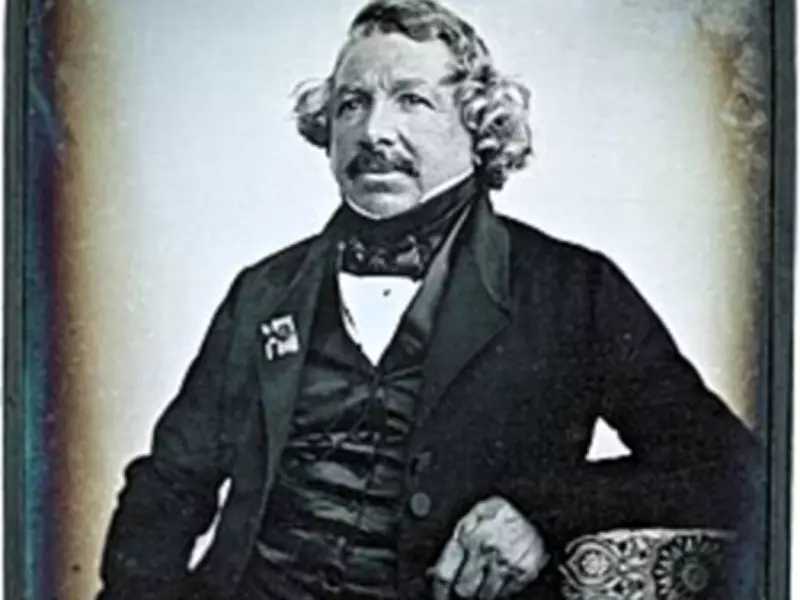
In the 1830s, in Paris, a discovery inside a wooden laboratory cabinet changed the way humans record history. Until that time, the only light perceived on a metal plate was a short, weak gleam that soon disappeared. Louis Daguerre had found a reliable method to make the invisible visible, creating the world's first practical photographic process: the daguerreotype.
Mercury Cabinet Magic
Simply letting a metal sheet darken in the sun was not a breakthrough. Instead, Daguerre's success came from a careful sequence of chemistry and light, culminating in a surprising reaction inside a wooden cabinet. By perfecting this multistep workflow, he transformed a fragile scientific experiment into a powerful means of recording the world in crystal-clear detail.
According to historical records from the Library of Congress, the process began with a silver-coated copper plate. The plate was sensitized with iodine and halogen vapors, making it sensitive to light. A camera was then used to capture an image. However, when the plate emerged from the camera, it appeared completely blank. The light had left only a faint, invisible mark called a latent image. To reveal the picture, the plate had to be placed in a special cabinet and exposed to fumes from heated liquid mercury. The hot mercury vapor rose and adhered to the light-struck areas of the silver plate, developing the hidden image into a sharp, high-contrast photograph. Without the mercury cabinet, the photograph remained trapped and unseen.

What Modern Science Tells Us
For a long time, Daguerre's story was considered a workplace legend. However, modern technology has allowed scientists to examine these antique plates up close, revealing exactly how they work at the microscopic level. A peer-reviewed paper in the Proceedings of the National Academy of Sciences explains that when light strikes the silver plate, it forms tiny clusters of silver atoms. When exposed to hot mercury vapor, these clusters develop into visible silver-mercury nanoparticles. This scientific analysis dispels the simple idea that the plate was stained or darkened by smoke. The chemistry shows that the image existed before anyone could see it. The mercury vapor did not invent the image; it merely provided the structure for the tiny silver particles to become visible to the human eye.
Changing the Way We See the World
This breakthrough made photography practical and repeatable. The mercury development process could be replicated consistently, yielding the same results each time. Photography could finally leave the laboratory and enter everyday public life. To nineteenth-century viewers, the resolution of the daguerreotype seemed almost magical. Portraits, buildings, and everyday scenes could be perfectly recorded without the subjective interpretation of a painter's brush. The final image, capturing light itself, carried a profound sense of truth—a real witness to a captured moment.
Daguerre's 1839 breakthrough solved the chronic problem of visibility. He captured a moment in time on a sheet of metal by exposing what was hidden inside a simple chemical cabinet. This practical process gave photography a permanent future, changing the way we preserve memories, trade goods, and view our history.