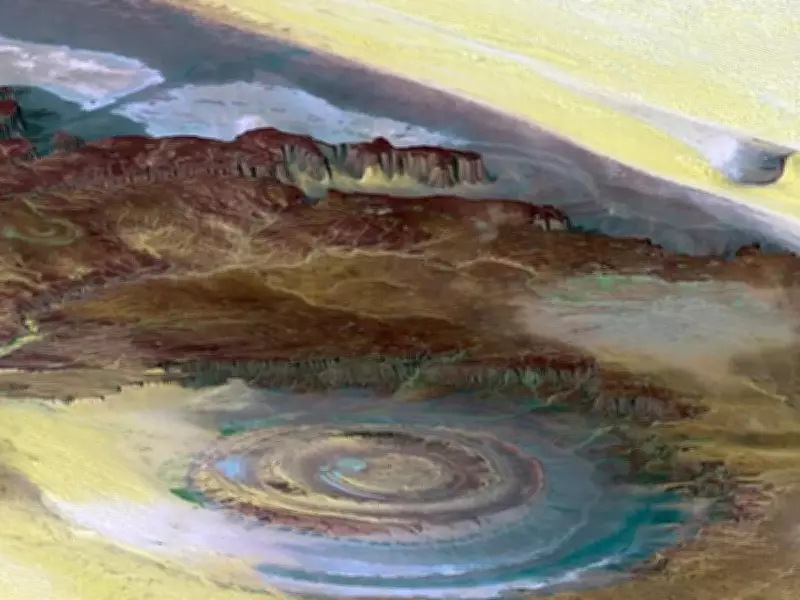
Astronauts aboard the International Space Station have spotted a remarkable landform in the Sahara Desert that resembles a giant eye gazing upward from Earth. Officially named the Richat Structure, this formation lies in Mauritania, as highlighted by NASA's Earth Observatory.
A Geological Marvel, Not a Crater
The Richat Structure spans approximately 25 to 30 miles in diameter, making it one of the most distinctive landforms visible from space. Its concentric rings appear almost perfectly proportioned, leading many to speculate that it resulted from a meteor impact. However, both NASA and geologists have dismissed this hypothesis. Impact craters typically exhibit shock waves and ejecta, which are absent here. Instead, the structure is a domed anticline, where layers of rock rose from beneath through geological processes. Over millions of years, erosion removed the upper layers, exposing the underlying rings. In such formations, older rocks are found near the center, while younger ones form outer circles, distinguishing it from impact craters.
Erosion's Role in Shaping the Rings
After the dome formed, differential erosion began. Different rock types eroded at varying rates: resistant rocks formed ridges, while softer rocks wore away faster, creating concentric circles. NASA notes that satellite images reveal diverse colors due to sedimentary and igneous rock variations. The Richat Structure serves as a navigational landmark for astronauts, who have used it since early space missions. A notable image was captured from the ISS on July 10, 2020, and enhanced by NASA for research.

Surrounding Dunes and Climate Insights
Endless sand dunes surround the structure, shaped by wind patterns. Longitudinal dunes align with prevailing winds, while transverse dunes form at right angles. Dunes may end abruptly near cliffs due to wind changes, revealing desert dynamics. The Sahara itself is crucial to global climate: NASA estimates 182 million tons of dust are released annually, with 27.7 million tons reaching the Amazon Basin, providing nutrients like phosphorus. The Saharan Air Layer travels worldwide, affecting air quality and weather, and contributes up to 60% of ocean productivity in some areas.
A Testament to Earth's Complexity
The Richat Structure exemplifies how appearances can deceive. What seems like a meteor scar is actually a geological masterpiece. The constantly moving dunes and globally dispersed dust highlight the desert's dynamism. Through NASA's observations and satellite data, scientists deepen their understanding of Earth's evolution. The TOI Science Desk, a team of journalists dedicated to science storytelling, brings such wonders to light, making complex topics accessible to all.