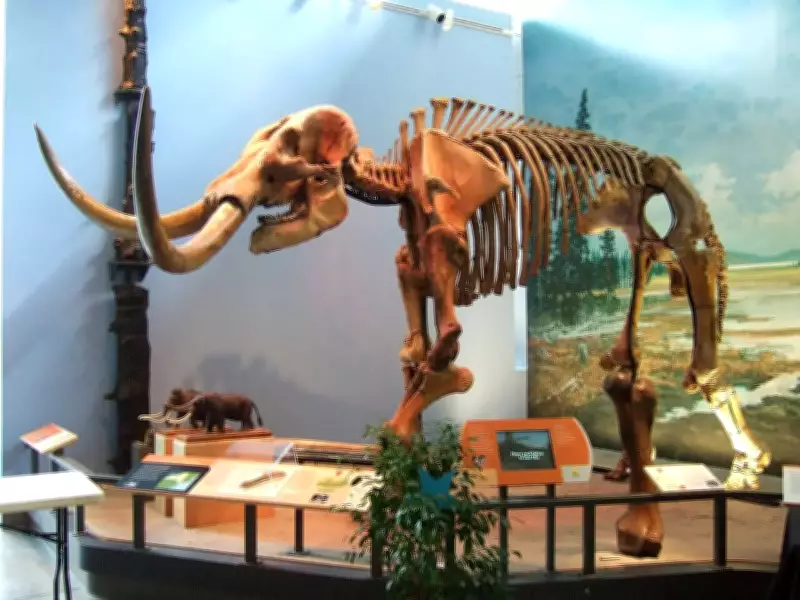
History often unfolds in the most unexpected settings. For John Masten, a farmer from Newburgh, New York, it began in the slimy marl pits on his land. In the last decade of the eighteenth century, farmers laboring in the dark, muddy pits discovered bones that resembled stones but were actually skeletal remains. It was immediately clear that these were not ordinary mammal bones. Among the finds was an enormous tooth resembling a brick and a femur bone towering over a fully grown man.
A Discovery That Captivated a Young Nation
At the time, the young United States was striving to prove it was more than a backwater colony. The unearthing of a giant, prehistoric "monster" in the New York wilderness provided precisely the evidence needed to demonstrate that America was home to grand and powerful things. News of the discovery traveled swiftly from the rural farm to the intellectual circles of Philadelphia, catching the attention of Charles Willson Peale, a renowned artist and polymath.
Peale's objective was not merely to collect the bones but to use them to establish America's first major museum. He acquired the bones from Masten for $200, along with a firearm. The retrieval process, however, was a monumental engineering challenge.

The Exhumation: A Feat of Engineering
In 1801, extracting a prehistoric animal from a swamp was no small task. According to Charles Willson Peale's Exhumation of the Mastodon, an article in the Smithsonian American Art Museum, a means of draining the constantly flooding pit was essential. Peale invented a gigantic wheel powered by manpower to drain the water. This marked one of the first major archaeological expeditions in America, a painstaking manual effort. Men worked around the clock in the mud, hoisting huge ribs and tusks using ropes and winches. The endeavor was so extraordinary that Peale immortalized it in a painting, illustrating the immense difficulty of dragging an Ice Age beast from the earth. More than simply unearthing fossils, it was proof that Americans were capable of discovering the ancient past.
Assembling the Beast: The First Mounted Fossil Exhibit
After cleaning the bones and transporting them to Philadelphia, Peale and his team faced the challenge of assembly. According to the historical document Account of the Skeleton of the Mammoth published by the Smithsonian Libraries and Archives, the skeleton from Newburgh became the world's first mounted fossil exhibit for public viewing. Since some bones were missing, the team used wood and papier-mache to complete the mammoth skeleton. When revealed, the skeleton amazed the world; there was nothing like it. At the time, it was classified as a "mammoth," though later science identified it as an American Mastodon.
The discovery settled a controversial issue of the era. Some European scientists argued that America's climate was "degenerate," producing tiny, feeble creatures. The mastodon from Newburgh provided a clear rebuttal. While today the mastodon is seen as a gentle plant-eater, back then it symbolized national power and the endless mysteries of the New World. This discovery illustrates how a single day's work on a farm can lead to a historic find, reminding us of other artifacts lying dormant just beneath the surface in rural areas.
This article is brought to you by the TOI Science Desk, a team of journalists dedicated to curating captivating news and features from the ever-evolving world of science. We strive to make science accessible and engaging for all readers.