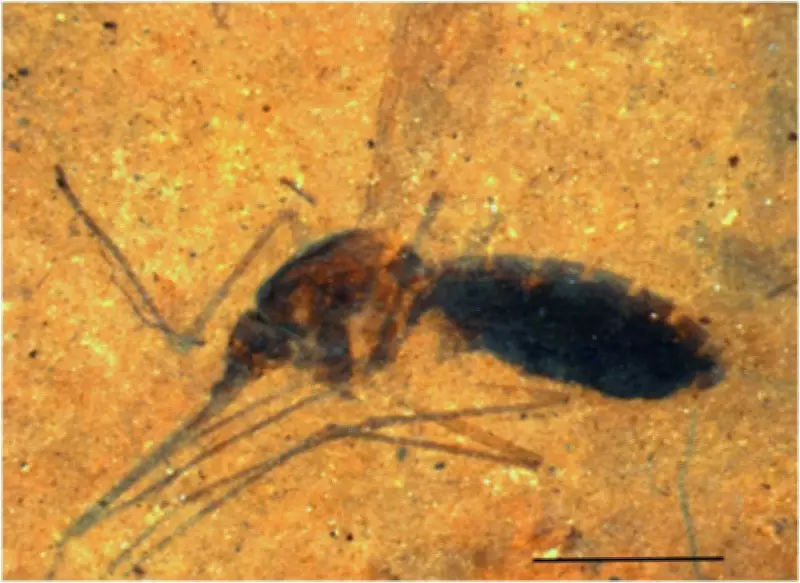
For decades, the notion of a prehistoric mosquito entombed in amber has shaped our perception of the past, largely due to Hollywood's allure of resurrecting these creatures. However, true science often delivers surprises that are both down-to-earth and awe-inspiring. Deep in a secluded corner of northwest Montana, a group of scientists stumbled upon something remarkable: a fossilized mosquito with its last meal intact. Unlike the classic amber preservation, this insect was perfectly preserved within layers of shale formed 46 million years ago during the Middle Eocene Epoch. Discovered in the Kishenehn Formation, a site famous for extraordinary fossilization, this specimen provides physical proof that blood-sucking by mosquitoes evolved long ago.
The Chemistry of a Prehistoric Dinner
While the insect itself is fascinating, the contents of its abdomen make the story extraordinary. During initial study, the team observed a dark, opaque substance within its belly. Chemical tests, detailed in a major study published in the Proceedings of the National Academy of Sciences, revealed high levels of iron and organic molecules known as porphyrins, specifically derived from hemoglobin. These chemicals proved that the mosquito had taken a final meal just before being swept into a lake and buried under sediment. This literal snapshot of a moment in time, frozen for 46 million years, offers direct evidence of blood-sucking behavior millions of years ago. The discovery provides a rare glimpse into prehistoric life and evolution, going beyond typical fossilized bones to preserve soft tissues and prey remains.
Classification and Evolutionary Significance
Another important study in Zootaxa enabled researchers to classify the insect into its proper family. After analyzing physical features, they concluded it belonged to the genus Culiseta, which still exists today. Despite dramatic changes over millions of years, the basic instincts of these creatures remain unchanged.

A Glimpse into the Past
Imagine Montana 46 million years ago: it was a subtropical region with numerous lakes and forests, not the jagged rocks and mountains of today. The mosquito likely flew across a humid canopy and fed on an extinct bird or mammal. Its preservation was a geological miracle, requiring perfect conditions. Most likely, the mosquito settled on a calm lake surface, sank, and was buried by silty sediment in an anaerobic environment that prevented decomposition. Over millions of years, pressure turned the silt into stone.
While this discovery is incredible, it does not bring us closer to building a prehistoric theme park. DNA is fragile and breaks down quickly, even under perfect conditions. The hemoglobin derivatives survived, but the genetic code of the creature the mosquito fed upon is long gone. However, we gain a deeper understanding of evolution, seeing how nature perfected blood-sucking early on and maintained it.
This tiny fossil is a humble testament to Earth's vast history beneath our feet, connecting our present environment to an ancient past. Each piece of evidence brings us closer to understanding the full story of life on Earth.