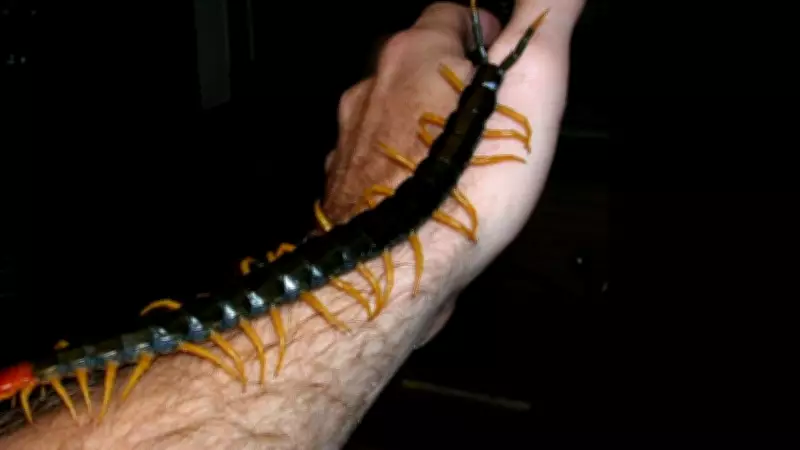
Deep in the rainforests of South America and the Caribbean lurks a creature that seems straight out of a horror movie. The Amazonian giant centipede, scientifically known as Scolopendra gigantea, is the largest centipede species on Earth, reaching lengths of over 30 centimeters (12 inches). That is roughly the size of a standard ruler. Despite its name, which means "one hundred feet," this arthropod possesses only 46 legs, a fact that is both surprising and somewhat reassuring. However, what truly makes this creature terrifying is not the number of legs but what it can accomplish with them.
Bat-Hunting Abilities
One of the most chilling behaviors of Scolopendra gigantea was documented in a 2005 study, later featured on BBC's Life in the Undergrowth. The research revealed that this centipede preys on three bat species in Venezuela: Mormoops megalophylla, Pteronotus davyi, and Leptonycteris curasoae. Rather than simply stumbling upon bats, the centipede actively hunts them. Like cave-dwelling spiders, giant centipedes are adept at climbing cave walls and ceilings to reach roosting bats. Even more impressively, they can catch bats mid-flight by hanging from the cave ceiling and snatching unsuspecting victims that fly within range. Imagine a ruler-sized centipede suspended upside down in total darkness, waiting to grab flying mammals out of the air. This is not mere survival behavior; it is tactical hunting.
Venom Designed for Overkill
To subdue prey larger than itself, the giant centipede relies on a potent venom. Centipedes possess a venom gland located in a modified leg pair beneath the head. The neurotoxic venom is injected through fang-like structures called forcipules, which also serve to seize prey. This precision delivery system has evolved specifically to immobilize creatures that would normally be too dangerous to tackle. According to Greg Edgecombe, a centipede expert at the Natural History Museum in London, a bite from this carnivorous arthropod would undoubtedly be painful to humans. While centipede bites are rarely fatal to humans, the pain can be intense, accompanied by local swelling.

Diet and Feeding Habits
As a carnivore, the Amazonian giant centipede can overpower and kill a wide range of prey. Its diet includes large insects, spiders, small vertebrates such as lizards, frogs, and mice, and even other centipedes. The centipede is a generalist feeder, meaning it takes advantage of any appropriately sized prey it encounters. This includes tarantulas and small snakes, making it a formidable predator in its ecosystem.
Why It Matters
What makes Scolopendra gigantea genuinely unsettling is not its deadliness to humans (most large centipedes are not regular killers of people), but rather its evolutionary adaptations. It has developed a hunting strategy optimized for challenges that seem beyond its scale. It did not just grow larger; it became more intelligent in its approach. It learned to hunt flying prey in caves, developed venom effective against vertebrates, and became an efficient killer of animals that typically have no business being preyed upon by arthropods. This creature is a testament to the terrifying ingenuity of evolution.