

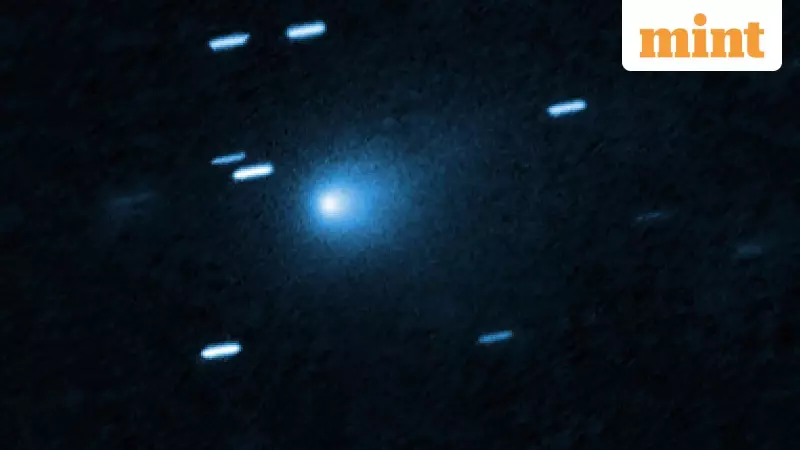
In an exciting development for astronomy, researcher Qicheng Zhang has successfully captured new images of the interstellar comet 3I/ATLAS, revealing its brilliant green glow and a cleverly hidden tail. This observation marks the comet's reappearance after it passed behind the Sun on October 29.
The Green Glow of an Interstellar Visitor
According to reports, Qicheng Zhang, a researcher at the prestigious Lowell Observatory in Arizona, used the facility's powerful Discovery Telescope to make these fresh observations on Wednesday, November 5. The comet had just become visible again after completing its journey around the far side of our star.
The captivating green colour is not just for show; it has a specific scientific explanation. Zhang employed a special filter to detect the presence of diatomic carbon (C2) particles, which are known to emit a green glow. He explained that comets like 3I/ATLAS contain a host of large molecules made of carbon and hydrogen, known as hydrocarbons.

When the comet ventures close to the Sun, intense ultraviolet (UV) light breaks these complex molecules apart. "It's sort of for the same reason that if we stay out in the sun too long without sunscreen, we get sunburnt," Zhang told Live Science. "The UV rays are destroying our DNA [in our skin cells], which is kind of a similar type of molecule in the sense that it's big and contains carbon." This process releases diatomic carbon, which is easily detectable by astronomers and creates the comet's stunning green aura.
Unraveling the Mystery of the Hidden Tail
At first glance, the new images seem to show a comet without its characteristic dust tail. However, this is an illusion. Zhang clarified that the tail is very much present but is being observed from a unique angle.
If one looks closely, the left side of the comet appears slightly brighter than the right. This slight asymmetric glow occurs because we are viewing the tail almost head-on. The tail is positioned directly behind the comet, curving slightly towards the left from our perspective on Earth. In other words, the comet's apparent lack of a tail is simply a trick of perspective and not a reason for scientific excitement.
These observations provide invaluable data about the composition and behaviour of objects visiting our solar system from interstellar space, continuing to fuel the curiosity of scientists and stargazers alike.






