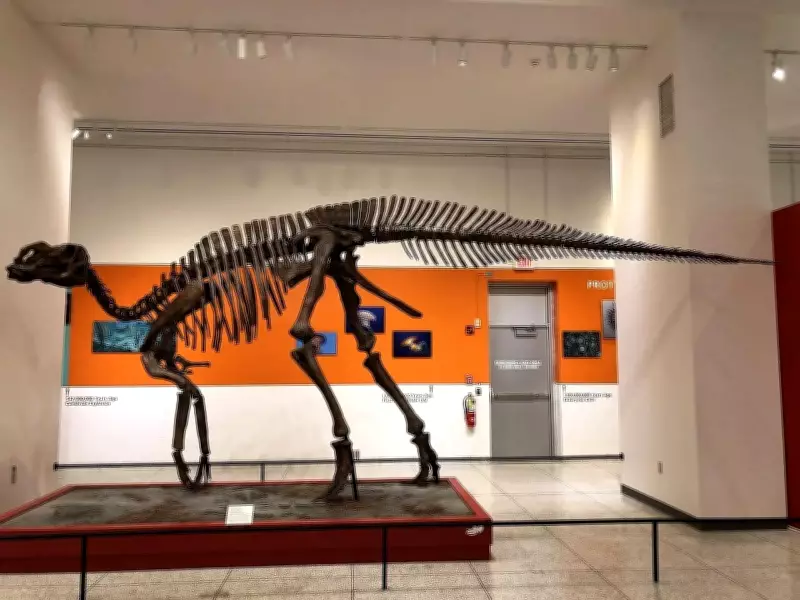
A major scientific discovery in paleontological history occurred long before any official team explored the fossil beds of the American West. In the fall of 1838, farm laborers digging in a quarry in Haddonfield, New Jersey, struck a massive petrified layer while extracting marl, a fertile mud used as fertilizer. They unearthed colossal, dark bones that seemed alien compared to any modern animal. Instead of reporting the find, they kept the fossils and allowed visitors to take samples as souvenirs.
Two decades later, naturalist William Parker Foulke learned of the legendary pit behind a property owner's house. He organized an excavation and discovered a spectacularly beautiful beast that would transform science: Hadrosaurus foulkii. According to the Rutgers University Geology Museum document The Story of New Jersey's State Fossil: Hadrosaurus foulkii, this skeleton was the first mostly complete one ever unearthed in North America. Before this, paleontologists relied on isolated teeth, jaw fragments, or single ribs from Europe.
Revolutionizing Dinosaur Reconstruction
The skeleton's completeness allowed anatomists to move from speculation to accurate reconstruction. As explained in the National Park Service article They Once Roamed Here, the findings proved that these animals were not clumsy, four-legged lizards like crocodiles. Instead, their long hind legs and short front limbs indicated they were advanced bipedal creatures resembling birds, standing and walking on two feet. This discovery revolutionized scientific understanding, proving dinosaurs were bipedal and highlighting the rich prehistoric life beneath our feet.

The Legacy of a Suburban Cretaceous Marsh
Mounting and displaying the skeleton in museums demonstrated its majesty to the public, who flocked to see paleontological marvels. The discovery was made possible by the unique geology of the eastern United States. About 80 million years ago, the area now home to suburban New Jersey was a shallow, warm-water coastal environment. When Hadrosaurus foulkii died, its body sank into anaerobic marine sediments, preserving it from scavengers and decay.
Today, the duck-billed dinosaur is New Jersey's state fossil, illustrating that amazing worlds lie hidden beneath our feet. The story teaches that groundbreaking discoveries don't require traveling to remote wilderness; sometimes, digging in your backyard reveals something extraordinary. It's humbling to think that while building neighborhoods and highways, a perfectly preserved giant from the prehistoric era existed just below the surface.