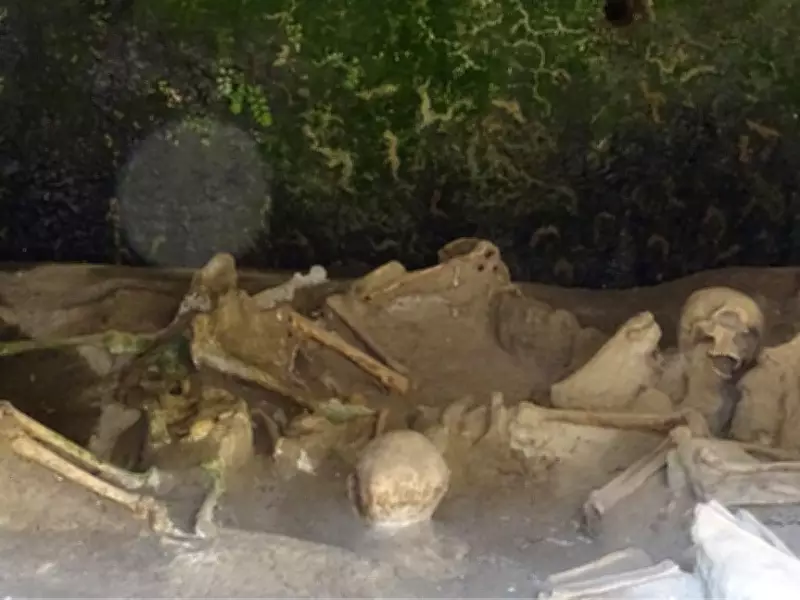
Nearly two thousand years after Herculaneum was buried beneath the shadow of Mount Vesuvius, scientists have announced that a mysterious black material discovered inside a victim's skull may represent one of the most unusual forms of preservation in history. For many years, the object was merely an artifact: a black, glass-like substance inside the skull of a person who died during the eruption of Mount Vesuvius in AD 79. Now, researchers suggest that this material could be vitrified human brain tissue, an exceptionally rare mode of preservation.
Study Reveals Unprecedented Preservation
According to a 2025 study published in Nature Journal, this finding adds a rare case to how extreme heat followed by rapid cooling can preserve organic tissue. The researchers argue that the eruption may not have entirely destroyed the victim's brain tissue. The remains belong to a young male whose body was unearthed from the Collegium Augustalium structure in the Roman city of Herculaneum, which suffered destruction similar to that of neighboring Pompeii due to the eruption approximately 2,000 years ago.
Initial interest in the case arose in 2020 when researchers discovered vitrified, or glass-like, materials in the victim's brain cavity. Using various analytical techniques, including protein analysis and microscopy, they identified proteins and fatty acids associated with human brain tissue. A paper published in PLOS ONE described remarkably preserved neuronal structures, including neurons and axons, preserved at a level rarely seen in archaeological specimens. While brains are occasionally recovered in archaeology, they typically undergo fossilization or saponification, turning into a soap-like substance. This was clearly not the case for the Herculaneum brain specimen.

How Can a Brain Become Glass?
This new study offers the strongest explanation yet. Experts examined samples extracted from the skull and conducted thermal testing. Their analysis revealed that the material reacted similarly to real glass, not burnt organic matter or volcanic debris. According to the experts, the individual's brain was likely exposed to high temperatures exceeding 510°C due to a superheated cloud caused by the volcanic eruption. However, the critical factor was the sudden drop in temperature. Glass forms when a liquid cools rapidly, preventing crystallization. In this instance, the brain tissue appears to have undergone vitrification before it could be destroyed by the heat.
"This process has never previously been documented for human or animal tissue in nature," the study's authors wrote. The researchers described the material as organic glass, noting that naturally occurring organic glass is extremely rare.
Evidence from Earlier Vesuvius Research
It is well established that the inhabitants of Herculaneum were exposed to extremely high temperatures. A landmark paper published in Nature in 2001 determined that the first pyroclastic surge reached temperatures of up to 500°C, likely killing most people instantly due to overheating. Subsequent research has reinforced this conclusion. In 2018, a paper describing the thermal behavior of pyroclastic density currents at Herculaneum was published. Another study hypothesized that detached clouds of ash would have produced heat sufficient to cause fatal burns almost immediately upon contact. Researchers also studied the skeletons found at Herculaneum and discovered chemical evidence that body fluids evaporated quickly due to the extreme temperatures.
All these works support the idea that people were exposed to extraordinarily high temperatures.
Why Archaeologists Are Paying Attention
The significance of the Herculaneum brain extends beyond this single victim. Archaeologists have long known about conditions conducive to soft tissue preservation, such as freezing, dehydration, tanning, and saponification. Vitreous transformation was never considered a method of soft tissue conservation. This discovery suggests that another, highly improbable process may occur under unique circumstances. Although some doubts remain about the interpretation, the authors describe it as a process not previously documented for human or animal tissue in nature.

What makes this case exceptional is the irony inherent within it. The natural disaster that caused the victim's death also preserved some of his nervous system tissue in a previously unknown way. Natural catastrophes usually eliminate all traces of their victims. At Herculaneum, a catastrophic volcanic eruption created a unique archaeological record of tissue preservation. Nearly two millennia later, a fragment of black glass inside a Roman skull continues to reveal how some victims of Herculaneum died and were preserved.