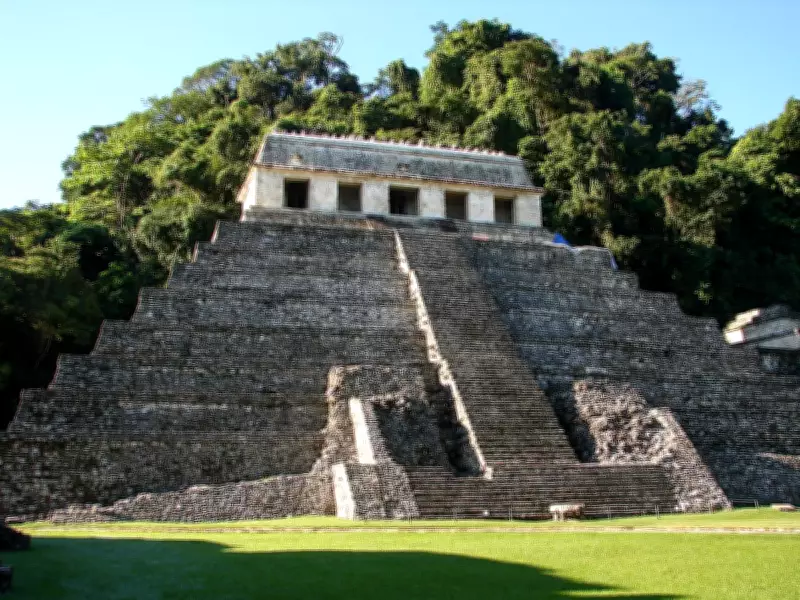
One of modern archaeology's most significant discoveries is the hidden staircase at Palenque's Temple of the Inscriptions. In 1952, French-Mexican archaeologist Alberto Ruz Lhuillier noticed several stone holes on the temple floor. Concluding they marked an entrance, he excavated through rock and fill to reveal a stairway. His hunch paid off, as the staircase eventually opened into a sealed tomb that dramatically altered archaeologists' views on the functions of some Maya pyramids.
The Tomb of King K'inich Janaab' Pakal
The tomb belonged to King K'inich Janaab' Pakal, the great ruler of Palenque during its golden age. This find was surprising because it changed many people's ideas about the purpose of Maya pyramids, from mere temple grounds to complex structures used for royal burials. The burial was not added after the pyramid was finished; instead, the entire Temple of the Inscriptions was designed with the tomb as its central focus. The burial chamber lies centrally within the structure, demonstrating that Maya elites incorporated tombs into large-scale architectural programs to express their superiority, sanctity, and dynasty. By sealing the steep staircase with stones and soil, the creators protected the tomb from looters and casual disturbance for over a thousand years, though natural decay still affected the chamber.
Modern Scientific Research
Today, the monument continues to play a role in scientific research. According to a 2026 study from npj Heritage Science, scientists are analyzing both the dolomite stone and microenvironment within the tomb. The authors note that preservation remains difficult due to the humidity and tropical climate of Mexico, which endanger the limestone structure.

Palenque's Royal Burial Network
Pakal's tomb was part of a broader royal funerary landscape, not an isolated monument. It was part of a well-planned architectural landscape where architectural planning and dynastic burial practices intertwined. To understand the context, scholars refer to nearby buildings. A study indexed by PubMed highlights Temple XIII, noting that the proximity of burial sites in these two temples suggests actual kin relations between members of the same dynasty. Maya kings were buried close to each other to strengthen their claims to the throne through this architectural strategy.
How the Discovery Changed Interpretations
Prior to 1952, ancient Maya rulers were viewed mostly from a mythical perspective. The discovery of an intact royal tomb provided concrete evidence of how these rulers organized their society, their practices regarding the deceased, and their views on the afterlife. This find introduced new imagery into Maya archaeology, revealing a culture focused on the soul's journey after death and the inclusion of magnificent treasures, such as the famous jade death mask. In essence, the hidden staircase at Palenque proved not only the presence of a king buried thousands of years ago but also much about the civilization that created it—a civilization with incredible architectural precision and reverence for its ancestors.