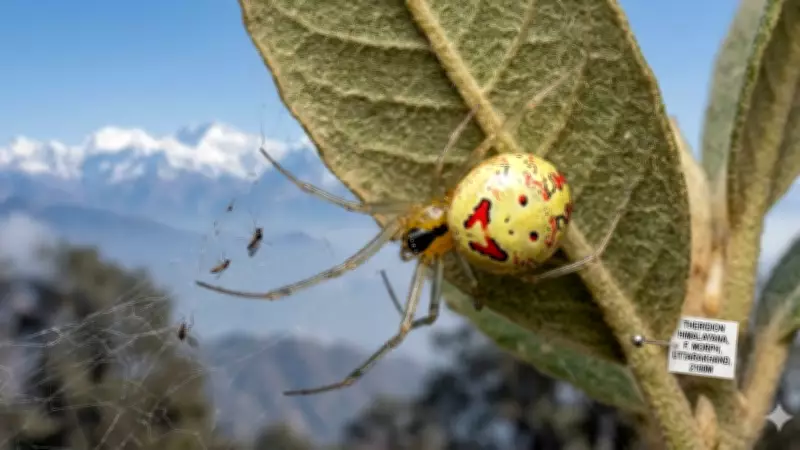
Deep in the high-altitude forests of Uttarakhand, researchers have discovered a striking new spider species named Theridion himalayana, now widely known as the Himalayan happy-face spider. Found at elevations above 2,000 metres in the western Himalayas, the spider has drawn scientific attention for its extraordinary 32 colour morphs, featuring red, black and white markings that resemble smiling faces. The discovery adds to India’s growing biodiversity records and raises fascinating questions about spider evolution, colour polymorphism and Himalayan ecosystems.
Discovery in Uttarakhand’s Montane Forests
Scientists Ashirwad Tripathy and Devi Priyadarshini from the Forest Research Institute and the Regional Museum of Natural History conducted ecological surveys in the montane forest areas of Rudraprayag and Chamoli districts in Uttarakhand. They collected more than 60 specimens from locations such as Makku, Tala, and Mandal. The spider belongs to the family Theridiidae, commonly known as cobweb spiders. The remarkable feature of Theridion himalayana is its colour polymorphism, with 32 different colour morphs observed in both males and females. These spiders display smile-shaped patterns on their abdomens, created by a combination of white, red and black dots.
Devi Priyadarshini explained in the study published in Evolutionary Systematics that the team conducted ecological research in the Himalayas because the region’s ecology differs significantly from plain areas, potentially giving rise to many interesting evolutionary traits.

Scientific Significance of the Happy-Face Spider
The celebrated happy-face spider was previously known only from the Hawaiian Islands as Theridion grallator. However, DNA studies show that the Indian species has an 8.5 per cent difference in its genetic makeup, indicating that it independently evolved in Asia and did not directly descend from its Hawaiian counterpart. According to researchers, these findings have the potential to change scientific views on parallel evolution, where two or more species independently evolve similar traits. It also demonstrates how isolated mountain ecosystems can give rise to distinct adaptations over time.
The spiders were often found on Hedychium genus ginger plants, similar to their Hawaiian cousins. Scientists are investigating whether there is an ecological or evolutionary link between the two types of spiders through these similarities. In addition to their remarkable physical appearance, the research paper mentions special reproductive structures that differentiate Theridion himalayana from those found in Europe and North America.
India’s Biodiversity Holds Remarkable Surprises
Theridion himalayana illustrates the vast number of species yet to be confirmed in the Indian subcontinent, particularly in remote Himalayan environments. India has almost 2,000 confirmed spider species, but many more unidentified ones are believed to reside in the country’s hilly and wooded areas. Beyond its unique features, this spider contributes to the ecosystem by preying on smaller insects and flies.
Ashirwad Tripathy noted that further surveys might reveal even more colour variants of the species. Ongoing climate change and deforestation pose significant risks to mountainous biodiversity, making discoveries like Theridion himalayana emphasize the importance of preserving Himalayan fauna before extinction.
The study highlights the need for continued exploration and conservation of these fragile ecosystems.