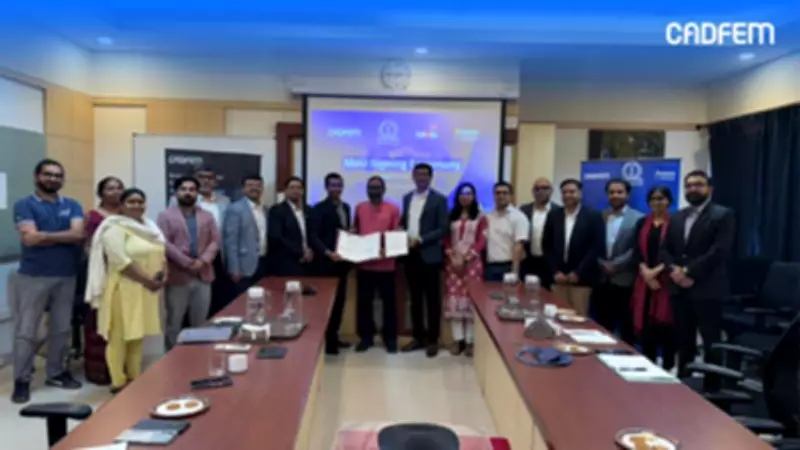
IISc, CADFEM, and Synopsys Forge Strategic Partnership to Establish Advanced Simulation Center of Excellence
In a significant move to bolster India's technological capabilities, the Indian Institute of Science (IISc) has entered into a strategic tripartite Memorandum of Understanding with CADFEM India Pvt. Ltd. and Synopsys. This collaboration aims to launch an advanced Center of Excellence (CoE) for Simulation and Digital Engineering at the Centre for Nano Science and Engineering (CeNSE) in Bengaluru.
Accelerating Semiconductor and Electronic System Development
The newly established CoE will integrate high-fidelity simulation, electronic design automation (EDA), and digital engineering workflows within CeNSE. This initiative is designed to accelerate the development of semiconductor and electronic systems in India, addressing the growing demand in sectors such as aerospace, defence, healthcare, robotics, autonomous mobility, and high-performance computing.
Semiconductor innovation is a critical pillar of technological advancement and strategic sovereignty, especially as nations race to enhance their digital capabilities. The CoE will leverage state-of-the-art multiphysics simulation tools, computational infrastructure, and specialized training programs to support research across key domains including photonics, optics, electronics, MEMS, NEMS, quantum technologies, and next-generation semiconductor systems.

Bridging the Gap Between AI and Semiconductor Development
While artificial intelligence (AI) evolves rapidly, semiconductor development remains a complex, multi-year process. The CoE aims to bridge this gap by utilizing physics-based multiphysics simulation, which enables engineers to predict device behavior, optimize designs, and significantly shorten the journey from concept to silicon. This approach is expected to enhance design confidence and technical rigor in research environments.
Dr. Shankar Kumar Selvaraja, Associate Professor and Associate Chair at CeNSE, IISc, emphasized the importance of this integration: "Integrating advanced simulation capabilities into our research ecosystem will allow our teams to evaluate complex device behavior much earlier in the design cycle. In domains such as photonics, semiconductor devices, and nanoscale systems, the ability to digitally validate concepts prior to fabrication will significantly accelerate research progress while strengthening design confidence and technical rigor."
Collaborative Support and Capability Development
Under this partnership, CADFEM India and Synopsys will provide comprehensive support, including the deployment of simulation software and hardware infrastructure, technical assistance, training programs, and access to online learning resources and certification platforms. These efforts are geared towards building strong simulation expertise within the research community and promoting the adoption of digital engineering approaches.
Dr.-Ing Madhukar Chatiri, CEO of CADFEM APAC, highlighted the strategic role of simulation: "Simulation today is no longer merely a design tool; it has become a strategic enabler of innovation. When high-fidelity multiphysics simulation is embedded within research environments such as CeNSE, it establishes a powerful digital engineering capability that enables scientists and engineers to explore a broader design space, validate ideas at much earlier stages, and significantly accelerate the pace of technology development."
Murali Pullela, Country Head (S&A) at Synopsys, added: "Semiconductor innovation is today at the intersection of advanced design, simulation, and system-level thinking. Synopsys' collaboration with the IISc and CADFEM reflects our commitment to strengthening India's deep-tech ecosystem by providing access to world-class electronic design automation and simulation capabilities. We believe this will empower researchers to move from concept to validated design much faster and help build critical capabilities in areas such as nanoscale devices, photonics, and next-generation electronic systems. This CoE launch is a key step toward developing India's future semiconductor ambitions."

Focus on Training and Industry-Academia Linkages
The collaboration will also emphasize capability development through thematic workshops, joint training programs, and structured learning initiatives. These activities are designed to strengthen simulation expertise across CeNSE's research community and create stronger linkages between academic discovery and engineering practice.
Dr. Chatiri further noted: "Our goal is to help build a connected digital engineering ecosystem in which academia and industry collaborate more closely. By combining IISc's research excellence with Synopsys' multiphysics technologies and CADFEM's implementation expertise, we aim to create an environment where innovation can move from concept to validated design far more efficiently and with greater technical confidence."
This initiative underscores the importance of simulation-driven innovation in advancing India's semiconductor sector and positioning the country as a leader in global technology development.