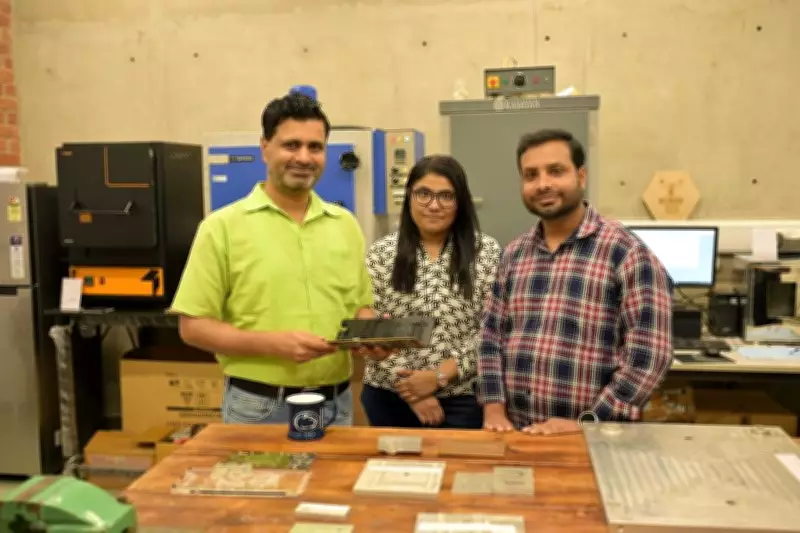
The Indian Institute of Technology Gandhinagar (IITGN) has secured a Rs 20 lakh seed grant to develop India's first indigenous liquid cooling plates for electric vehicles, AI infrastructure, railways, and high-performance electronics. The technology addresses critical cooling needs in fast-growing AI-driven data centres and electric-vehicle battery thermal management.
Grant Awarded at MATRIx 2026 Expo
The research team won the grant at MATRIx 2026 (Materials Research, Innovation & Entrepreneurship Expo), organised by the Indian Institute of Metals (IIM), a professional body for metallurgists. The indigenous manufacturing technology aims to improve industrial thermal management through a new generation of liquid cold plates.
Patent and Technology Readiness
The team has filed an Indian patent application, 'A Friction Stir Channelled Cooling Plate', jointly with industry partner Epsilon Engineering Pvt. Ltd. The technology has reached Technology Readiness Level (TRL) 7, with prototypes validated in an operational environment. The largest prototype withstands pressures exceeding 35 bar, well above industry requirements, and has passed fatigue and tensile testing.

How Liquid Cold Plates Work
Liquid cold plates are metal components with internal channels through which coolant flows to extract heat from high-power electronic systems, similar to a car radiator removing heat from an engine. They are widely used in battery thermal management, data centres, railways, power electronics, defence, and aerospace applications where excessive heat affects performance, safety, and reliability.
Limitations of Current Manufacturing
Most commercial liquid cold plates are manufactured using vacuum brazing, a process that joins multiple metal components at high temperatures. According to Dr Amit Arora, Associate Professor at IITGN, 'Brazing's success rate runs at only about 40 to 60 per cent, with a large fraction of plates being scrapped for hidden defects or leaks. With the cold plates being manufactured by fusing multiple joints, any potential leak is not a nuisance but an electrical and thermal hazard.' Due to lack of indigenous infrastructure for vacuum-brazed components, India relies heavily on imported technologies.
Team Objectives and Milestones
Prachi Sharma, a final-year doctoral student at IITGN, stated, 'Our objective was to develop an alternative manufacturing approach that addresses the limitations of conventional liquid cold plate fabrication while making the technology more accessible for the Indian industry.' Rizwan Qureshi, who led the manufacturing process development, added, 'Winning the Rs 20 lakh seed grant at IIM Matrix 2026 is a proud milestone for our team. It will enable us to bridge the gap between laboratory research and market deployment, helping us transform a promising research outcome into a viable technology venture. The funding will support larger-scale testing, intellectual property development, product refinement and commercialisation efforts.'
Impact on Indian Manufacturing
The innovation has potential to strengthen India's manufacturing ecosystem by enabling domestic production of a critical engineering component currently sourced from imports. One immediate application is in railways, where liquid cold plates cool high-power electronic systems (IGBTs) in modern high-speed trains and metro coaches. The IITGN team has developed and tested prototypes for high-speed rail applications.