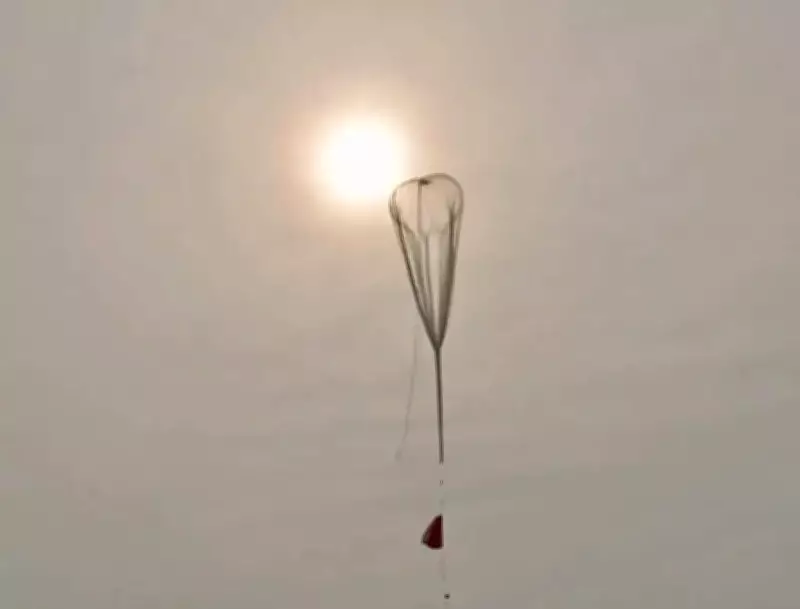
Hyderabad-based near space startup Red Balloon Aerospace, founded by former Skyroot Aerospace executives, successfully launched India's first indigenous super pressure balloon from Vijayawada on Wednesday as part of its maiden mission.
Maiden Flight Aims for National Endurance Record
The Vijayawada-based startup, which recently conducted tethered trials of its super pressure balloon, plans to set a new national endurance benchmark by keeping the balloon airborne for up to 24 hours in the stratosphere, between 20 and 40 km above Earth. This layer is beyond the reach of conventional aircraft and below satellites.
If successful, the mission will place India among a select group of countries with indigenous capabilities in this sector.

Technical Specifications and Payload
The super pressure balloon is made from polymer nanocomposite and filled with hydrogen gas as part of its lighter-than-air technology. It is equipped with a high-precision global navigation satellite system (GNSS) module for navigation. With a capacity to carry a payload of up to 50 kg, the maiden mission carried six payloads, including a high-resolution imaging payload capable of delivering 25 to 75 centimetres resolution, along with other sensors.
Red Balloon Aerospace co-founder and CEO Dr CVS Kiran and co-founder and COO Sireesh Pallikonda told TOI that the mission is designed to break India's current balloon endurance record with a targeted flight of up to 24 hours. It will validate the balloon's structural integrity and reliability while enabling uninterrupted day-and-night monitoring.
Applications and Affordability
The platform can support telecommunications in rural and underserved regions, monitor industrial corridors stretching hundreds of kilometres, aid disaster response across entire states, and provide continuous observation for strategic uses. Dr Kiran said near space platforms like theirs can be deployed in weeks at a fraction of satellite deployment costs and can be recovered, repaired, and redeployed.
Sireesh Pallikonda noted that the startup, founded last year, aims to make stratospheric access affordable through rideshare and dedicated missions for startups, universities, and research teams. He added that the technology could extend connectivity to villages, tribal regions, and coastlines where conventional towers cannot reach.