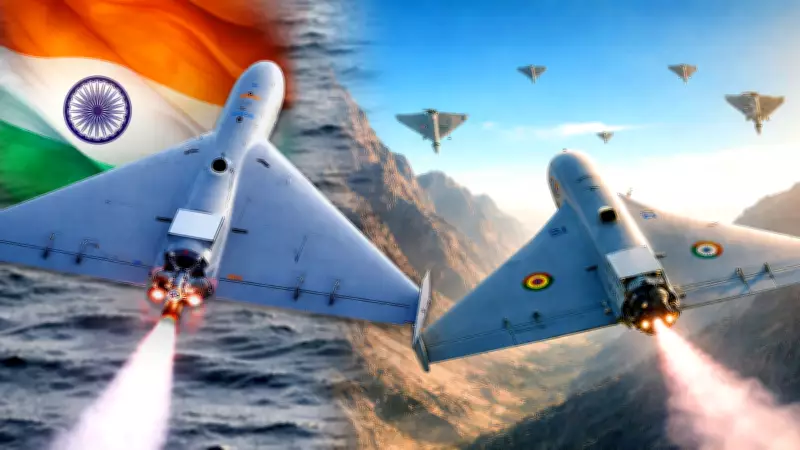
India's Sheshnaag-150: A Strategic Response to Global Drone Warfare Trends
As global conflicts intensify, the deployment of low-cost one-way attack drones has become a defining feature of modern warfare. In a historic move, US Central Command recently announced the first combat use of such drones by the United States during Operation Epic Fury against Iran. The weapon, named LUCAS (Low-cost Unmanned Combat Attack System), is acknowledged by American officials as a reverse-engineered version of Iran's own Shahed-136 loitering munition. This same class of drone is currently being employed by Iran to target Israeli cities and American military installations across the Middle East.
The Rise of Expendable Drone Warfare
The strategic shift towards inexpensive, numerous, and expendable unmanned systems represents a significant evolution in military tactics. Iran demonstrated that these affordable weapons could effectively counter costly and irreplaceable defense assets. Russia has scaled this approach industrially in the conflict in Ukraine. With the introduction of LUCAS, the United States has now entered this arena, marking a global trend that nations worldwide are closely monitoring.
India's Indigenous Answer: The Sheshnaag-150
Approximately 5,000 kilometers east of the Persian Gulf, India is crafting its own sophisticated response to this emerging threat. Bengaluru-based NewSpace Research and Technologies has developed the Sheshnaag-150, a 150-kilogram long-range collaborative attack drone. Named after the mythological serpent king, this system is engineered from the ground up specifically for swarm warfare operations.

The Sheshnaag-150 boasts impressive specifications that place it in the same conceptual category as the Shahed-136 and LUCAS, yet with enhanced capabilities:
- Range: Exceeds 1,000 kilometers
- Endurance: Over five hours of continuous flight
- Warhead Capacity: 25 to 40 kilograms
- Key Feature: Advanced swarm coordination and mission versatility
Superior Swarm Capabilities and Strategic Implications
What sets the Sheshnaag-150 apart is its focus on collaborative attack capabilities. Designed for swarm warfare, it enables multiple drones to operate in coordinated formations, potentially overwhelming enemy defenses more effectively than individual systems. This swarm coordination and mission adaptability are argued to surpass both the Iranian Shahed and the American LUCAS in terms of tactical flexibility and operational impact.
India's development of this system reflects a proactive defense strategy, learning from global conflicts where drone technology has proven decisive. By observing every Shahed barrage and monitoring LUCAS's combat debut, Indian defense researchers are building their answer on test ranges outside Bengaluru, positioning the nation as a significant player in the future of unmanned warfare.
The Sheshnaag-150 represents not just a technological achievement but a strategic statement. As nations worldwide invest in drone capabilities, India's entry with a swarm-focused system underscores its commitment to developing indigenous solutions that address contemporary security challenges while leveraging advanced collaborative technologies for defense superiority.